since the turn of the last century, the motor engine has been hailed as one of the most important inventions which is use still being used in modern day. From Henry fords first production petrol engine (petrol, 2.9 litres producing 20 brake horse power) to the very most modern engines i.e. an example of two modern Volkswagon engines. (petrol,1.8 litres 20valve,turbocharger & intercooler. producing 150 brake horse power)(diesel,1.9 litres,turbocharger & intercooler. from the first engines being made, refinement has gone into making next generation engines producing more BHP, less CO2 emissions and far better economy.
i have gathered some information on how petrol and diesel engines combust:
INTERNAL-COMBUSTION ENGINE.
When a fuel is burned in air, the resulting hot gas tries to expand, generating a force that can be used to move a piston in a cylinder, as in the automobile engine, or to drive the blades of a turbine. In either case, because the combustion takes place within it, the engine is called an internal-combustion engine.Modern transportation relies heavily upon internal-combustion engines. All airplanes and most automobiles, ships, and railroad locomotives are powered by them. They also power lawn mowers, chain saws, air compressors, and other power tools.
The two most common internal-combustion engines are the gasoline and the diesel engines. The first is used in most automobiles. The diesel engine burns a heavier fuel and finds its primary application in larger vehicles such as ships, locomotives, heavy trucks, and buses, though it is also used in some automobiles. Almost any liquid or gaseous fuel, however, can be used in an internal-combustion engine, including gasoline-alcohol mixtures called gasohol, alcohol, methane gas, and compressed coal gas.
History
The German engineer Nikolaus A. Otto developed the modern four-stroke cycle engine in 1876, which--coupled with the invention in 1885 of the carburetor by another German, Gottlieb Daimler--ushered in the automobile age. Seeking improved engine efficiencies, the German engineer Rudolf C.K. Diesel developed in 1892 the engine that bears his name.
Characteristics of Piston Engines
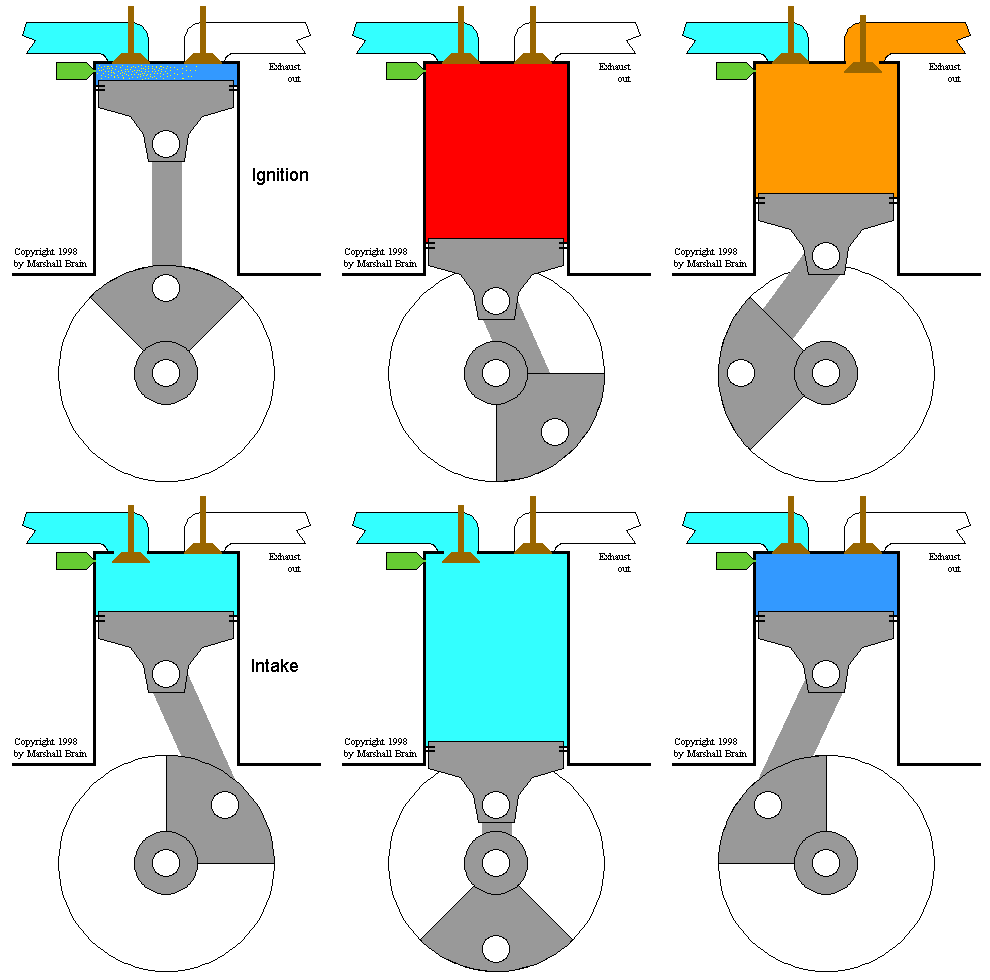
Both Otto-cycle and diesel engines use many of the same components. The combustion chamber consists of a cylinder in which a closely fitted piston slides. The space between the sides of the cylinder and the edges of the piston is sealed with piston rings, and friction is reduced by introducing lubricating oil along the cylinder wall. The up-and-down motion of the piston varies the volume of the chamber from a maximum at "bottom dead center" to a minimum at "top dead center." The ratio of the maximum to the minimum chamber volume is known as the compression ratio. Typical compression ratios for Otto-cycle engines range from 7 to 12 and for four-stroke diesel engines from 4 to 18. The piston is attached to a connecting rod, which in turn is coupled to a crankshaft so that the up-and-down reciprocating motion of the piston can be converted into rotary motion. A number of cylinders can be used, each with a piston connected to the crankshaft. Four to six cylinders are normal for automobile engines, though cars with as many as 16 cylinders have been built. As many as 28 have been used on reciprocating aircraft engines.
All internal-combustion engines must be started with an auxiliary device that can be either a starting motor or, for large diesels, compressed air. In conventional gasoline engines the fuel is premixed with air in the carburetor, while in diesel and fuel-injection engines it is injected directly into the combustion chamber by a fuel pump and atomized, or turned into a fine spray, through an injection nozzle. The airflow into and out of the cylinder is controlled by valves, which are held in the closed position by springs and opened only at the appropriate times by cams set on a rotating camshaft that is driven by the crankshaft.
The fuel must be ignited at the correct moment, usually near top dead center. In the gasoline engine this is accomplished by a spark plug. In the diesel, where the gases are more compressed and reach a higher temperature, combustion takes place automatically as soon as the fuel is injected.
Only a fraction of the energy of the fuel is converted to useful power. Most of the energy becomes heat that must be removed by a cooling system. Usually this involves water cooling in which the proper water temperature is maintained through a radiator. Some small engines and aircraft engines employ direct air cooling through fins mounted on the outside of the cylinder over which air is blown.
The engine efficiency of an Otto-cycle engine is from 20 to 25 percent. This means only that percentage of the energy in the fuel is converted to mechanical power. The remainder goes, wasted, into the cooling system and the exhaust. In large diesels, efficiencies of 42 percent have been reached, though for automobile and truck engines the range is only from 25 to 30 percent. The performance of both diesel and gasoline engines can be improved if the air is pre-compressed through a rotary compressor, or turbocharger, before entering the combustion chamber.

Mercedes leads the way to the next generation engine:
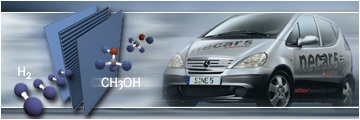
| Fuel cell - a vision becomes reality |
| The only way to
secure the future of our mobility is the successful development of
alternative drive systems. Mercedes-Benz is setting standards worldwide
with its development of the New Electric Car (NECAR). And now a new
chapter is starting with the field test of the Fuel Cell Sprinter. |
| The
fuel cell combined with an electric drive motor - that is the heart of
the propulsion principle used by our NECAR vehicles and the Fuel Cell
Sprinter. Based on forward-looking technology, this system saves
resources as it functions by using alternative or regenerative fuels. It
is low on pollutants or even absolutely pollutant-free - depending on
whether the energy carrier uses methanol or hydrogen. And, compared with
conventional drive systems, it is extremely effective. |