| FlyfishingPA.com |
|
|
 |

The Fly Fishing Loop is sponsored by flydepot.com [ Home Waters | Next | Random | List | Search ] |

|


|
| The Grannoms, a sure sign of spring By Warren Albert |
 |
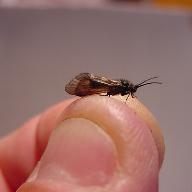
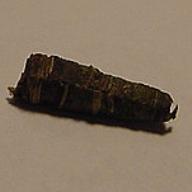
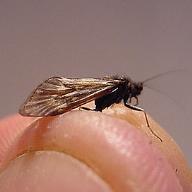
| If you were to ask a group of people what they thought was a sure sign that spring was here to stay, many would say blooming flowers or some would say chirping songbirds were their true measures that spring is here. If you were to ask me I would say that I know spring is here to stay when the Grannoms start hatching. I rely on this hatch every year to remind me that warmer weather is just around the corner. The Grannoms belong to the Caddisfly family (Trichoptera) and are sometimes called the Mother�s Day Caddis or the Little Black Caddis. They start hatching in late April to Early May and usually last a week to ten days with the peak about five days after the start of the hatch. I have seen them as early as April 13th and are very weather dependent on when they start hatching. You will find these insects hatching all day long with the majority of the hatch occurring midday. Life Cycle The Grannoms follow the same hatching pattern as all caddisflies, undergoing a complete metamorphosis (meaning they have a pupal stage that the mayflies and stoneflies lack). This is important to the fisherman because the pupa and the adult stages are the most important to pay attention to and imitate. The complete life cycle for the Caddisfly consists of the Egg, Larvae, Pupa and the Adult. Larvae The life cycle of the caddisfly lasts one year starting with the egg laying by the adult. This egg then hatches in to a larva. The larval stage is the longest stage for the caddisfly lasting about 11 months. Most Caddisflies are unique in that the larvae protect themselves by building a hard casing around them made out of wood and vegetation and are attached to a rock or stick. The legs of the pupa stick out of the other end of the case searching for food. The unique case known to the Grannom is called a Chimney case and can be identified by its square sided cone like structure. Chimney Case The Larvae stays in the case and feeds throughout the year until it is fully mature. The larvae will eventually reach a point where it no longer eats and grows, it is then that it is ready to move on to the next stage. Pupa When the stream conditions are right, the larva crawls out of its case and starts its journey to the water surface. It is then that it�s classified as a Pupa and is now most vulnerable to the lurking trout. This Pupa will drift for a long period of time struggling to make its way to the surface. As it does it becomes a very easy prey for the trout and produces most of the feeding activity for this hatch. The pupa that does somehow make it to the surface breaks out of the pupal shuck and molts into the adult Grannom. Adult The adult stage is what we see flying around everywhere blanketing the air space above the stream. Mating takes place sometime after hatching and can happen two or three times unlike mayflies which only mate once. The gravida will go to the stream and deposit her eggs by either dropping her eggs on the surface of the water or sometimes diving into the water and laying her eggs on the stream bottom. This is the second most vulnerable time for this particular species. With the eggs laid, the whole cycle starts over again in preparation for the next year. Spent Adult The final stage for the caddisfly is when mating is complete. Once mating if finished for the year (They usually mate two or three times), The female caddis lays the last of her eggs and then dies on the stream. This spent caddis is very easy prey for the waiting salmoniod and provides an excellent fishing opportunity. The spent stage isn�t really considered a true stage in the caddisfly lifecycle. For the fisherman though, it is a valuable piece of information to know and understand. Identification Identification of insects as the hatch is one of he keys to ensure a successful day on the water. Exact imitation is not always necessary but to even come up with a �close enough� Imitation, you should take the time to observe and study the insects that are found on the stream. The Grannom is fairly easy to identify. It hatches during a part of the year when there is very little insect activity happening on the stream. It is fairly safe to say that when you see a dark bodied caddisfly hatching in late April, it is going to be a Grannom. Adult Grannom The body size for the Grannom varies from 8-13mm in length, or a size 16 dry fly hook in fisherman terms. The body color varies from a dark black to a dark green depending on the location you are fishing. Here in Western Pennsylvania, all of the Grannoms I have observed have a Charcoal colored body. The Wings are Gray in color with black veining and the legs are also dark gray to dark dun in color. Imitations As with most caddis hatches, there really is only a very select few number of patterns that are necessary to have a productive day on the stream. I find that good imitations of the pupa and adult stages is all that is truly needed for the Grannoms. I also like to have two other patterns, one imitating the emerging pupa, and another imitating the female diving to the bottom of the stream to lay her eggs. I don�t fish these secondary patterns that often but when you can determine that the fish are keying in on that type of activity, they sure can come in handy. Below are the patterns I commonly use to imitate the different life cycles of the Grannom: |
 |
 |
 |
 |
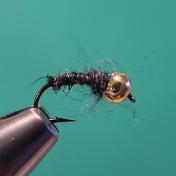 |
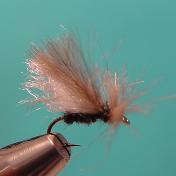
| Grannom Pupa Hook: Size 16 Scud Hook Thread: 6/0 Black Head: Gold Bead Body: Charcoal Colored Dubbing Thorax: Same as body Dub a heavy thorax and tease it out using a dubbing brush Grannom Adult Hook: Size 16 Dry Fly Thread: 6/0 Black Body: Charcoal Colored Dry Fly Underwing: Gray Antron Overwing: Natural CDC Legs: CDC butts tied spend and clipped short |
| Copyright � 2001 Warren Albert |