Pati, Pasu, and Pasa
Extract from Thirumanthiram
Pati (Sorupam) is its own self (Pati in situ) and uncreated. It has no beginning, middle, or end; is beyond creation, maintenance, destruction, obscuration (or grace) (five functions); is Sat-Cit-Ananda (Being, Consciousness, and bliss); is void (sunya) in Parabindu, which is Nirguna Siva without any attributes; does not possess a gross or subtle form; and is pure, all-pervasive, and transcendent. Pati in his Tatattam form is manifest controller (Siva Isvara) of the five functions as mentioned earlier. Tatattam as opposed Sorupam, causes Pancha Kiruttiyam, five functions. In Tattatam form, Pati forms a trilateral relationship with Pasu and Pasa.
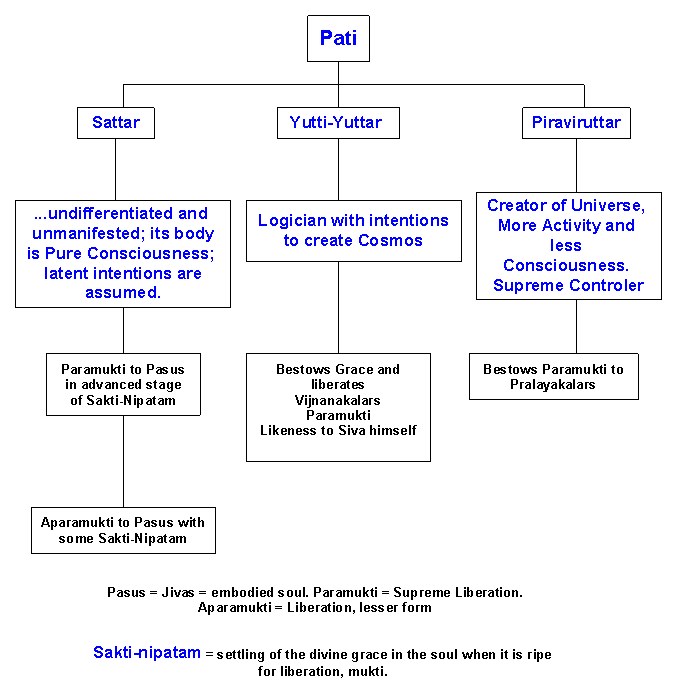
Based on Arupam, Iccha, Jnana and Kriya (Formlessness, Desire or Will, Knowledge, and Action), Siva goes by three names: Sattar (Ilaya Sivan, Arupa Sivan), Yutti-Yuttar, and Piraviruttar.
Sattar and Ilaya Sivan are the other names for Arupa Sivan meaning that he is formless; his pure power is in potent unmanifest form; he has no intentions, plans, or inclinations to create cosmos; his power is undifferentiated without any palpable entity; he is Nishkala (without parts or attributes); He is Niskriya (no activity); and his body is pure Consciousness.
Yutti-Yuttar: The name means that he is a logician or sophist. He is the embodiment of skills and knowledge to create cosmos. He is NOT just Nishkala anymore, he is Nishkala-Sakala (Siva without and with parts and attributes). He is Nishkala because he has masses of unmanifest energy without parts, he is Sakala because he has parts and Pasus (individual souls in bondage waddling in malas - impurities). Nishkala-Sakala is a transitional state between His Unmanifest (Avyakta) to his manifest state of many forms (Sakala). His energy or Consciousness shows differentiation in five Suddha Tattvas: Siva Tattva, Sakti Tattva, Sadasiva Tattva, Isvara Tattva, and Suddha Vidya Tattva.
Siva Tattva: He is Para Sakti, Nishkala-Sakala Siva, Sat-Cit-Ananda, and Cosmic Dancer after Mahapralaya (dissolution of the universe). He originates Para Nada and Nada, from which Bindu originates; Bindu is the progenitor of Prakritic Asuddha Tattvas. Of the five tattvas mentioned here Siva Tattva is Pure Consciousness; the other succeeding four take their birth from Siva Tattva in a father-son linear fashion with step-down dilution of Consciousness.
Sakti Tattva: He is Paramesvara, the Supreme Soul, Nataraja (personal God), and Androgynous Ardhanaresvara. He is a Cosmic Dancer after Pralaya (dissolution). He is endowed with Kriya Sakti, Action Energy. He is the Light of lights (Bindu).
Sadasiva Tattva: His energy has the revealing power (Anugraha) and Grace in conferring of liberation. He is Sadasiva, he is ever auspicious. He has Jnana and Kriya Sakti. He has five faces. For details go to SADASIVA.htm.
Isvara Tattva: He obscures and conceals Grace. In him knowledge translates into action. He is Para Bindu. Go to Bindu.htm.
Suddha Vidya Tattva: He is pure Knowledge and his portfolio includes creation (Brahma), maintenance (Vishnu), and destruction (Rudra-Siva). Pure knowledge is by no means Pure Consciousness.
Piraviruttar: Pira-viruttan means he who exercises Pra-Vritti. Pra-vritti = moving forward, advance, manifestation, activity, function, prosecution of. Piraviruttan is Tamil spelling. Piraviruttar is honorific way of addressing God. This belongs to Suddha Vidya Tattva. The Consciousness compared to Siva Tattva is less, but activity (creation, maintenance, destruction) has enhanced. He is Sakalan here for he has many parts, attributes, and action saktis (powers); he is Mahesvara whose subsidiary manifestations are Brahma, the creator; Vishnu, the maintainer; and Siva-Rudra, the destroyer.
Pati has nine archetypical forms: Siva, Sakti, Nada, Bindu, Sadasiva, Mahesvara, Rudra-Siva, Vishnu and Brahma, who range from Nishkala, to Nishkala-Sakala and to Sakala. Sakti and Siva, Nada and Bindu form the Quadplex or Tetralogy, essential in the manifestation of universe and beings. I name this quadplex as Tetralogy (four entities) of Saiva Siddhanta.
Nadanta Dance forms the basis for Saiva Siddhanta philosophy where tetralogy consisting of Siva, Sakti, Nada, and Bindu play exclusive roll in the unfolding of the universe; this is evolution. Involution is the inverse order where the Tattvas (building blocks) involute backwards into Nada and Nadanta, the latter being the Void, Sunya or black hole, where only Siva and Sakti exist, having become the repository of all Tattvas in their subtle state. Sunya or Void sucks in all Tattvas, which go in a spiraling funnel into the black hole, which is a bottomless pit, and where the Tattvas loose their substance and become subtle.
Sadasiva as Yutti-Yuttar confers Grace and liberation eventually ending in Para mukti (Supreme liberation, likeness to Siva) to Vijnanakalars who are in advanced stage of ripeness (Sakti-nipatam). These blessed souls are Anusadasivars, Vittiyesurans, and Rudras who enjoy Divine Bliss in Sadakiya Tattuvam, where knowledge and action are in balance. Anusadasivar = Souls enjoying Divine Bliss in Sadakkiya (Sadasiva) Tattuvam. Vittiyesurans = learned scholar, one who possesses Vidhi, knowledge. Sakti-nipatam: settling of Divine Grace in the soul when it is ripe.
Three Categories of Jivas, Verses from Tirumantiram, 0492-0500
●Life came about from Sakti-Siva Play. Jiva was in a pure Kevala state enveloped in Turiya from which Jiva separated and united between the two Mayas. The Lord entered Citta (mind) and made it all Sivamayam (Siva in essence). Comment: Kevala in this context means the individual soul or Jiva was in a pristine Mukti (liberation) state enjoying Turiya, the fourth dimension beyond normal consciousness. End of comment.
●There are ten categories of souls (Pasus): Vijnanakalars with four subdivisions, Pralayakalars with three, and Sakalars with three.
●Vijnanakalars are of four subgroups: those in Anava state, those who are self-realized, those who reached the status of Eight Vidyesvaras, and those who belong to the 70 million Manthra Nayakas. The latter are realized beings free from ego or Anava.
●The Pralayakalars are of three subgroups: those who attained Mukti, those who still have bondage of Anava and Karma malas, and those who belong to 108 Rudras. The Sakalars still have all three malas.
●There are three subgroups of Sakalars: those who attained siddhis, those who attained Mukti, and those who have attained neither. The latter wallow in three malas, with no will to conquer them.
● They who rid themselves of five malas become Siva; free from blemish, they are siddhas; they attained Jivan Mukti; they cut asunder pasu pasam, Jiva’s bondage; they ended the cycle of births and rebirths. They realized the Tattvas.
● Vijnanakalars are of three types. There are those who still abide in Anava mala. They are in all nine classes of jivas in various stages of development. Comment: Sakti-Nipatam is the conferment of Grace to a soul when it is ripe. Ripening process is development of the soul from imperfection to the stage of Paramukti.
●Vijnanakalars get physical bodies by dint of karma. By doing holy acts they enter the womb of the celestials and gain Jnana form. By constant practice, they receive eternal wisdom and become Siva Himself.
●The Vijnanakalars remove all Anava mala and lose the memory of Jiva. They become Bindu and Nada, having attained oneness with Siva Tattva. The Sakalars carry a load of three impurities: Anava, Maya and Kanma. Comment: Losing memory of Jiva is a good thing. Loss of memory means the Jiva or the individual soul has removed the faulty notion that it (Jiva) is finite, when it attains liberation or mukti; Jiva's fountainhead is Siva and therefore it cannot be finite. But earthbound souls (fools) are so wrapped up in malas or impurities and body sheaths, they think they are finite as their body. End of comment.
Comment: Malas: Mala in ordinary sense is feces. Malas as a technical term means impurities of the soul. Its origin is Divine Will and it is of three kinds (Mum-malam: Anava Mala, Kanma Mala, and Maya mala.
Anava Mala: Here the soul feels like an orphan, as if it is not connected to the Great Soul, Pure Consciousness or God. It is due to ignorance and matter enveloping the soul, preventing vision of the Great Soul. It is full of ego. It is a case of I, Me, My, and Mine, a quadrilateral corral for Pasus. Life in Muladhara and Svadhisthana Chakras and below is one of Anava Mala. Grace of God erases Anava mala. Yoga and Jnana Margas remove Anava mala.
Kanma mala: In Kanma (Karma) Mala, the past is catching up with the present; the past may be recent or one or many births in the past. Kanma mala brings the soul and body together in a being. It is the karma from the past or the karma made new. karma is thought, word and deed that bring punyam or papam, meritorious or painful consequences. The Karmas of past lives cling like Vasanas (fragrance to the subtle body) and has the tendency to confer Samskaras, tendentious behavior, which might reinforce punyam or papam; thus, the actions tend to feed upon themselves and produce more of the same. The proper thing to do is cancel out papam with punyam and get Karma to a zero-sum status, conducive to liberation. Spiritual practices and love of God erase Kanma mala. Kriya Marga (Agamic rites and ceremonies) remove Karma mala.
Maya Mala: It is the material cause of the universe; Asuddha Tattvas make up our body and give us the soul-body experience and limited spiritual knowledge in this world; spiritual practices, love of God, Chariya, worship of God-in-form in a temple remove Maya Mala.
As man eliminates Karma Mala and Maya Mala, Anava Mala seems to expand to take their place, and fill the vacuum and becomes stronger; the I-factor is a dominant impurity, which is erased by Grace of God. All these malas lead man down their paths - Margas, Anava, Kanma and Maya. These margas should be supplanted by Charya, Kriya, Yoga, Jnana Margas, Prapatti, Saranagatti and attainment of higher Chakras, Ajna and Sahasrara.
Vijnanakalar - a person with one mala-- Only Anava mala
Pralayakalar - a person with two malas--Anava and Maya malas
Sakalar - a person with three malas--Karma, Maya, and Anava malas