
Proportional Representation is a system for electing where the % of seats gained is more closely linked to the % of votes cast for each candidate.
1. National list system.
2. Alternative top up (system suggested in the Jenkins report)
3. Single transferable vote.
7. National List System
This is the simplest form of PR. This system would produce a result which meets the equation.
% of votes = % of seats.
Each party would produce a list of candidates,one for each constituency.
Voters would vote for a party not a candidate.
After the votes had been counted each party would receive seats in the House of Commons in proportion to to % of votes it received.
For example in 2001 if a party had gained 42% of the votes cast the first 270 candidates on the parties list would have been awarded seats in the House of Commons.
8. Alternative Top-up System
Constituency boundaries would be redrawn reducing the 659 constituencies to 560. Every voter would have 2 votes. One would go to a constituency candidate. Electors would number constituency candidates in order of preference. Any candidate gaining 50% of the vote would be elected. Where this did not happen the least popular candidate would be eliminated and second preference votes would be taken into account. The second vote would go to elect a top up MP. This can be done by voting for a political party. The remaining 15-20% of MPs would be chosen in this way on a county basis. This would lead to a non proportional overall result.
9. Single Transferable Vote
This form of PR is used in many European countries. Many consider STV fairer than FPTP. STV is complicated and would mean large multi-party constituencies. In 2001, in North East Scotland there were five constituencies with a MP for each.
With STV there would be only one constituency and voters would have to rank their choice of candidates in order of preference on the ballot paper.
Once a candidate reached the agreed quota of votes to be elected his/her surplus votes would be re-distributed to those not meeting the quota.
This process is repeated until five candidates reach the quota.
10. The Additional Member System
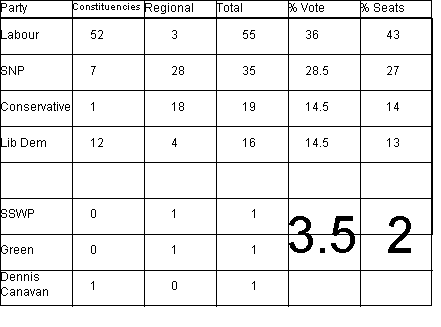
The Additional Member System was used to elect the Scottish Parliament in 2000.
73 MSPs were elected using FPTP ballot. Each MSP would represent a constituency similar to that represented by an MP at Westminster.
56 MSPs were elected on a second ballot paper. In this ballot voters voted for the political party of their choice.
Scotland has been divided into 8 regions so there are 7 'additional' MSPs for each region.