

It is easy for voters to understand
It provides a quick result
You cast a vote directly for the candidate of your choice - the winning candidate is directly responsible for the constituency
Usually one party gains a clear majority
This system provides strong government and avoids coalition governments which are seen as weak governments
We have used this system for 100s of years. It has worked well. Why change?
5. Arguments Against First-Past-The-Post
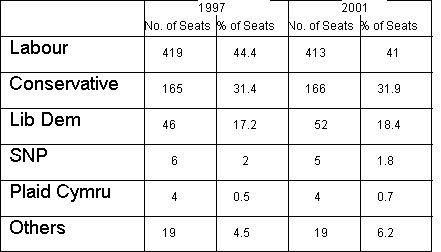
Governments can be elected without a majority of votes, for example in 2001 Labour got 41% of the vote and 63% of the seats (413) This means that 59% of voters did not want a Labour government.
First-Past-The-Post favours the two main parties, Labour and Conservative. It disadvantages smaller parties, like the Liberal Democrats.
The percentage of seats a party receives does not equal the percentage of votes they received. In 2001 Liberal Democrats got 18.47% of the votes but only 8% of the seats. Labour got 41% of vote and 63% of seats.
Many votes are wasted. In constituencies where the candidate has a large majority many of these votes could be used in a different part of the country e.g. candidate A won with a majority of 10000 votes. Only one vote was needed so 9999 votes were wasted. Candidate B however lost by 1000 votes and would have won if extra votes from candidate A could have been added to his total.
A party can come second in many constituencies gathering hundreds of thousands of votes across Britain but receiving few or no seats. Extremes of Government can come to power leading to constant changes in policy. Such instability is not good for the country as it makes long term planning difficult.
6. What is Proportional Representation?
Proportional Representation is a system for electing where the % of seats gained is more closely linked to the % of votes cast for each candidate.
1. National list system.
2. Alternative top up (system suggested in the Jenkins report)
3. Single transferable vote.
7. National List System
This is the simplest form of PR. This system would produce a result which meets the equation.
% of votes = % of seats.
Each party would produce a list of candidates,one for each constituency.
Voters would vote for a party not a candidate.
After the votes had been counted each party would receive seats in the House of Commons in proportion to to % of votes it received.
For example in 2001 if a party had gained 42% of the votes cast the first 270 candidates on the parties list would have been awarded seats in the House of Commons.