Official name
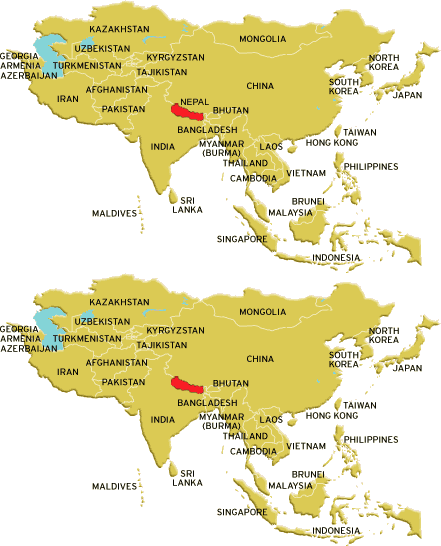
Asia Map
Kingdom of Nepal
|
Nepal Facts and Figures
Official name |
Asia Map Kingdom of Nepal
|
| Capital | Kathmandu |
| Area | 147,181 sq km |
| 56,827 sq mi | |
| People | |
| Population | 25,284,463 (2001 estimate) |
| Population growth | |
| Population growth rate | 2.32 percent (2001 estimate) |
| Projected population in 2025 | 39,917,760 (2000 estimate) |
| Projected population in 2050 | 53,293,874 (2000 estimate) |
| Population density | 172 persons per sq km (2001 estimate) |
| 445 persons per sq mi (2001 estimate) | |
| Urban/rural distribution | |
| Share urban | 12 percent (1999 estimate) |
| Share rural | 88 percent (1999 estimate) |
| Largest cities, with population | |
| Kathmandu | 533,000 (1995 estimate) |
| Ethnic groups | |
| Newar, Bihari, Tibetan, Gurung, Magar, Tamang, Thakali, Bhutia, Rai, Limbu, Sherpa | |
| Languages | |
| Nepali (official), English, almost 20 other languages divided into numerous dialects | |
| Religious affiliations | |
| Hindu (Hinduism is the official religion) | 86.5 percent |
| Buddhist | 7.8 percent |
| Muslim | 3.5 percent |
| Other | 2.2 percent |
| Health and Education | |
| Life expectancy | |
| Total | 58.2 years (2001 estimate) |
| Female | 57.8 years (2001 estimate) |
| Male | 58.6 years (2001 estimate) |
| Infant mortality rate | 74 deaths per 1,000 live births (2001 estimate) |
| Population per physician | 24,757 people (1998) |
| Population per hospital bed | 5,792 people (1997) |
| Literacy rate | |
| Total | 61 percent (2001 estimate) |
| Female | 44 percent (2001 estimate) |
| Male | 76.6 percent (2001 estimate) |
| Education expenditure as a share of gross national product (GNP) | 3.2 percent (1997) |
| Number of years of compulsory schooling | 5 years (1998) |
| Number of students per teacher, primary school | 38 students per teacher (1997) |
| Government | |
| Form of government | |
| Constitutional monarchy with parliamentary democracy | |
| Voting qualifications | Universal at age 18 |
| Constitution | 9 November 1990 |
| Armed forces | |
| Total number of military personnel | 46,000 (1999) |
| Military expenditures as a share of gross domestic product (GDP) | 0.8 percent (1999) |
| Economy | |
| Gross domestic product (GDP, in U.S.$) | $5 billion (1999) |
| GDP per capita (U.S.$) | $210 (1999) |
| GDP by economic sector | |
| Agriculture, forestry, fishing | 41.7 percent (1999) |
| Industry | 21.3 percent (1999) |
| Services | 36.9 percent (1999) |
| Employment | |
| Number of workers | 10,850,260 (1999) |
| Workforce share of economic sector | |
| Agriculture, forestry, fishing | 79 percent (1995) |
| Industry | 6 percent (1995) |
| Services | 16 percent (1995) |
| Unemployment rate | Not available |
| National budget (U.S.$) | |
| Total revenue | $475.5 million (1998) |
| Total expenditure | $788 million (1998) |
| Monetary unit | |
| 1 Nepalese rupee (NR), consisting of 100 paisa | |
| Major trade partners for exports | |
| India, United States, Germany, United Kingdom | |
| Major trade partners for imports | |
| India, Singapore, Japan, Germany | |
| Energy, Communications, and Transportation | |
| Electricity production | |
| Electricity from thermal sources | 9.56 percent (1999 estimate) |
| Electricity from hydroelectric sources | 90.44 percent (1999 estimate) |
| Electricity from nuclear sources | 0 percent (1999 estimate) |
| Electricity from geothermal, solar, and wind sources | 0 percent (1999 estimate) |
INTRODUCTION
Nepal, officially Kingdom of Nepal, constitutional monarchy in South Asia. Locked within the rugged ranges of the Himalayas, Nepal is bounded by the Tibet region of China on the north and India on the south, east, and west. It was cut off from the rest of the world until the early 1950s, when a palace revolution and the subsequent overthrow of the autocratic Rana dynasty marked the beginning of Nepal�s emergence into the modern world. Kathmandu is the capital and largest city.
LAND AND RESOURCES
Nepal covers an area of 147,181 sq km (56,827 sq mi). It is divided into four topographical zones: the Great Himalayas, the Middle Himalayas, the Outer Himalayas, and the Tarai. The highest zone is the Great Himalayas, in northern Nepal. Eight of the ten highest mountains in the world are located either wholly or partially in this area. These include Mount Everest (8,850 m/29,035 ft), Kānchenjunga (8,598 m/28,209 ft), Makalu (8,481 m/27,825 ft), Dhaulagiri (8,172 m/26,811 ft), and Annapurna 1 (8,091 m/26,545 ft).
To the south of the Great Himalayas are the Middle Himalayas, dominated in Nepal by the Mahābhārat Range, with peaks averaging less than 3,000 m (9,900 ft). Several rivers run through Nepal�s Middle Himalayas including the Seti, Karnali, Bheri, Kali Gandaki, Trisuli, Sun Kosi, Arun, and Tamur. In the Middle Himalayan zone most rivers converge and form four main river systems: the Karnali, Narayani, Gandaki, and Kosi, which traverse the Mahabharat Range through deep gorges, making navigation difficult or impossible.
South of the Middle Himalayas lies the Siwalik Range of the Outer Himalayas, with an average elevation of about 1,000 to 2,000 m (about 3,300 to 6,600 ft). This area of Nepal has a number of flat valleys well suited to agriculture.
The Tarai, a generally flat, fertile lowland, is the southernmost topographic zone in Nepal. Much of this area comprises the northern extension of the Gangetic Plain of India. Rivers rising in the Himalayas emerge in the Tarai and continue southward, some of them becoming tributaries of the Ganges in northern India. The Tarai is susceptible to flooding, which occurs regularly with the summer monsoon runoff from the mountains. The fertile soils of the Tarai make up a major agricultural area where nearly half the country�s population lives.
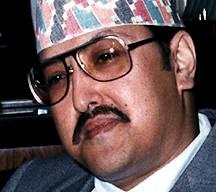 Birendra Bir Bikram Shah Dev (1945-2001), king of
Nepal (1972-2001). Born in Kathmandu, Birendra was educated in India and
England before taking degrees from the University of Tokyo in Japan and Harvard
University in the United States. He ascended to the throne as king of Nepal in
1972, following the death of his father, and was formally crowned in 1975.
Birendra inherited a political system that banned the formation of political
parties and allowed for the autocratic rule of the king through a nonparty
system of councils, or panchayats.
Birendra Bir Bikram Shah Dev (1945-2001), king of
Nepal (1972-2001). Born in Kathmandu, Birendra was educated in India and
England before taking degrees from the University of Tokyo in Japan and Harvard
University in the United States. He ascended to the throne as king of Nepal in
1972, following the death of his father, and was formally crowned in 1975.
Birendra inherited a political system that banned the formation of political
parties and allowed for the autocratic rule of the king through a nonparty
system of councils, or panchayats.
In 1980, in the face of political demonstrations and general unrest, Birendra called for a referendum to allow the people to choose between the existing panchayat system and a multiparty system. The referendum returned a slight majority for maintaining the panchayat system with certain modifications. Birendra allowed a number of democratizing reforms, such as the direct popular election of the Rashtriya (National) Panchayat. In 1990 a coalition of opposition forces, including a number of political parties operating unofficially, began an agitation against the panchayat system. When the protests turned violent, Birendra conceded democratic sovereignty to the people in a new constitution, ending the panchayat system and allowing for general elections and the emergence of political parties.
( In early June 2001, King Birendra and eight other members of the royal family, including Queen Aiswarya, were fatally shot in the royal palace in Kathmandu. )
Plant and Animal Life
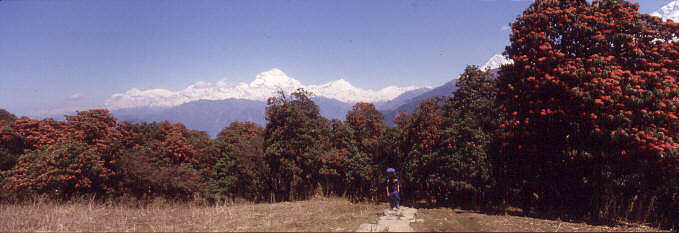
Forests occupy 27 percent of Nepal�s land area. The Tarai supports extensive hardwood and bamboo forests in areas not cleared for agriculture or resettlement. On the lower slopes of the mountains, pines flourish amid oaks and wildflowers. Firs and shrubs thrive in the higher regions, most notably the tree rhododendron, Nepal�s national flower, which produces beautiful red and pink blooms from March to April. Smaller plants, such as mosses and grasses, grow at elevations above 3,700 m (12,000 ft). Above the snow line of the Great Himalayas (higher than about 4,300 m/about 15,000 ft) no vegetation grows.
Deforestation is a major problem in Nepal. The country lost half its forests between 1950 and 1980 because of increased demand for fodder, fuelwood, and land for agriculture and settlement. Much of the deforestation has taken place in the Tarai, although the Middle and Great Himalayan regions have also experienced serious deforestation. With the assistance of the United States and international agencies, Nepal has embarked on several programs to extend and restore its forest cover.
The wildlife of the Tarai includes tigers, leopards, deer, and elephants. The Royal Chitwan National Park, located in the Tarai, was set aside to house and protect endangered wildlife such as the rhinoceros, tiger, sloth bear, gaur (a large species of ox), and Ganges River dolphin. Wild goats, sheep, and wolves live at higher elevations, and yak are herded by local people.
Natural Resources
Fertile soils are limited to the Tarai and some of the larger valleys of the Middle Himalayas. Some 20.3 percent of the country�s total land area is cultivated�a figure that includes hillsides with thin, poor soils terraced for farming. Due to population pressure, the percentage of Nepal�s cultivated area has increased from only 10 percent in the 1960s.
Nepal�s mineral resources are limited. Low-grade deposits of iron ore are found in the mountains near Kathmandu. Small deposits of copper exist in many areas and small reserves of mica have been found in the hills northeast of Kathmandu. Mineral extraction and transport is a major problem due to the country�s rugged terrain.
Climate
Nepal�s climate varies according to elevation. The Tarāi of southern Nepal has a tropical monsoon climate characterized by rainy summers and the southwest winds of the monsoon, and almost dry winters. The effect of the southern monsoon climate extends northward into mountain valleys. In the Middle Himalayan valleys the amount of precipitation varies with the extent of exposure to the rain-bearing monsoon winds. Several high valleys located in the rain shadow (area where precipitation is partially blocked by mountains) are dry. In the Kathmandu Valley the average rainfall is about 2,300 mm (about 90 in), most of which occurs from June to September. Between elevations of about 500 and 2,700 m (about 1,640 and 8,860 ft) there is a warm temperate climate; between about 2,700 and 3,000 m (about 8,860 and 9,840 ft) a cool temperate climate prevails. Between about 3,500 and 4,100 m (about 11,480 and 13,450 ft) summers are cool and winters are very cold. Above 4,100 m (about 13,450 ft) a severely cold, alpine climate prevails.
THE PEOPLE OF NEPAL
Nepal had a population of 18,462,081 at the time of the 1991 census. The average population density at the time was 125 persons per sq km (329 per sq mi), although nearly half the people were concentrated in the narrow Tarāi region. In contrast, the 2001 population estimate was 25,284,463. The population has grown rapidly since 1950 when there were only 9 million people. Although the government has sponsored family planning since the 1950s, these programs have been slow to affect Nepal�s population growth. In 2001 the population was increasing at an annual rate of 2.3 percent. Only 12 percent of the population lived in urban areas in 1999. Major cities include Kathmandu, Lalitpur (Patan), Bhaktapur, Birātnagar, and Bīrganj.
Ethnic Groups, Languages, and Religion
Nepal�s indigenous population consists of two major groups, the Indo-Nepalese, whose ancestors migrated into the country from the south, and the Tibeto-Nepalese, whose ancestors entered Nepal from the north. Although intermingling between the two groups has occurred, cultural, linguistic, and religious differences exist both between and within the two groups. The Indo-Nepalese group comprises people who speak Sanskrit-derived languages and are strict adherents to Hinduism. Nepali, the official language, is derived from Sanskrit. Differences within the Indo-Nepalese group are marked more by caste (a system of social hierarchy) than by ethnicity. The Tibeto-Nepalese group comprises several different ethnic groups including Newar, Bhutia, Sherpa, Gurung, Magar, Tamang, Rai, and Limbu people. Although most of the Tibeto-Nepalese speak Nepali, each ethnic group also has its own language. While the majority of Nepali people practice Hinduism, the official religion, a strong shamanist element remains in the religious practices of many Tibeto-Nepalese ethnic groups (see Shaman). Buddhism is also important within the country. Buddha, the founder of Buddhism, was born in Lumbinī, in present-day Nepal. There is also a small Muslim population mainly located in the Tarāi.
Education
Under the Rana family, which ruled Nepal from 1846 to 1951, only the upper class had access to education. After the 1951 revolution, Nepal established an education system with free primary education for all children. Primary school begins at the age of 6 and lasts until age 10. Secondary education that follows lasts until the age of 15. Attendance of primary school was near universal for boys, but only 84 percent of primary school-aged girls were enrolled in 1996. Secondary school enrollment included only 37 percent (48.7 percent of the boys of that age group and 25 percent of the girls) in 1996. Formal schooling in Nepal is constrained by economic and cultural factors such as a bias against educating girls and a need for children to work at home or in the fields. In 2001 the literacy rate was estimated at 61 percent of the adult population, with a large gap between male and female literacy rates. Only 44 percent of the female population was literate in 2001 compared to 77 percent of the males. Urban areas have higher literacy rates than rural areas. In 1990 Nepal launched a 12-year literacy program targeting 8 million people between the ages of 6 and 45 years old. Tribhuvan University, founded in Kathmandu in 1959, is the only doctoral-granting institution of higher education in Nepal. Nepal also has a number of colleges, all of which are either affiliated with, or follow standards set by, Tribhuvan University.
Way of Life
Nepal�s society is predominantly rural. Social life in the village revolves around the family, which is headed by the father. Extended families sometimes break apart as sons separate from parents and brothers from each other in search of additional land. Family property is divided equally among sons at the time of separation. Consequently, family land holdings are extremely fragmented. Villagers often pool resources and labor to implement village-level projects such as irrigation ditches or channels. Rice is the food staple in most parts of the country. Barley, millet, and potatoes are important food staples in the Himalayas.
In Nepal women are generally subordinate to men and have less access to education, economic resources, and political power. Their plight, however, varies from one ethnic group to another. Among Tibeto-Nepalese communities female status is relatively better than in Indo-Nepalese communities. Generally, women work harder and longer than men, taking care of household chores, fetching water and animal fodder, and farming. Women in upper-class families, however, have maids who do household work and other menial chores.
A revival of artistic and intellectual expression occurred in Nepal after the overthrow of Rana rule in the early 1950s. Nepali works of poetry and literature emphasize patriotism and national pride. Hindu and Buddhist religious values inspire the expression of Nepali artists. The lives of gods, saints, and heroes and the relationship of the individual to society and the universe are explored in sculpture, architecture, and drama. Numerous temples and shrines in the Kathmandu Valley display the skill and highly developed aesthetic sense of Nepali artists. Favorite recreational activities of the Nepali include music and dance. Religious ceremonies involve the use of drums and musical instruments preserved since ancient times. In rural areas devotional songs are an important part of cultural life. Radio Nepal schedules folk music programs to foster the traditional culture of the country.
ECONOMY
The United Nations (UN) classifies Nepal as one of the least developed counties in the world. The country�s gross domestic product (GDP) was $5 billion in 1999, with an estimated per capita GDP of $210. Several factors have contributed to Nepal�s underdevelopment, including its landlocked geography, rugged terrain, lack of natural resources, and poor infrastructure. China, India, Japan, the United States, and several European nations have made large investments in Nepal�s economy through foreign aid since 1952. Still, the country�s economic growth has been slow. Nepal�s economy is characterized by heavy dependence on foreign aid, a narrow range of exports, increasing economic disparity between the mountain areas and the more developed Tarāi region, excessive governmental control and regulation, and inefficient public enterprises and administration. In addition, the economy has not kept pace with the country�s high population growth. In particular, the slow growth of agriculture has resulted in food shortages and malnutrition for some of Nepal�s people.
Agriculture and Manufacturing
Agriculture dominates Nepal�s economy. It provides a livelihood for 79 percent of the population and contributes 42 percent of GDP. The Tarāi is the main farming region of the country. Rice and corn are major food crops; potato, oilseed, sugarcane, jute, and tobacco are major cash crops. Nepal�s industrial base is limited. Most industries are based on agricultural raw materials or dependent on various imported materials, mostly from India. Large manufacturing plants are owned and operated by the government. Major manufactured products include jute, sugar, cigarettes, beer, matches, shoes, cement, and bricks. Traditional cottage industries such as basket and carpet weaving are also important to Nepal�s economy.
Services
Tourism represents a growing sector of the economy. Foreign tourism is primarily confined to Kathmandu Valley and major national parks such as the Sagarmatha National Park (around the Mount Everest area), Annapūrna Conservation Area, and Royal Chitwan National Park. Tourism has created demands for services and materials that are slowly changing the ecology, environment, and economy of the Himalayan region. Sherpas, well known for assisting as guides on Himalayan treks and mountain-climbing expeditions, benefit from Nepal�s growing popularity as a tourist destination.
A unique part of Nepal�s economy are the famous Gurkha mercenaries. Beginning with a treaty signed with British-controlled India in the early 1800s, young Nepali men served in the British, and later Indian, armies. Known for their brave fighting skills, these mercenaries have fought in nearly every major war, and with UN peacekeeping forces. Nepal receives more than $50 million in hard currency annually from soldiers� salaries sent home, pensions, and other Gurkha-related payments.
Energy
Most of the energy consumed in Nepal comes from traditional sources such as fuelwood, the use of which contributes to deforestation. Tremendous potential exists for hydroelectric power development, but growth is inhibited by terrain, lack of infrastructure, and insufficient capital investment. Nepal has harnessed only a fraction of its potential hydropower. The country is heavily reliant on India for imported, nonrenewable sources of power such as oil and kerosene.
Transportation and Communications
Nepal has a relatively underdeveloped network of roads. There are some main roads, which connect major cities and stretch to the borders of both India and China. However, the main means of transportation is the network of footpaths and trails that interlace the mountains and valleys. There is also a small railway along the Indian border. The government-owned Royal Nepal Airlines was the only commercial airline until 1992, when the government permitted other airlines to operate. Now a number of airlines provide domestic service between Nepal�s major cities as well as to its remote regions. International service is available to India, Singapore, Hong Kong, Thailand, Pakistan, and Japan. Tribhuvan International Airport outside Kathmandu is the main airport. There are also several smaller airstrips serving domestic air travel in Nepal.
Nepal has limited telecommunication services. Postal services have improved in recent years but are still inaccessible to many Nepalese. Few people own telephones, although most urban areas have public telephone services. Radio Nepal broadcasts programs in Nepali and English to more than 90 percent of the population. Television programming is limited, but programs from overseas are available via satellite in remote parts of the country. The major newspapers in Nepal include the Gorkhapatra, Nepali Hindi Daily, Samaya, and Daily News; freedom of the press was guaranteed under Nepal�s 1990 constitution.
Foreign Trade
For geographical and historical reasons, most of Nepal�s trade is with India. Attempts have been made to diversify trade by making new agreements with China, Pakistan, Bangladesh, the United States, the United Kingdom, Singapore, Thailand, Germany, and Japan. Nepal has a growing trade deficit with India. Major exports are clothing, carpets, grain, and leather goods. Major imports are petroleum products, fertilizer, and machinery.
GOVERNMENT
Nepal�s government is a constitutional monarchy. In response to major pro-democracy protests, Nepal adopted a new constitution in 1990 that established a multiparty democracy but preserved the king�s status as chief of state. The 1990 constitution ended nearly 30 years of absolute monarchy in which the king dominated Nepal�s politics and political parties were banned. Nepal has universal suffrage beginning at the age of 18.
Judiciary
The judiciary is made up of three tiers: the Supreme Court, appellate courts, and district courts. The Supreme Court is the highest court. The chief justice is appointed by the king on the recommendation of the Constitutional Council. Other judges of the three courts are appointed on the recommendation of the Judicial Council.
Political Parties
Major political parties include the Nepali Congress Party (NCP), a reform-oriented centrist party, and the Communist Party of Nepal (United Marxist-Leninist), or CPN-UML. Both of these parties operated illegally in Nepal from exile in India until the 1990 reforms lifted the ban on political parties. The pro-royal National Democratic Party (NDP) was formed prior to the 1991 elections�the first elections following the reforms. In 1998 the CPN-UML split into two groups, giving rise to a second communist party, the Communist Party of Nepal (Marxist-Leninist), or CPN-ML.
International Organizations
Nepal has been a member of the United Nations since 1955 and participates in several international agencies such as the United Nations Food and Agricultural Organization; the United Nations Educational, Scientific, and Cultural Organization; the World Health Organization; and the Economic Council for Asia and the Far East. In 1961 Nepal became a member of the International Bank for Reconstruction and Development (World Bank). Kathmandu is the permanent seat of the South Asian Association for Regional Cooperation.
HISTORY
Although Nepal emerged in history in the first millennia bc, it was only in the 18th century that Nepal developed as a country of the present size. Archaeological remains suggest that areas of Nepal have been inhabited for more than 10,000 years. The Kirant hill tribe people are thought to be the first rulers of the Kathmandu area. The earliest undisputed Nepali dynasty is the Licchavi dynasty, which was established in about ad 400. The Licchavi dynasty, which probably migrated from present-day Vaishāli, India, was centered in the Kathmandu Valley. The Licchavi dynasty expanded its influence to the Kali Gandaki River in the west and Sun Kosi River in the east. The Licchavi period, as well as the Malla period that followed, was deeply influenced by Indian culture.
The Licchavi dynasty came to an end in the late 9th century and was followed by the medieval period. The early medieval era was unstable and poorly documented. It culminated in the Malla period (1200 to 1769) when three separate dynasties, divided into three kingdoms in the late 15th century, were conquered by the Shah dynasty in 1769, led by King Prithvi Narayan Shah. Nepal�s southward expansion under the Shah dynasty resulted in a clash with the English East India Company. The Anglo-Nepalese War (1814-1816) reduced the country to its current size, although Nepal retained its independence.
In the first half of the 19th century, Nepal entered a short period of instability that culminated in the Kot Massacre, in which fighting broke out among military personnel and administrators after the assassination of a high-powered favorite of the queen. Jung Bahadur, a strong pro-British leader, prevailed during the massacre and seized control of the country. He declared himself prime minister and began the Rana line of rulers. The Rana rulers monopolized power by making the king a nominal figure. They also made the office of the prime minister hereditary. Nepal gave valuable assistance to the British during the Sepoy Rebellion (1857-1859) and during World War I (1914-1918). The British government reaffirmed the independence of Nepal through a treaty in 1923. A British resident (colonial official acting as an adviser to the ruler of a protected state), stationed in Kathmandu, controlled Nepal�s foreign relations. Nepal supported the Allied cause, with the contribution of Gurkha soldiers, during World War II (1939-1945). Nepal and the United States established diplomatic relations in 1948.
The Rana autocracy was increasingly criticized in the late 1940s, particularly by dissidents residing in India. The political-reform movement, which was approved by the Indian government and directed by the newly created Nepali Congress Party, won the support of King Bir Bikram Tribhuvana. Like his predecessors under the Ranas, he possessed purely nominal powers. His intervention in domestic politics deepened the crisis, however, and he was removed from the throne in 1950 by Prime Minister Maharaja Mohan Shumsher Rana. A few days later the king fled to India and Nepali Congress insurgents began military operations along the southern frontier. In 1951 Prime Minister Rana allowed a reorganization of the Nepalese government along democratic lines and the king was reinstalled. Friction between the Rana and Congress Party factions culminated in November 1951 when Prime Minister Rana was removed from power and the Congress Party formed a government headed by Matrika Prasad Koirala.
After the Rana autocracy ended, Nepal embarked on a mission of economic and social development. However, political parties organizing the government during the 1950s were not effective. King Mahendra, crowned in 1955, seized absolute control of the government in 1960 after a decade of political unrest. King Mahendra dismissed the government and suspended parliament, calling it corrupt and inefficient. Considering a parliamentary system unsuited to Nepal, the king proclaimed a new constitution in 1962 that banned the formation of political parties and allowed for the autocratic rule of the king through a nonparty system of councils, or panchayats. The government then instituted social reforms, including land reforms and modernization of the legal code, which helped alleviate some caste discrimination.
When the king died in 1972, he was succeeded by his son Birendra Bir Bikram, who was formally crowned in 1975. The young king initially exercised strong control over the government, attempting to repress the reform movement led by former prime minister Bisheswar Prasad Koirala. As antimonarchist sentiments grew in the late 1970s and serious riots challenged his authority, the king relaxed his control.
In a 1980 referendum on the form of government, the voters decided to retain the nonparty panchayat system with certain modifications. Elections under the new provisions were held in 1981 and 1986. After a wave of pro-democracy protests in early 1990, a new constitution providing for a multiparty system was adopted in 1990.
In 1991 the Nepali Congress Party (NCP) won the country�s first democratic election in 32 years, and the party�s general secretary, Girija Prasad Koirala, became prime minister. Koirala resigned in July 1994, and the king subsequently dissolved parliament and set new elections, in which the Communist Party of Nepal (United Marxist-Leninist), or CPN-UML, won the majority of seats. Man Mohan Adhikary was sworn in as prime minister. In 1996 the Communist government was dissolved by the parliament and Adhikary resigned his position under allegations of corruption. The king swore in Sher Bahadur Deuba of the NCP as prime minister. That same year, a radical leftist party called the Nepal Communist Party (Maoist), or NCP-M, unhappy with the pace and direction of change, launched a �people�s war� aimed at overthrowing the government, abolishing the monarchy, and establishing a people�s republic. Incidents of violence were at first confined to remote mountain regions but by the late 1990s had spread to more than half of the country.
Political stability remained out of reach, and in March 1997 Deuba unexpectedly lost a vote of confidence and was forced to resign. King Birendra then named Lakendra Bahadur Chand, a member of the pro-royal National Democratic Party (NDP), as prime minister; Chand was backed by a royalist-Communist parliamentary coalition in which the CPN-UML had the largest bloc of seats. Chand was forced to resign in October as the NDP split into two factions, one headed by Chand and the other by NDP president Surya Bahadur Thapa. Thapa was named prime minister later that month, heading a coalition government that excluded the CPN-UML. In March 1998 the CPN-UML split, with the smaller faction taking the name Communist Party of Nepal (Marxist-Leninist), or CPN-ML. The split left the NCP with the largest bloc in parliament. In April 1998 Thapa resigned, and Girija Prasad Koirala of the NCP was again made prime minister. Koirala briefly won the support of the CPN-ML in a majority coalition, but when the party withdrew from the coalition in December, he was forced to resign. Koirala immediately was reappointed prime minister at the head of a center-left coalition that incorporated the CPN-UML. Parliamentary elections held in May 1999 ended the need for coalition governments by awarding a majority of seats to the NCP. The legislature elected Krishna Prasad Bhattarai, a former prime minister, to lead the government. Bhattarai stepped down in March 2000 and was replaced by former prime minister Girija Prasad Koirala.
| Sources |
| Basic Facts and People sections |
| Area data are from the statistical bureaus of individual countries. Population, population growth rate, and population projections are from the United States Census Bureau, International Programs Center, International Data Base (IDB) (www.census.gov). Urban and rural population data are from the Food and Agriculture Organization (FAO) of the United Nations (UN), FAOSTAT database (www.fao.org). Largest cities population data and political divisions data are from the statistical bureaus of individual countries. Ethnic divisions and religion data are largely from the latest Central Intelligence Agency (CIA) World Factbook and from various country censuses and reports. Language data are largely from the Ethnologue, Languages of the World, Summer Institute of Linguistics International (www.sil.org). |
| Health and Education section |
| Life expectancy and infant mortality data are from the United States Census Bureau, International Programs Center, International database (IDB) (www.census.gov). Population per physician and population per hospital bed data are from the World Health Organization (WHO) (www.who.int). Education data are from the United Nations Educational, Scientific and Cultural Organization (UNESCO) database (www.unesco.org). |
| Government section |
| Government, independence, legislature, constitution, highest court, and voting qualifications data are largely from various government Web sites, the latest Europa World Yearbook, and the latest Central Intelligence Agency (CIA) World Factbook. The armed forces data is from Military Balance. |
| Economy section |
| Gross domestic product (GDP), GDP per capita, GDP by economic sectors, employment, and national budget data are from the World Bank database (www.worldbank.org). Monetary unit, agriculture, mining, manufacturing, exports, imports, and major trade partner information is from the latest Europa World Yearbook and various International Monetary Fund (IMF) publications. |
| Energy, Communication, and Transportation section |
| Electricity information is from the Energy Information Administration (EIA) database (www.eia.doe.gov). Radio, telephone, television, and newspaper information is from the United Nations Educational, Scientific and Cultural Organization (UNESCO) database (www.unesco.org). Internet hosts, motor vehicles, and road data are from the World Bank database (www.worldbank.org). |
| Note |
| Figures may not total 100 percent due to rounding. |
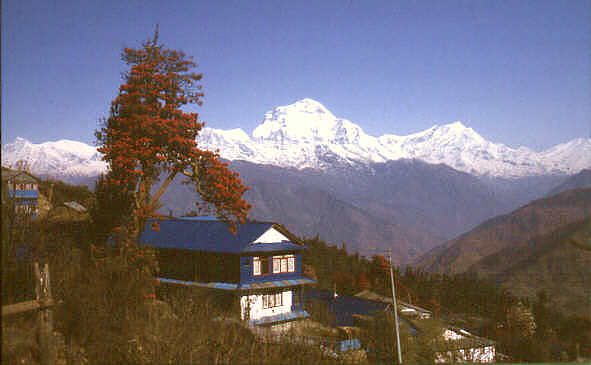
Panorama view of Nepal
Daulagiri
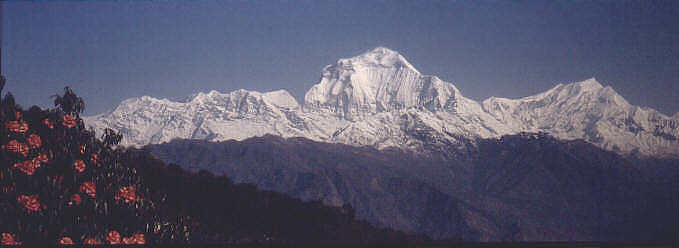
Gorepani with Daulagiri
Rhododendron forests
Ulleri
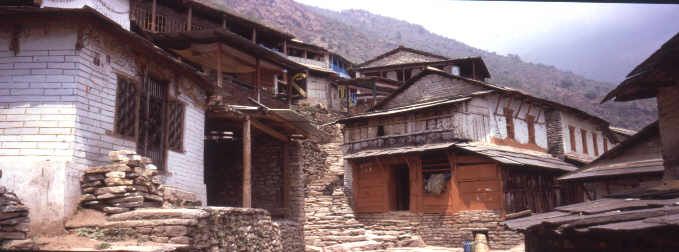
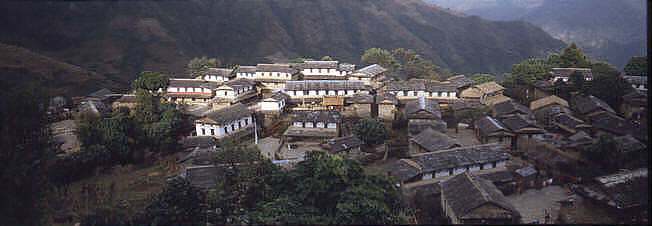
Gandung (Landrung)