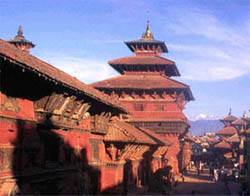
Patan Durbar Square
It is Situated in
the heart of the city consitutes the focus of visitor's attraction. The Square
is full of ancient palaces, temples and shrines, noted for their exquisite
carvings.
The Patan Durbar square consists of three main chowks or court- yards, the
Central Mul Cowk, Sundaru Chowk and Keshav Narayan Chowk. The Sundari Chowk
holds in its centre a masterpiece of stone architecture, the Royal bath called
Tushahity.
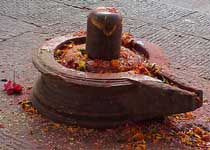
Bhai Dega Shiva
Statue of Nandi, the "golden calf" mount of Shiva, outside the Bhai Dega Shiva
temple in Patan.
Each of the major Hindu deities has
an associated animal known as their "mount." Depictions of the god or goddess
will usually include a direct or indirect reference to the mount.
Buddhist stupa
on the hill in the center of Nagarjun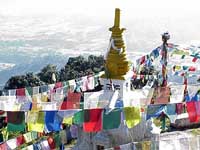
Nagarjun is a royal forest and hunting preserve west of Kathmandu, now open to the public. Different entry fees are charged according to whether you are travelling by foot, by car, by motorbike, by horse, or by elephant.
Krishna Mandir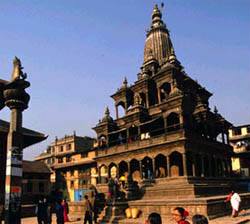
It was built in
the seventeenth century,the temple of Lord Krishna holds a commanding position
in the palace complex of Patan. It is suposed to be the first specimen Shikhara
style architecture in Nepal. It is the only temple in Nepal having 21 spires and
is completely made of stone.
Hiranya Verna Mahavihar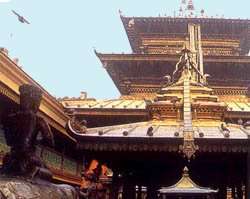
It is located inside, Kwabadehal, this three storey golden pagoda of Lokeshwor (Lord Buddha) was built in the twelfth century by King Bhaskar Verma. Inside the upper storey of the pagoda, are the gold- en image of Lord Buddha and a large prayer wheel.
Jagatnarayan Temple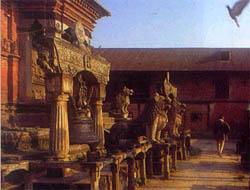
It is located inside, Kwabadehal, this three storey golden pagoda of Lokeshwor
(Lord Buddha) was built in the twelfth century by King Bhaskar Verma. Inside the
upper storey of the pagoda, are the gold- en image of Lord Buddha and a large
prayer wheel.
The Ashokan Stupas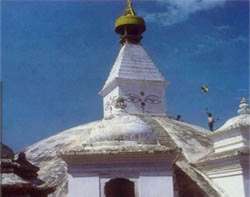
There are four ancient stupas
popularly believed to have been built in 250 B.C. by Emperor Ahoka at the four
corners of Patan.
The four stupas are situated in Pulchowk, Lagankhel, Ebahi and in Teta
respectively. These stupas give evidence to the city's ancient religious
importance.
Phulchowki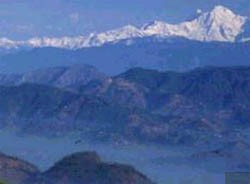
It is located about ten kilometers south-east of Patan, this mountain, 2758 m. high, is a good spot for hiking. A Buddhist shrine is situated on the top of the hill which can be reached through a jeepable road.