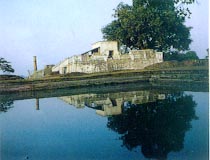
It is Situated at the Terai plains of the southern Nepal, Lumbini is the place where Siddhartha Gautam, the Shakya Prince and the ultimate Buddha, the Enlighted One, was born in 623 BC. The sacred place, marked by a stone pillar erected by Emperor Ashoka of India in 249 BC, is listed as one of the World Heritage Sites.
About 30km east of Lumbini is the village of Tilaurakot which is believed to have been the location of the Kapilvastu royal palace where the Buddha grew up as the Shakya dynasty prince, until he renounced it at the age of 29 in search of enlightenment.
Ashoka pillar
It carries an inscription identifying the holy site as the birthplace, is situated nearby the Sacred Garden. To one side of Ashoka pillar is the Mayadevi Temple which houses a bas relief depicting the nativity. Recent excavations have turned up a stone bearing a "foot imprint", indicating the exact place of birth. The Puskarni pond, where Queen Mayadevi, the Buddha's mother, had taken a bath before giving birth to him lies to the south of the pillar. Kushinagar is the place where Lord Buddha passed into Mahaparinirvana. Here are a lot of chaityas, stupas and viharas to see. The Muktabandhana stupa is believed to have been built by Malla dynasty to preserve the temporal relics of Lord Buddha. A smaller shrine nearby contains a reclining Buddha which was brought from Mathura by the monk Haribala. Bodhgaya is the place where Buddha attained enlightenment. The tree under which Buddha attained wisdom is called the Bodhi tree, while the temple marking the sacred spot is known as Mahabodhi temple.
The Lumbini Museum
It is
located in the Cultural Zone, contains Mauryan and Kushana coins, religious
manuscripts, terra-cotta fragments, and stone and metal sculptures. It also
possesses an extensive collection of stamps from various countries depicting
Lumbini and the Buddha.
Lumbini International Research Institute (LIRI), located opposite the
Lumbini Museum, provides research facilities for the study of Buddhism and
religion in general. Run jointly by the Lumbini Development Trust (LDT) and the
Reiyukai of Japan, LIRI contains some 12,000 books on religion, philosophy, art
and architecture.
Kapilvastu Museum is situated 27 km west of Lumbini in the village of
Tilaurakot. The museum holds coins, pottery and toys dating between the seventh
century BC and fourth century AD. The museum also has good collection of
jwellery and other ornaments of that period.