The
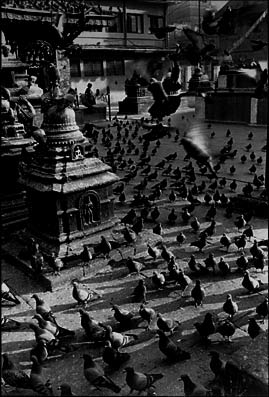
Kathmandu Valley, the capital, is the political, commercial and cultural hub of
Nepal. Spread across an area of 360 square kilometers and at an altitude of 1336
meter above the sea level, Kathmandu is an exotic and fascinating showcase of a
very rich culture, art and tradition. The valley, roughly oval bowl measuring 24
km east-west and 19 km north-south, is encircled by a range of green terraced
hills and dotted by compact clusters of red tiled-roofed houses.
A remarkable legend speaks that the valley was once covered by a lake until the Bodhisattva Manjushri raised his sword of wisdom and sliced a passage through the mountain walls, draining the water and creating the first settlements.
The valley embraces most of Nepal's ethnic groups, but Newars are the indigenous inhabitants and the creators of the valley's splendid civilization.
The valley consists of three fabulous cities of great historic and cultural interest. These legendry cities go by the names of:
Kathmandu
Patan or Lalitpur
Bhakatapur
(There are also villages and small towns that provide charming glimpses of rural life in this Valley)
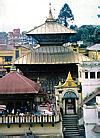
Banepa ( Pashupatinath)
Along the Arniko Highway 5 kilometers before Dhulikhel is the sprawling town of Banepa. Banepa itself is not a very interesting town, but it is the intersecting point for routes to Nala and Panauti. To the northeast, just a kilometer beyond lies the Chandeshwori Temple, which has a huge abstract mural depicting the goddess Parvati in the from of Chandeshwori, slayer of the demon Chand.
It is a small town at an altitude 1,440-meter from the sea level. The artistic skills and urban ethos of its Newar inhabitants have made a place of charm and beauty. Once an important link in the ancient trade route to Tibet, the town has a glorious past that can be witnessed in the lovely buildings and intricate woodcarvings found along the shop-lined streets and in the temples. The place has many vantage points that offer a panorama of the low hills, valleys and the Himalayas. Sunset views are spectacular from here. Bird watching, mountain biking and hiking are the favorite activities of this place.
This is really a magnificent place to stay a night and awaken to the sun rising across the wide Himalayan range. There are many luxurious resorts with all-modern amenities and facilities in this area. To get there, you can get into local bus from the main local bus station at Kathmandu city. The other alternative is to hire a cab. It takes around two hours to reach this place by local bus and an hour by cab.
Nagarkot, at 2,175 meter above the sea level, is the most popular resort destination in the Kathmandu Valley. It is the favorite weekend gateaway among those seeking mountain view in comfort and quiet. At sunrise, the Himalayan range, stretching from Dhaulagiri in the west all the way past Everest to Kanchenjunga in the east, emerges from the darkness to greet the happy visitors with its awe inspiring majesty and beauty.For those wishing to stretch their legs and enjoy the fresh morning air, there are charming walking trails as well as a lookout tower from which the sights can be taken in. Reaching Nagarkot is easy. Situated at 30 km east of Kathmandu city, it doesn't take more than two hours to reach there by a tourist bus.
Phulchowki "The Peak of Flowers"
Phulchowki is situated at an
altitude 2,762 meter above the sea level. It is the highest peak of the
Kathmandu Valley and offers a beautiful panaromic view of the Valley's
clustered settlements and the Himalayas. The area is also a home to many types
of butterflies, birds, moths and a number of mammals such as leopards and
Barking deer. Spiny Babbler, one of the endangered bird species of the world,
is found here.
It has an amazing vegetation, rich in color and fragrance of flowers like
rhododendrons and orchids.
Godavari, at the foot of Phulchowki, is 40 km from Kathmandu and is reached passing through serene villages and green fields. From here a bumpy motorable road twists and turns up the hillside to the summit. For hikers, there is a steep ten kilometer foot trail that begins behind St. Xavier's Godavari School and runs across the road's many switchbacks. It takes roughly three hours to reach the top for the hikers.
Shivapuri, at 2,732 meter, is the second highest peak of Kathmandu Valley. It is situated at the northern end of the Kathmandu Valley and offers a terrific hilltop retreat. Splendid views, rich flora and fauna are the main attractions of this place. The area encompasses a Shivapuri Watershed and Wildlife reserve, which harbors many rare and endangered animal and bird species like sloth bear, languor monkey, leopard and barking dear.
To get there, one should either head north from Balaju or Budhanilkantha at the foot of Shivapuri hill up the well-paved road until one reaches the gate of the reserve. From there, it's needed to hike up a steep trail passing by Nagi Gompa, a Buddhist monastery. Walking along the ridges adorned with fluttering prayer flags and Buddhist stupas and again through the dense wood for about two hours brings one to the summit. It's an excellent flat area that gives a panoramic view of the Himalayas. After a leisurely rest, one can either go back down the same route or follow the ridge descending south towards the stupa at Bouddhanath. The third option is to follow a small and steep trail that brings one down to Budhanilkantha.
Timal Narayan is one of the excellent destinations from dhulikhel for short trek. It is indeed a wonderful trek that gives you an opportunity to visit the rural village of Tamang people. The vantage point of Timal Narayan offers a beautiful view of Gaurishanker Himal and other important peaks as well as Sunkoshi river.
A corner of Kathmandu valley rim that time forgot is suddenly on the tourist map with an opening of a deluxe mt. resort, Malla Alpine Resort Nearby are 5th century Licchavi villages of Sunakothi, Thecho and Chapagaon.
