FRIDAY, AUGUST 17 - NATIONAL THRIFTSHOP DAY
Yikes! I've really got nothing for this day. I've taken care of all my shopping for the trip, so this one's for naught. How about a recycled viewpoint?
As great as your vacation is, you always know that someone else is at another even more spectacular spot. Case in point: Danielle and Pat kept cell phones on hand to keep up with Danielle's sister Shannon and her family's happy fun time pleasure cruise in Alaska. Show offs. I hope Isaac treated 'em right and Julie gave the kiddies plenty of activities to keep busy.
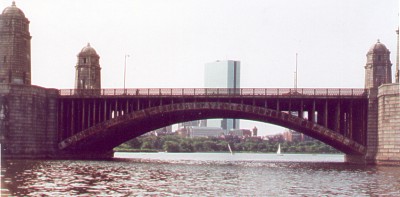
7 a.m. - Meet in lobby - daggum it's early! - to hop on the T into town for a Boston Duck Tour, something that Pat and Danielle brought up as something that looked like a fun way to get acclimated to the historical sights of Boston. Cool beans, I'm game for any enjoyable (and non-walking) excursion.
8:30 a.m. - Get our tickets for the 9:30 tour.
9:30 a.m. - We board a DUKW, or "duck," a reconditioned World War II amphibious landing craft, and set off on an hour-and-a-half ride through downtown Boston checking out the high points and splashing into the Charles River for a spell. As always with a fun tour like this, the guide - called a ConDUCKtor - has plenty of information and amusing tidbits of the town's history.
11:30 a.m. - Our quartet gets off the T at Park Street to begin walking the Freedom Trail, Boston's top historical attraction. A red line on the sidewalk points the way, and we as dutiful tourists stray little from its path.
But if we do, Boston's citizens are largely very nice people and helpful to tourists. I suppose they're accustomed to their town being a popular destination for visitors, and coming across groups of sightseers staring blankly at six-foot-wide maps. Personally, my copy of "The Complete Idiot's Travel Guide to Boston" was beneficial, and a lot more amusing and interesting than ol' reliables "Fodor's" and the "AAA Tour Book" that contains plenty of information, just dryly written.
Once we get to our destination we're golden. But the process of getting there, finding our way in unfamiliar territory, is unpleasant at best. There's no bloodletting, but let's just say that 19th century dentistry was probably less painful. Just chalk it up to a bunch of opinionated folks all having the best ideas as to how we should do things (and all with a different idea). Fried shrimp with extra cocktail sauce helps.
Especially important, why get upset when you've got an entire day's worth of sightseeing in one afternoon? Here's a rundown of the sites we visited over the next five hours and 3 1/2 miles (facts in italics courtesy The Freedom Trail Foundation's visitor map & guide):
| 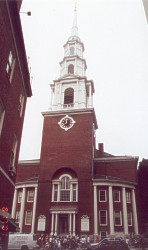 |
| Park Street Church |
Boston Common
In 1634, all Bostonians were assessed one shilling and it became America's first public park. Over many generations, the Common has been the site of hangings, duels, public celebrations and spirited oratory, and today is the starting point for the Freedom Trail.
Massachusetts State House
Completed in 1798, it is the oldest building on Beacon Hill. The state House of Representatives meets here under a wooden fish, the Sacred Cod (donated in 1784), a reminder of fishing's importance to the local economy.
Park Street Church
Founded in 1809, the Park Street Church building and the 217-foot steeple were, for many years, the first landmark seen by travelers approaching Boston.
It was the site of a number of important anti-slavery speeches in the early 1800's, the first missionaries to Hawaii left from here in 1819 and "America" (You know, "My Country 'Tis of Thee...") was first sung here on July 4, 1831.
Henry James described the structure as "the most interesting mass of bricks and mortar in America." Apparently James never made it to the Corn Palace.
| 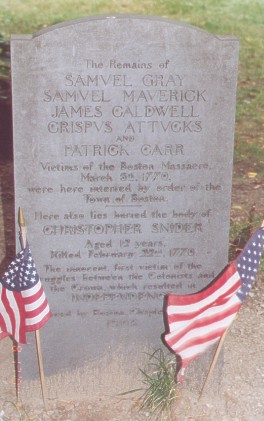 |
| Grave of the five killed in the Boston Massacre. |
Granary Burying Ground
The final resting place of many eminent Revolutionary-era patriots, such as Samuel Adams, Peter Faneuil, Paul Revere, John Hancock and the five killed in the Boston Massacre.
King's Chapel & Burying Ground
The first Anglican church in Boston(1688), and later the first Unitarian church in America after patriots ousted the English.
Pew number 13 is called the "Pew of the Condemned" because when prisoners were going to be hanged on Boston Common, they had the option to sit in this pew for a few last prayers.
The burying ground was the only burying place in Boston proper for nearly 30 years (it dates from 1630), and is the final resting place for some of Massachusetts Bay Colony's most prominent citizens, such as the Colony's first governor, John Winthrop; and Mary Chilton, the first female colonist to step ashore on Plymouth Rock.
First Public School Site
A half-smiling, half-serious statue of Benjamin Franklin outside Old City Hall and a plaque on the sidewalk marks the site of the First Public School, Boston Latin School (1635), which educated such notables as John Hancock, Benjamin Franklin, Samuel Adams and Ralph Waldo Emerson.
Franklin's is the first portrait statue erected in the United States, but virtually impossible to see firsthand because it's on private land now, owned by a French restaurant that won't let us step a foot in their land to get an up close view to read the plaques at the base. Just one more reason to hate the French, those cheese-eating surrender-monkeys. (Not only that, but on the day I wrote this part of the write-up, the French tried to reclaim the Statue of Liberty!)
Old Corner Bookstore
Not much to see today as the Boston Globe Store, Thomas Crease built the building at the corner of School and Washington Streets in 1718 for his apothecary shop and residence. It became known as the Old Corner Bookstore when the Ticknor and Fields Publishing House was located here from 1832 to 1865. Charles Dickens, Ralph Waldo Emerson, Henry Wadsworth Longfellow and Henry David Thoreau all frequented the most famous periodical of 19th century America.
Old South Meeting House
Built in 1729, the Old South Meeting House was the largest building in Colonial Boston. In the years leading to the American Revolution, people gathered here to challenge British rule, protesting the Boston Massacre and taxes. Outrage boiled over on December 16, 1773, when 5,000 angry Colonists came to Old South to protest the tea tax-and started a revolution with the Boston Tea Party.
Old State House
Built in 1713, the Old State House was the headquarters of the British government in Boston. It served as merchants' exchange, general meeting place, site of revolutionary fervor in the legislature and as the symbol of Royal authority in the colony. The site played a central role in the story of the rebellion, from the Boston Massacre in 1770, which sparked the fires of the revolution, to the reading of the Declaration of Independence from the balcony in 1776.
| 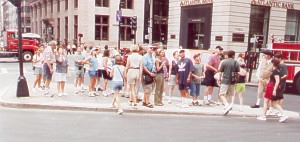 |
| Tourists squish onto the Massacre site. |
Boston Massacre Site
If you didn't know it was there, you'd miss it completely.
About 25 yards in front of the Old State House is a cobblestone circle in a traffic island marking the site of the 1770 Massacre that helped fuel the rebellion against the British.
One of the interesting parts of David McCullough's biography of John Adams is the chapter in which McCullough describes how Adams represented the British troops and won, with the ruling that the troops acted in self-defense. I find it a proud example of the American justice system, but Dad disagrees
Faneuil Hall
The "Cradle of Liberty," Faneuil Hall was the site of many fiery Towne Meetings. Built in 1742 by merchant Peter Faneuil and given as a gift to the town, Faneuil Hall has served as an open forum meeting hall for over 250 years. Here, Bostonians protested the British taxation policies of the 1760's. Their protests eventually led to the American Revolution.
| 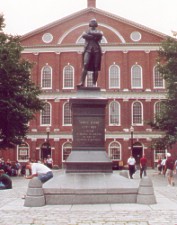 |
| Samuel Adams statue in front of Faneuil Hall. |
The grasshopper atop Faneuil Hall has been an important part of Boston's history. With its glass doorknobs for eyes, the grasshopper was well known by everyone in Boston. During the War of 1812, suspected spies were asked if they knew about the grasshopper in Boston. If they could identify it, they had proven themselves patriots; if they couldn't, they were deemed spies and faced dire repercussions.
1 p.m. - We stop for lunch at Salty Dog Seafood, between Faneuil Hall (rhymes with Daniel) and the Quincy Market (pronounced Quin-zee), full of shops and restaurants, and the perfect stopping point along the Trail. It is also a good place to mail postcards.
After this stop the sites get less frequent, bathrooms are rarer, the walks between locations are longer and we head into Charlestown across the Charles River.
Paul Revere House
A half-mile walk from Faneuil Hall, under and over the Big Dig, we're in the North End, Boston's oldest neighborhood, where the city began in 1630, and is now home of much of the Italian-American population of Boston. The European-flavored area has narrow streets lined with ethnic restaurants and food markets.
Built around 1680, this house is the oldest building in downtown Boston, and served as the home of patriot/silversmith from 1770 to 1800. Revere left here for his famous "midnight ride." Today it has been restored and is available to walk through and see how Revere and family lived.
Old North Church
Where the phrase "One if by land, two if by sea" came about.
Officially known as Christ Church, built in 1723, Old North Church is the oldest church building in Boston. On April 8th, 1775, the church's sexton, Robert Newman, displayed two lanterns to warn Paul Revere and others of British troop movements, thereby igniting the War of Independence and leading to the birth of our country.
Inside a Park worker gives a talk about the importance of the building, as you sit in old-style pews that are arranged like cubicles. She provides absorbing information, such as the bust of George Washington is reputedly the first memorial to the first president and closest in resemblance, and that the four eagles sitting by the organ above the congregation were stolen from a French vessel.
Copp's Hill Burying Ground
Up the hill from the Old North Church, we didn't even stop, just kept chugging towards Charlestown and the final stops of our expedition.
The second-oldest graveyard (1659) in the city, this is the final resting place of merchants, artisans and craftspeople who lived and worked in the North End. The land was given to the town by the Copp family and the site took its name from the family. The grounds are also the final resting place of thousands of free blacks who lived in a community on the current Charter Street side of the burying ground, called the "New Guinea Community."
Because of its height, the British used this vantage point to train their cannons on Charlestown during the Battle of Bunker Hill...The gravestones at Copp's Hill were used for target practice by the British soldiers during the Revolution.
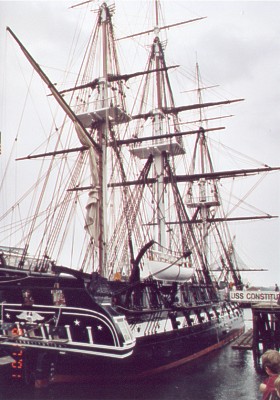
USS Constitution
3:30 p.m. - Cross the Charles River and give our regards to "Old Ironsides", the undefeated USS Constitution, one of the U.S. Navy's six original frigates, is berthed within sight of the Bunker Hill Monument.
Located in the Charlestown Navy Yard, the USS Constitution was launched in Boston on October 21st, 1797, and is the oldest commissioned warship afloat in the world. Her first mission during the late 1790's was to guard American commerce in the Caribbean against the French depredations. She defeated HMS Guerriere in the War of 1812, the first in a grand succession of victories in this war. It was during this ferocious battle that the seamen, astonished at how the cannonballs were bouncing off her hull, cried out "Huzzah! Her sides are made of iron!," hence her nickname, "Old Ironsides."
I leave Pat, Dad and Danielle on a bench by the ship and join the guided tour, led by an active-duty member of the United States Navy stationed at the ship. It has a compliment of over 60, and they still take the ship out of harbor about six times each summer to make sure that it gets weathered evenly to prevent awkward or rapid decomposition.
|  |
| I scream, you scream, we all scream for ice cream. |
Bunker Hill Monument
"Don't fire until you see the whites of their eyes!"
This legendary order has come to immortalize the determination of the American Colonists who united to take on the might of the British Army on June 17, 1775 at the famous battle of Bunker Hill, the first formal battle of the American Revolution. A 221-foot granite obelisk dedicated in 1843 commemorates the battle on the site of the main Colonial fortification.
Students of history know that the battle was actually fought on Breeds Hill, but lazy mapmakers never reversed the error that caused the incorrect name to be given. It was also technically a British victory, but at great cost. Half of the British troops were killed or wounded, which contributed to their decision to abandon Boston nine months later.
4:30 p.m. - After five hours and three+ miles, we have reached the end. Sure it was 92 degrees, but hey, that's only 33 degrees Celsius!
Forget "Don't fire 'til you see the whites of their eyes." By this time I was all about "I'm tired and want a Sprite with my fries." And it was still another mile walk to the nearest T at Bunker Hill Community College (where Robin Williams' office was in Good Will Hunting).
I'm down, but not out; pooped yet still able to walk around Fenway before and during the game with plenty of vigor, and even climbed up and down the five flights of stairs at the hotel later that night. Not even sore the next day.
 7:05 p.m. - Game time for our second trip to Fenway Park, with the Red Sox welcoming Baltimore to town and most especially, the retiring Cal Ripken Jr., certain to be elected to the Hall of Fame in five years. Danielle joined us tonight to see Cal for the last time, with Pat taking in Copley Square and the Hard Rock Cafe.
| 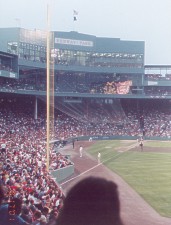 |
| Pesky's Pole down the right field line. |
Our seats tonight are in right field, on the fair side of Pesky's Pole. What is Pesky's Pole? The right field foul (or fair) pole, where many a home run has wrapped around due to the short distance from home plate. Even though Pesky's Pole was dubbed that in the 1950s, the phrase really didn't become popular until the late 1980s or early 1990s.
According to former Red Sox star Johnny Pesky, it was Sox pitcher Mel Parnell who coined the term, after Pesky hit a home run just beyond Fenway Park's right-field foul pole. That home run - one of only six homers Pesky ever hit at Fenway Park - won the game for Parnell.
If you're still wondering what the big deal is about a pilgrimage to Fenway, I'll give an idea of how rabid the members of Red Sox Nation are, fighting against supernatural forces keeping the World Series at bay:
...It was just one of a series of legendary mishaps that have prevented Boston from winning a World Series since 1918. From the '46 series when Johnny Pesky "held the ball," to Bucky Dent's home run in 1978, to Buckner's error, the Red Sox appear to be jinxed. Further proof can be found in Game 7 losses in both the 1967 and 1975 World Series.
The curse's hold on Red Sox Nation is so powerful that lifelong Red Sox fan Paul Giorgio climbed Mount Everest in hopes of vanquishing it. On May 23, on the advice of a Tibetan Buddhist holy man, Giorgio, a 37-year-old real estate investor who is a serious climber, placed a Red Sox cap on the top of Mount Everest, some 29,000 feet into the sky. For good measure, he also burned a New York Yankees cap on the summit.
Only in Red Sox Nation. (Baseball Weekly, July 25, 2001)
| 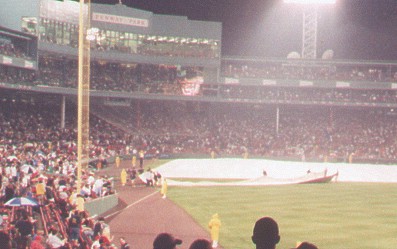 |
| Rain, rain, go away. |
9 p.m. - What we have been expecting and dreading for three days comes to pass, as a thunder booming front moved in and the rain rain rain falls down down down on the Fens. During the sixth inning the game is halted due to lightning and heavy rains, and after a half-hour of Beach Ball Bingo with other fans under the roof, we decide to head back to the hotel.
Even though the game does eventually restart it is after a two-hour delay and would have meant not getting much sleep for the drive the next day. We agree later that decision is ultimately for the better especially since the Red Sox end up getting blown out, 11-5.
:( Time to go home.