
|
|
         |
The Dogue de Bordeaux Robyn Spierenburg
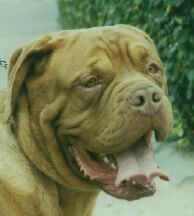
The Dogue de Bordeaux with it's deeply lined face resembles a tired, aging prize fighter. The comparison is fitting because the Dogue de Bordeaux was once used as a ferocious fighting dog trained to attack bulls , bears and other dogs. Today's breed appears as intimidating as it's ancestor , however it is a calm and gentle creature, loyal to it's master and patient with children. There are about 80 registered breeders in Australia but unfortunately there haven't been many exhibitors at dog shows in the past six years. The largest number of Dogue de Bordeaux's exhibited to date was at the Sydney Royal 2000 where there were 17 shown; let's hope we can look forward to seeing a greater number of Bordeaux being shown throughout Australia so the breed can continue to gain in strength.
A Brief Look at History
By the end of the Middle Ages , the formidable Dogue de Bordeaux has acquired a new and more respectable occupation as a working dog. Butchers used the dog to drive cattle to the market. This role earned the Dogue de Bordeaux it's lasting nickname as the 'Butchers Dog'. From the lowly meat sellers shop, the Dogue de Bordeaux ascended to the estates and mansions of the wealthy and aristocratic. The rich prized the dogs as protectors whose vigilance and courage deterred thieves and intruders. This patronage may have salvaged the breeds reputation but it
almost
Fortunately, the butchers dog survived in sufficient numbers to permit the breed to continue. Until recent years , the competition from other more popular watch dogs such as the Boxer and the Great Dane kept it's numbers extremely low. Today however, the Dogue de Bordeaux is enjoying a revival in popularity thanks to the growing recognition of it's gentleness and devotion. The breed is well established in France and its reputation is spreading. The Dogue de Bordeaux , a rare French Mastiff , was first imported into Australia by Garry Gillard in 1992. Garry was also responsible for the ANKC recognition of the Dogue de Bordeaux as a pure breed in 1994. Exercise As with all large and heavy dogs there can be problems with muscles and ligaments, therefore it is recommended not to overdo exercise during the growth period. The tendons and ligaments take great strain during puppy's fast growth periods. Most of the growing process takes place during his first year. Feeding The Douge de Bordeaux has a healthy but not outrageous appetite. Turning of the stomach or bloat can occur with medium or large dog types. The cause of this remains largely unknown , therefore it is recommended to feed twice daily and let the dog rest for a while before and after eating dry dog food. Breeding The Dogue de Bordeaux almost disappeared during the second world war, which partially explains their price today and why breeders will travel thousands of kilometres to keep the bloodlines pure. Because of their rarity, most breeders plan their litters carefully and attach great value to producing healthy vital pups resulting from wise matings. They will critically assess any potential new owners for their pups and watch over the their puppy's with great interest. By being extremely selective when breeding it is becoming easier to avoid hip dysplasia , however this is still a problem within the breed. When selecting a puppy it is important to ensure that the puppies have neither signs of entropion or ectropion, in both cases the eyes become enflamed causing extreme pain to the dog. Anaesthetics Please be careful if your Dog needs an operations as the breed is very sensitive to anaesthetics , a normal dosage has the potential to be deadly to the Dogue de Bordeaux. Although these problems can occur, they are not necessarily each dogs destiny. Raising a Bordeaux Bringing up a Bordeaux pup should be done with politeness,
rewards and the shaking While there is some suggestion that the Dogue de Bordeaux may be too independent to obey repeated commands, this doesn't seem to hold true as many pass their obedience exams. The Dogue de Bordeaux loves to play right through to old age and will often prefer towels or pillows to sticks or balls. Whilst it shouldn't be a problem for a Bordeaux to take a 10 to 20 kilometre walk (though never in the heat of the day for the dogs sake) , puppies should not be pushed. It is fair to say that when they sit down , they have had enough.
Runderkraal Dogue de Bordeaux
Leo
& Robyn Spierenburg International phone 61 7 46984125
This page was last updated on
09/21/02
|
 During
the middle ages, the breed was considered a brutal and expendable beast. Gaston
Phoeleus, a fourteenth century French writer describes the dog as follows: "With
their thick heads, thick lips and large ears they are well suited to hunting
bears and pigs because they are stubborn. They are heavy and ugly and if a wild
bore were to kill them it would be no great loss." The early contempt for the
Dogue de Bordeaux survives in some common French phrases. In France people
still say "une humeur de dogue" when referring to a bad temper and use :L'air de
dogue" to describe an unpleasant expression.
During
the middle ages, the breed was considered a brutal and expendable beast. Gaston
Phoeleus, a fourteenth century French writer describes the dog as follows: "With
their thick heads, thick lips and large ears they are well suited to hunting
bears and pigs because they are stubborn. They are heavy and ugly and if a wild
bore were to kill them it would be no great loss." The early contempt for the
Dogue de Bordeaux survives in some common French phrases. In France people
still say "une humeur de dogue" when referring to a bad temper and use :L'air de
dogue" to describe an unpleasant expression.
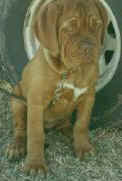 of
the coat behind the pup's neck rather than rolled up newspaper. If you do not
want the Dogue de Bordeaux to take over your sofa or bed as an adult, don't give
in to it's pleading looks as a pup.
of
the coat behind the pup's neck rather than rolled up newspaper. If you do not
want the Dogue de Bordeaux to take over your sofa or bed as an adult, don't give
in to it's pleading looks as a pup.
