Galway
Greener than green
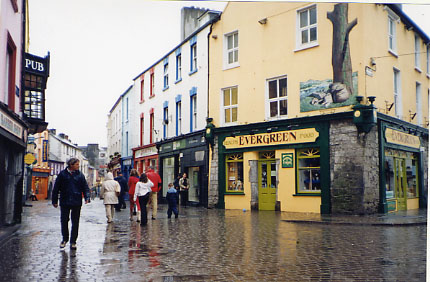 Quay Street, Galway: Galway is a very small city, not even a city, really; it's more of a town, with one main drag, seen here. It would be cute if it were not so determinedly touristy, though the streets wend about even more drunkenly than Dublin�s in a charming way. Many of the sides of buildings are painted with shop signs and murals, while the buildings themselves are brightly colored, as if to stave off the grayness that seems to hang over the city. Joanne and I saw a pub with a bright blue phoenix-looking mural on its side.
Tourists most certainly outnumber the natives; you must constantly be alert not to be trampled or bicycled over by gawking meandering folk. A lot of the city is off-limits to cars, thankfully (for pedestrians), so look out for big signs and poles preventing entrance if you like your bumper the way it is. With the exeption of this visual pollution, the place is like a colorful medieval village, and is situated right on the ocean. The whole of the place is scented with brine, and can be quite damp. While we were there, it rained every day, so, as with all of Ireland, bring a raincoat. That's why it's so green, of course. :)
Places to Stay
I can only really talk about the place that I stayed, Barnacle�s Quay Street House. It was a moderately-priced hostel in the middle of all of the action! To either side of it were pubs, restaurants, and shops, along both sides of the street. It was clean, the (dorm-like) rooms were of a decent size, it was fairly well-lit and seemed safe. There were no lockers to keep your stuff safe, though. Benefit: no curfew. :)
To pick a place to stay, I'd do some comparison shopping--some places really rip you off. Check out one of those travel books, or try to find websites online. Also, safety (if not yours, then your stuff's) is an issue I'd be sensitive to.
Places to Eat
Riordan�s: a cozy little mom & pop place. I had an excellent ham dinner, complete with gravy, (real) mashed potatoes, turnips, and green beans, and a cappuccino. This is the first time I�ve had ham here in Ireland. It was everything I�d hoped for! A great meal with great company in a pleasant atmosphere�sigh. =)
Busker Browne�s, one of the few restaurants open "later", we chose this upscale-looking place for dessert--a delicious piece of fudge cake with a strange fruit that I dared eat but Joanne thought was very sketchy and decided to pass on it. It must have been edible, and not just a garnish, because I�m not dead. ;) The atmosphere was less than cozy, but that's to be expected for both its size and its modernity.
Stuff to See
Galway Cathedral (the rest is not in any particular order): much smaller than St. Patrick�s Cathedral, like Galway itself when compared to Dublin. The rose window is quite nice, and the dome impressive; at night the whole fa�ade is lit up with an eerie green glow which reflects off the water of the Corrib River.
Spanish Arch: the remainder of the city walls (the rest having been destroyed by the repugnant Cromwell and the redoubtable William of Orange).
Salmon Weir: a manmade waterfall of sorts, the weir controls the water level of the Corrib right before it flows into Galway Bay. Evidently during salmon season whole schools of them jump up the boundary.
Nora Barnacle�s House: Nora Barnacle was the wife of James Joyce, and in this house she lived before marrying him; Joyce visited her frequently here. It is quite small and nondescript, with whitewashed plaster, and not recommended for those not interested in Joycean lore. Call ahead, as it is only open during certain times of the year.
Lynch�s Castle: converted into a branch of the Allied Irish Bank, the castle is pretty unremarkable (we walked by it several times) but is supposedly one of the finest examples of �inner city� castles. It's not tagged, if you're wondering.
Collegiate Church of St. Nicholas of Myra: we didn�t go in, and missed the best parts of this church, but by the time we got there it was closed. It is the largest medieval parish church still in use, and Cromwell stabled his horses here (yes, he did; Cromwell was an atheist and destroyed many churches in an effort to stop the people from practicing religion).
Kennedy Park: a little park to commemorate President Kennedy. Has the P�draic O�Conaire Statue, of a controversial Irish poet, and Browne�s Doorway, a remnant of a house from another site with worked stone columns and inscriptions, as well as an odd modern art piece of rusted metal that�s meant to look like a Galway h�ic�ir (�`hook-er�, a boat, silly).
Galway Bay: we got incredibly lost at this point, looking for a decently priced restaurant (as I said, Galway is a big tourist and student town, so the prices range dramatically). Roads crisscross the lobes of the bay, and there are several bridges. We ended up across the Bay, in Claddagh, briefly. Claddagh (pronounced `Clad-ah)was an �outlaw� town outside of Galway�the bridges were gated, and the Claddagh residents were looked upon as nearly lawless. It's kinda funny that the internationally-known Claddagh ring, which portrays hands representing friendship, a crown representing loyalty, and a heart representing love, hearkens back to such a diminutive beginning.
Nightlife
King�s Head Pub: live music, an Irish rock band called Pyramid who covered a bunch of different things. We only stayed briefly because it was very smoky and we were both tired. It's a cool pub, crowded, dark, and lively the way they should be. :)
Bus Tour of the Burren
Joanne and I took a day-long bus trip with O�Neachtain Tours around the areas of interest outside Galway. Our tour guide was a cute little old man, Desmond, with a leprechaun-like accent who took a fancy to my red hair, especially when I knew about Maire Rua O�Brien (an infamous redhead who supposedly killed off as many as 12 husbands for their money and lands). He was a good driver (thank God) and had a chipper personality, and had been driving the course for 6 days a week for 6 � years, and boy, did he know a lot. He had an endearing habit of always repeating the last thing he said, as if so used to being asked to repeat that he had made it second nature.
The tour touched a lot of amazing places, and there was plenty of time to explore a lot of them. The first few and last few places are in the same county as Galway, while the middle portion is in County Clare. During the trip, we passed through several small towns, including Oranmore; Clarinbridge, known internationally for its September oyster festival; Kilcogan; Kinvara, a small fishing village; Ballyvaughn; Kilfenora; Lisdoonvarna, where they held matchmaking festivals and one of two sites for the filming of the movie �Matchmaker�; and Doolin, where we had lunch at the famous O�Connors pub, known for its traditional music.
Unfortunately, poor Joanne became quite motion sick, and I doubt that she enjoyed the experience as much as I did. So if you're planning on being on and off of a bus for eight plus hours, and you think you might be in the least bit prone to motion sickness, please for the love of everything sacred take some medication. (Joanne hadn't known ahead of time, unfortunately for her.)
- Ancient Wonders

 Corcomroe Abbey: our first stop, this 12th century Cistercian ruined abbey has an active graveyard (active as in people are still being buried there). The roof was gone (probably another �gift� from Cromwell), and rooks nested in the rafters. It was hauntingly magical.
Earthen Fort: basically, an earthen ring around a hollow center, surrounded by a moat of water. They were built more for secrecy than for security by the religious people of the area, and it�s not possible to see over the walls.
Famine Walls: these stone walls were built by starving men along the edges of their landowner�s boundaries to earn a pence or a handful of grain to feed their family during the worst times of the Great Hunger. The most painfully ironic part of this story is that they were building the walls of stone in a field of grass or stone, and they were never used to keep animals in or out, or to really do anything else�it was just busy work. Meanwhile, the women were building the roads that form the base of the current roads of the region (which just goes to show that women do indeed have more common sense than men). You can see some of these walls in the Corcomroe Abbey arch picture, in the distance.
 Poulnabrone Dolmen: on a field of limestone, the dolmen is the glorified frame entrance to a tomb (now closed off), with two and one half stones supporting a capstone and the whole thing tilting dangerously to the back toward the broken stone. It�s a really cool monument.
Leamanegh Castle: the home of Maire Rua O�Brien, mentioned above. It�s now a ruin, but it�s being repaired, and the mullioned windows are quite large for the time period. Apparently I remind the tour guide Desmond of its former owner, though this distinction is somewhat besmirched
 Dunguaire Castle: 16th century tower house, set prettily right by the water; when we got there the tide was in & its reflection was outstanding.
Natural Wonders
Cow calving: it�s possible to see just about anything on these tours, it seems. We were able to witness the first tentative steps of a newborn calf. Wow.
Aillwee Cave: not as spectacular as some caves I�ve been in, but definitely interesting, with good lighting effects. The waterfalls were particularly nice, as they had been having quite a bit of rain previously. The first explorers found the bones of brown bears, since extinct in Ireland for about 1000 years.
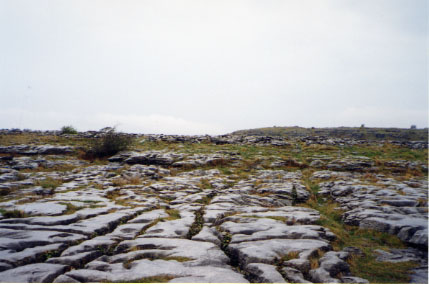 We have now entered the Burren, in County Clare, a region of nearly uninterrupted limestone fields. It was formed in a shallow sea and upthrust and slowly eroded away, leaving pitted (and slippery) limestone everywhere. In places, there are crags between the boulders large enough to fall in and deep enough to break a leg, and in which ivy and hardy flowers grow. Many different textures of limestone exist, from the massive smooth rock near the Dolmen (see above) to the pitted jagged rock near Galway Bay to the sheety layers of the Cliffs of Moher. The limestone, while eroding, puts nutrients in the sparse soil, which makes the grass (the only crop that grows there) particularly nutritious for the sheep and cows that are positively everywhere. One of Cromwell�s officers remarked that there was �neither water enough to drown a man, nor a tree to hang him, nor soil enough to bury him�. You can imagine how hard it was to live there, nevermind when Cromwell�s goons were trying to figure out new and interesting ways to kill you.


 Cliffs of Moher: my favorite stop during the whole tour, I had been looking forward to this since I got in Ireland, and the cliffs did not disappoint. At their highest point near O�Brien�s Tower, they tower 203m over a sheer drop into a very green and very angry ocean that�s crashing and frothing over the boulders that have fallen off of the face of the cliffs over time. Sea birds spiral below and black flies above, and one can see the Aran Islands (Inis M�r, Inis Me�in, and Inis O�rr) and the Connemara coastline on a clear day; we could barely see them through the mist, which cast an eerie glow on the tapering edges of the cliffs. I have so many photos of that place! And, shh, don�t tell my parents, but I jumped the safety fences to stand on the very edge of the cliffs, which was a complete rush. Not bad for someone afraid of heights, no?
 Fanore Beach and Blackhead Lighthouse: another drop-to-your-death limestone �beach�, absolutely beautiful.
Galway Bay meets the Atlantic Ocean: a match made in heaven! Even more of the Galway Bay. We could see the Aran Islands and Connemara coast here too, more clearly and much closer.
Return Home
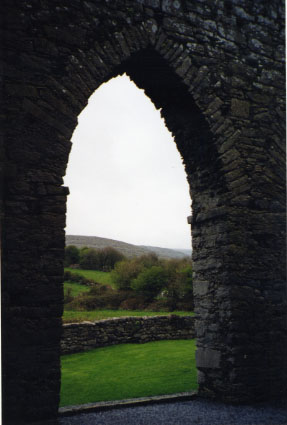
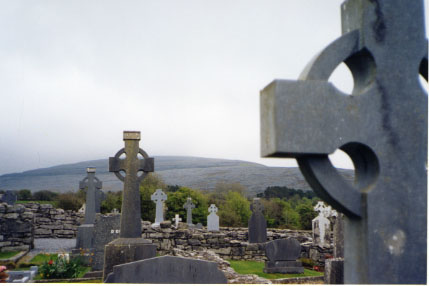 Corcomroe Abbey: our first stop, this 12th century Cistercian ruined abbey has an active graveyard (active as in people are still being buried there). The roof was gone (probably another �gift� from Cromwell), and rooks nested in the rafters. It was hauntingly magical.
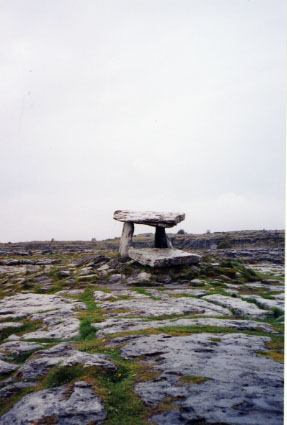 Poulnabrone Dolmen: on a field of limestone, the dolmen is the glorified frame entrance to a tomb (now closed off), with two and one half stones supporting a capstone and the whole thing tilting dangerously to the back toward the broken stone. It�s a really cool monument.
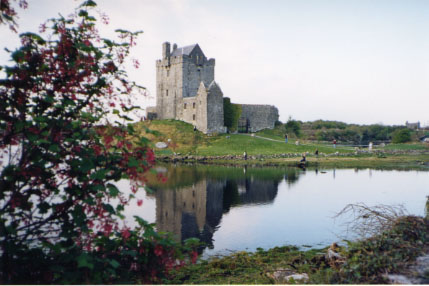 Dunguaire Castle: 16th century tower house, set prettily right by the water; when we got there the tide was in & its reflection was outstanding.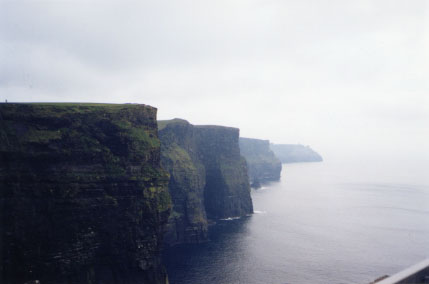
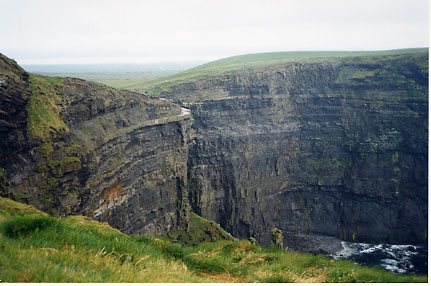
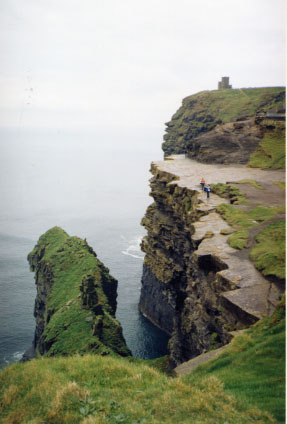
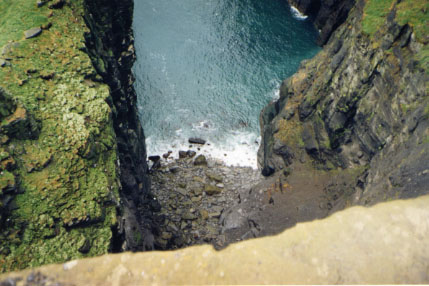 Cliffs of Moher: my favorite stop during the whole tour, I had been looking forward to this since I got in Ireland, and the cliffs did not disappoint. At their highest point near O�Brien�s Tower, they tower 203m over a sheer drop into a very green and very angry ocean that�s crashing and frothing over the boulders that have fallen off of the face of the cliffs over time. Sea birds spiral below and black flies above, and one can see the Aran Islands (Inis M�r, Inis Me�in, and Inis O�rr) and the Connemara coastline on a clear day; we could barely see them through the mist, which cast an eerie glow on the tapering edges of the cliffs. I have so many photos of that place! And, shh, don�t tell my parents, but I jumped the safety fences to stand on the very edge of the cliffs, which was a complete rush. Not bad for someone afraid of heights, no?
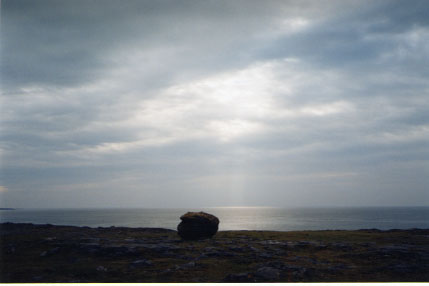 Fanore Beach and Blackhead Lighthouse: another drop-to-your-death limestone �beach�, absolutely beautiful.