
To get good support for your ball carriers your team needs to develop good communication methods so you know where and when to run in support of whatever team move is being executed when you start from a particular area of the field.
One method is to set up zones up the field and channels across�some teams have channels but not zones�..
Zones and Channels
To help you create a framework for your team, you divide the field up into a grid set up and create an overall view of how you might play in each area.
In the following diagram the field is divided into 3 channels across and 3 zones up , you can use more..the aussies used to use 8 channels across�and name or number them differently.
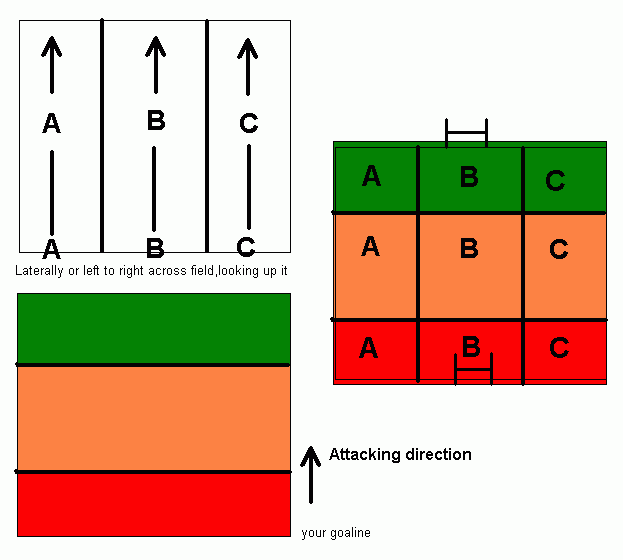
With this map of the field , you can communicate precisely where you intend your starter move to get to and get an idea of who can support the ball.
You create a grid reference system by combining the zones with the channels.
If all your players know what is supposed to happen, they will arrive first and in the right depth to play the next phase�but as always practise what if...?or what happens next�.?
Before the players set up for the scrum or get to a line-out, they should all know what the plan is with the ball next. If you are starting in A and the backs intend to move it to C then this is communicated to the loose forwards and they know to come off the scrum and RUN as its going wide ..and if the backs throw in a dummy switch first that hopefully pauses the opposition cover defense then you are sure to have more at the potential contact point than them.
This from bob woods league pages on the topic..�
http://freepages.sports.rootsweb.com/~bobw/index.htm
�.Lateral field positions (percentages or 1,2,3 or ABC) - To the best of my knowledge Warren Ryan instigated percentages in lateral field positions. 50% was halfway across the field, 70% was almost three quarters across etc. Teams started to divide the field into imaginary grids (similar to gridiron). The game plan involved working the play to a specific point within a Zone. For example in the Orange Zone you may work the ball to the 70 to open up the field for you backs. Or in the Green Zone you may work to the 50 to give you the opportunity to attack either side of the ruck.
Some coaches are now simplifying the division by breaking the field up into 3 longitudinal areas (Red, Orange, Green) and 3 lateral areas (1,2,3 or A,B,C). The idea is to make it easier for players to identify the area to work towards. So in the examples above your team would work towards a C field position in the Orange Zone and a B position in the Green Zone.......
Zones - you need to have specific attacking patterns in each zone. Explain these plays to your players and rehearse them.
Red Zone�.Simple controlled set piece play
Orange Zone�More complex plays from the starter scrum and lineout
Green Zone�Patience, leave here with points
You may have a weakness in getting out of your Red Zone because your players are too adventurous with the ball in that area. Design an offensive pattern specifically for the Red Zone and rehearse getting out of the Red Zone.
Power plays - will be used in either the Red Zone or the Green Zone. Power plays are designed to smash the opposition defence line to either allow you room to kick (to get out of the Red Zone) or to open up the defence to allow you to score in the Green Zone. Your players should know what your Power Plays are and when and how to use them. You should rehearse the power play situations.
Surrender plays - when coming out of your Red Zone too many players try to be Macho and fight the tackles. If you can teach your players how to use surrender plays (for example diving between two tacklers, landing on hands & knees and getting a quick play the ball away) you will be a lot more effective in getting out of your Red Zone.
Actually what we were chatting about is the number of coach's who spend all their effort in getting teams into the Green Zone, but then have nothing to offer once they get there. And we were watching these guys from different clubs and who had nothing to offer in the Green Zone ... most of the players were like lost little sheep ... no bloody idea ... they had got to the money end of the field and had then run out of options.
I had always worked on my Green Zone plays, but after that discussion, I remember that I checked all my training schedules ... just to make sure that I had given enough emphasis on Green Zone attack.
And from the rugby legue coaching manuals
��Do you have game plans and patterns of play?
We have a structured pattern in both attack and defence to give the players some broad direction. Players have to adapt and react to situations in the game, make decisions, and take the appropriate action. If the door opens I would expect the players I have to be able to take it. During a training session I will devote equal time to both defence and attack, correcting and refining errors. Most of the structured plays would be in the Red Zone, particularly to minimise errors. When in the Green Zone play is more impulsive, reaction to the situation, allowing players the freedom to express themselves. Our big players are used to bunch up the defence toward the middle allowing the playmakers to work their plays and be creative.
��all plans have to be adopted depending on the team you are playing. We don't go out with the same plan week in week out but there is a basic game plan that we try to execute, and perform everytime we play. So the basics to us are very important and depending on the opposition and where you want to be and concentrate on.
We have quite a number of set plays in our collection and over the years you accumulate them and keep them in your "little book" often when you are looking at a tape of the opposition you think that a certain play will or will not work and so it is important that you do your homework. It is the old saying that "failing to plan is planning to fail" and that is something that has stuck with me.
As your team develops understanding, you can better put various bits and pieces of play together in your attempts to confuse and scatter the opposition's defence. Once you have developed a framework, it will be easier for your team to play with confidence.