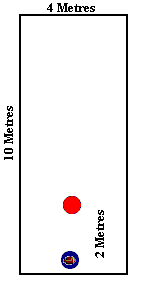
More options for the two lines drill
Two drills from Bob Woods League pages...ten offloads and defensive footwork
5 touch drills to teach various aspects of the game
2 ball / 3 ball
Striver touch
8v4 touch
Bound up touch
2 touch/double touch
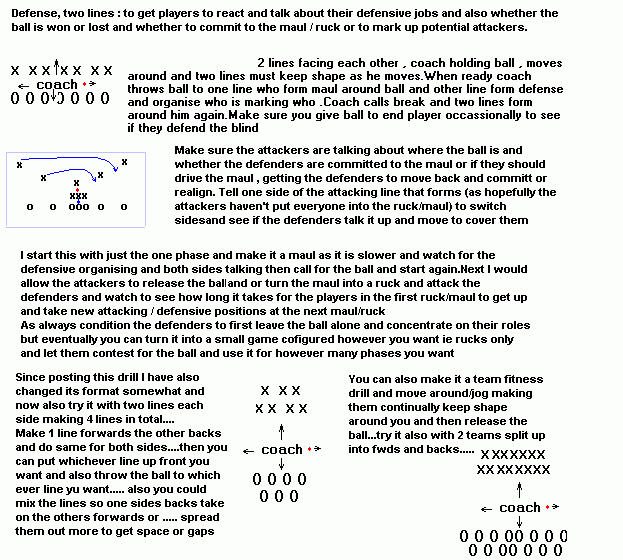
2 ball / 3 ball: Full field
Basically what it says ...instead of using 1 ball , you use 2 or even 3 balls depending on your numbers , all kicked off at the same time by the same team.
The idea is to get 2 or 3 little games of touch going on ,with more action and less standing around, using whatever rules you want ....
We play that when a try is scored by any ball that stops the game and restarts with the balls being kicked again
You can limit the players to the ball that they go to to start with or you can allow them to leave one game to attack or defend in the other(s), this gets their heads up and looking around and not just focussed on their ball /game ...also gets them talking as well........
Tries are scored quicker , and depending on numbers yu can even use more balls and get lots of 2v1's 3v2's going on , and dont stop the game until the last ball is scored ,limiting players to their "ball"or game, then count up who scored the most tries
Striver touch...normal game of touch , but when a try is scored there is no kickoff , instead the other team picks up the ball from where the try was scored and start to attack from there , meanwhile all the team that scored the try have to go back to halfway before they can come back into the game as defenders....so while they are running back to cross the halfway line they have to look at the new attackers and talk and adjust to try and stop them getting a break....players already behind the half when a try is scored can come straight into the game as defenders.Continuous action ...transition from offense to defense ...looking and scanning options on offense and defense....
10 v 5, 8 v 4, 7 v 3 touch or whatever works for your numbers.....
normal game of touch but the defenders can only send out half their players on defense ...so in 8v8 it would be 8v 4 , 20 players 10 v 10 =10 v 5 etc ..the defenders have to work hard but can do it for a long period of time if they talk ,keep their alignment etc.....
Bound up touch
Carrying on the theme of making it more difficult for the defenders from the above game , in this game instead of leaving players idle on defense , they bind in pairs ,or pairs and a 3, depending on odd or even numbers and have to stay bound until the attackers score..so 20 players = 10 v 10 but because the defenders are bound it is in reality 10 v 5 with more space to attack in and slower defenders....
Our rules are:50 x 50 m field , attack will always be in the same direction...
Defenders kick off from behind their goaline...half field , sidelines are goallines and must be bound (linking arms) in pairs or one group as a 3 if odd numbers.....before they can move forward in defense.
These defenders are simulating slow defenders who can not move very fast laterally (opposition props in a game?)and the attackers have to recognise this and attack accordingly...
When a touch occurs it is recycled and the attack continues...
If the ball is lost fwd or passed fwd or intercepted the ball is tossed back 10 m ,the attack regather the defenders reform and the game continues..so the attackers stay as attackers until the try in scored....
when a try is scored the teams switch ends on the run
The attackers pick up the ball from where they scored and when everyone on their team is behind the goalline they kick it off and the game continues..the team that was defending unbind and sprint to the other goaline and must cross it before they can come back into the field of play and play the kicked ball , where they will meet the defenders coming down together bound up in 2's working on their kickchase formation and talking it up about who has who etc.....
If the attackers beat the defenders on the outside (the easiest place, espec with a few quick phases and the defense slow movers from one side of the touch to the other ).....I make them have to pass to someone else before they can score or even make them make 2 passes so there is a point to trying to cover defend and the attackers have to support the break ...see the next game for this.......
2 touch/double touch
Make sure you regularly go to
http://www.rugby365.com/coaching/index.shtml
as it has a regular tip hint or drill and answers many of the questions the modern coach or player may ask
Also make sure you check out this link there
http://www.rugby365.com/stories/coaching/COA_010214_22593.shtml
as it describes another variation on the touch games
.....I know how many coaches have an obsessive hate of touch rugby but I maintain that it has a lot to teach one. The trouble with the usual game is that it encourages players to support shallowly and to run laterally - two grave faults. Players, however, love to play touch and it does practise passing and it encourages footwork, support work and even running of angles if it is properly played. It is played like ordinary touch rugby except that a player has to be touched twice, each time by a different opponent, before he relinquishes the ball. If he is touched once, he may continue running but may not score; he must wait for a supporter from his owns side and pass to him to score. If the ball goes to ground, play continues as long as the ball does not go forward. You may also kick if you so wish. The beauty of this game is that it encourages players to run straight, take the first touch, continue running but the fact that he has been touched means that he cannot risk another touch, and so must look for support and support must get to him. There is far more running than in ordinary touch and far less lateral running. Play half or full field.
http://freepages.sports.rootsweb.com/~bobw/index.htm
Ten Offloads
In a grid (20m x 20m) an equal number of players and one football. The team with the football attempts to offload the football to a support player 10 times. Every time that they complete 10 continuous offloads, they score 1 point and the other team gets the ball to try to get 10 continuous offloads.
The defending team tries to block the ball and gain possession themselves. If they get possession the first team's turn ends and the second team try to complete 10 continuous offloads.
For younger players don't allow physical contact. For older players allow tackling. You can move around the grid while in possession of the ball. The ball may hit the ground but can not be knocked on ... it must be fielded cleanly. If the ball goes outside the grid the other team starts with it. You may offload in any manner that you want, overhead passes, one handed passes, grubber kicks, or chip kicks.
Coaching Points:
� Emphasise offloading under pressure - holding off a player with one hand while passing with the other;
� Work off the ball - run in support, run into gaps etc;
� Communication - both defence and attack;
Defensive Footwork
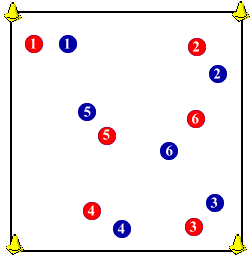
This drill helps develop good body position and quick footwork. It also assists with agility and reaction.
The drill is in a 10m x 4 m grid.
The defender keeps his hands on his hips - ie should just body block.
The defender starts by facing the attacker and 2 metres away from the attacker.
The drill starts with the attacker's first movement. The defender tries to mimick all of the attacker's moves and to keep the 2 metre distance between them.
The attacker moves up the grid, stepping, faking, head faking etc trying to get the defender into an unbalanced position (ie too wide a stance) ... the attacker can then rush past the defender to score.
The defender retreats up the grid, trying to stay on the balls of his feet and his hips and shoulders square to the attacker.
Coaching Points:
Both players to stay on the BALLS of their feet;
Defender to keep HIPS and SHOULDERS, SQUARE to attacker;
Defender to focus on attacker's HIPS