
The Origins Of Humanity
���� Whereas, no skeletal remains older than 500,000 years have been found outside of Africa, the oldest reported finding was in Java, where a 500,000 year old human skeleton named Homo erectus� (also called Java man) was discovered.� In the Great Lakes region of Africa, numerous human skelatal remains have been found that are in excess of three million years old.� It is believed that so called modern man, homo sapiens, evolved from homo erectus which in turn evolved from homo habilis which descended from the early primate ramapith-erectus.� Albert Churchward (1978) suggests that homo erectus is actually the so called Pygmy or the Twa people, and that the African Twa people are the parents of all of humanity. All of today?s human forms: African, Asian, European, Latino, and Oceanic, are very recent children of their
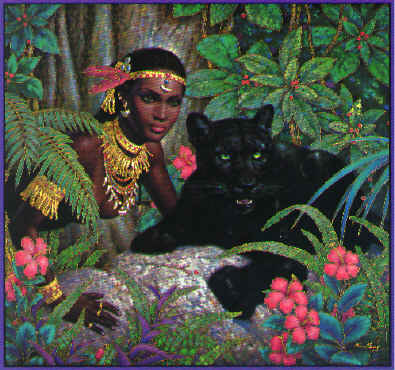
Artist: Karl Bang
African parents, the Twa people. All of humanity came from the same black womb of the black woman fertilized by the black seeds of the black man. Thus, there is only one race of humanity on the planet earth, the Black Race, with many shades of Black, from Black-Black to Black White. All members of the human family have various shades of skin color but they are all rooted in Blackness . Thus, the vast majority of humanity's time on earth, many millions of years, was spent in a Black African context . The Holy Land of the ancient African Egyptians was named Holy because it was the birthplace of man. The Khui Land great lakes region of Africa at the head of the nile, is the birthplace of the ancestors of the Egyptians; the so called Pygmy or Twa Peaople. Present day humanity comes from the Black African race developed over a period of many millions of years. Though all humanity started in Africa, they migrated to different corners of the globe, changing in superficial aspects as a result of different climatic-sunlight exposure conditions (King, 1990).

���� In equatorial Africa dark color is an advantage. The man born in Africa was necessarily dark-skinned due to the considerable force of ultraviolet radiation in the equatorial belt. Overexposure to the ultra violet rays of the tropical sun is harmful to skin, and many experts feel that as the hominid skin became less hairy and more exposed, the melanocytes (cells that produce the skin darkening pigment melanin) compensated by producing extra pigment to block the ultra violet rays.
The presence of a screen of pigment inhibits the photosynthesis of vitamin D in the skin. When people settled permanently in regions with less sunlight they did not get enough vitamin D; in this case pigment was no longer a protection but a drawback.� Vitamin D exists in four forms, Vitamin D1, 2, 3 and 4.� Vitamin D1 and 2 are inactive forms of vitamin that circulate throughout the body in the blood stream (Jolick, 1980; Beeson, 1968, as cited in King, 1990).� As blood, containing Vitamin D passes through the dermal dermis layer of skin, light is often able to penetrate the upper epidermal layer of skin, and Vitamin D in the dermal blood containing level energizes and converts Vitamin D3 and 4.� Vitamin B 3 and 4, while passing in blood in the intestinal lining is able to actively transport calcium across cell membranes from the intestinal lumen into the blood supply and whole body distribution.� However, in ice-age Europe there was frequent cloud cover.
Thick animal skin clothing, and a dark pigmented upper epidermis level caused inadequate amounts of sunlight to reach the deeper dermal layer in order to activate Vitamin D.� A degree of pigmentation that could further the contribution of vitamin D to the bodys chemistry was better for survival, so lighter skin evolved.� In this way we can account for the evolution of the blond northerner, the white-European-African� (King, 1990).� It is from this perspective only, that the appearance of Europeans must be seen.� In the Solutraean he is seen after 20,000 years of adaptation and transformation from the Grimaldi negroid where he was found and no pre-historical archeology has provided any other explanation for his appearance (King, 1990).
���� The environmental factors listed above also resulted in a reduced ability to retrieve calcium from dietary sources thereby depleting body calcium levels. There are at least three other glands and classes of hormones involved in bone physiology in addition to Vitamin D:� (1) parathyroid gland that produces parapthyroid hormone, (2) thyroid parafollicualar cells that produce thyrocalcitonin hormone, and (3) pineal gland that produces serotonin and melatonin.� The parathyroid hormone promotes skeletal homeostatasis, and calcium ion concentration in the extracellular fluid.� It pushes calcium into the bone for absorption and incorporation of calcium in bone growth.� Thyrocalcitonin does the reverse.� It pulls calcium out of the bone structure thereby raising the calcium level in the extracellular fluid including blood levels of calcium ion concentration.� Interestingly, the pineal gland controls both the parathyroid and thyrocalcitonin, for in examples where the pineal gland was removed in laboratory animal experimentation, pinealectomy resulted in hyperlasia of the parafollicular cells of the thyroid and hypofunction of the parathyroid, all of which could be restored to normal by the administration of the pineal hormone melatonin (Daramola, 1972, as cited in King, 1990).
According to King, there appears to exist an even more profound relationship of calcium to the pineal gland.� Calcium in the form of hydroxy appetite or bone formation is found in the structure of the pineal gland, from small particles the size of fine sand grains to large solid nuggets that are actually visible upon physical inspection of the pineal post-mortem or in skull x-rays (Pilling, 1977; Earle, 1965; Mable, 1974, as cited in King, 1990).� When the pineal gland is heavily infiltrated with large amounts of calcium (pineal calcification), though remaining pineal tissue continues to manufacture and release melatonin it does so in greatly reduced amounts.� People with a non-calcified pineal gland will usually possess a blood serum level of about 70 ng.� However, people with a calcified pineal gland will experiencce a 50% decrease in blood serum levels such that they average melatonin levels of about 35 Ng. (Petham, 1973).
There are racial differences in pineal calcification that broadly parallel the intensity of skin pigmentation.� The darker the skin pigmentation the lower the incidence of pineal calcification.� Thus, adult Black African populations in Africa and North America have recorded pineal calcification incidence rates of 5-15% (Daramola, 1972; Adeloye,1974, as cited in King, 1990).� Whereas, European populations in Europe and North America experience pineal calcification incidence rates of 60%-80% in adult population (Naffzger, 1925; Dyke, 1930; Vastine, 1927).� Asian populations in India, Japan and China experience pineal calcification incidence rates of 15-25%.�
The European-Africans reject their ancient African heritage. According to King, most people have damaged their developmental process because they continue to avoid their historical black selves.� All people must answer the complex question of blackness for themselves.� Those who reject their own blackness, will remain lost. The critical question, then, is how to relate to ones blackness. Needless to say, there are a variety of examples of how people relate to their historical blackness. Some examples include racism, mental slavery, out right denial of blackness, avoidance of black ancestry, and a general fear of being overwhelmed by blackness (King, 1990).
���� Todays racist is afraid, ignorant of his/her blackness, choosing to run from the ancestral black core.� Todays reborn black masters will accept their blackness, become unified with the universe and be inspired to creative genius at levels that surpass the pyramids (African Origin of Biological Psychiatry by Richard King, 1990).
There Is Only One
Race
THE AFRICAN RACE

Return to Sisters of the Sun's Homepage