How We Feel About The War
We don't believe everything Bush says. We don't believe everything the U.N. says. We don't believe anything Saddam says.
We believe in Human Rights.
These are excerpts from The Amnesty International Annual Reports Following an assassination attempt in December on 'Uday Saddam Hussain, the President's eldest son, hundreds of arrests were reportedly carried out in Baghdad and other cities. The fate and whereabouts of those arrested remained unknown.AI Report 1997 - Iraq
Physical and psychological torture and ill-treatment of detainees and prisoners remained widespread. Methods of torture reported included beatings, electric shocks to the tongue and genitals, suspension from a rotating fan, burning the skin using heated metal implements or sulphuric acid, and rape. Some prisoners were said to have been flogged before their release.
See Full Report
AI Report 1998 - Iraq Scores of people, including women, were reportedly killed and hundreds of others injured when the security and intelligence forces clashed with hundreds of Shi'a Muslims from al-Basra participating in an annual religious procession to the Shi'a holy shrines in Karbala' in June. The security forces reportedly opened fire indiscriminately on the crowds.
See Full ReportAI Report 1999 - Iraq In January the authorities issued an order for the forcible expulsion of 1,468 Kurdish families resident in the Kirkuk province to provinces under kdp or puk control, citing the �security and geographical importance� of the area as the reason for the expulsions. The order also stated that one person from each targeted family must be detained. By the end of June more than 100 families were said to have been expelled and further expulsions were subsequently reported. Members of the targeted families were detained as �hostages� until the expulsions of their respective families had been completed.Around June Muhammad Haj Rashid Hussain al-Tamimi was executed and his body handed over to his family. He had been arrested at his home in Baghdad in December 1997 on suspicion of organizing opposition groups. His brother, Colonel Tariq Haj Rashid Hussain al-Tamimi, had been executed in 1988 for his involvement in a plot to overthrow the government. In April a senior Shi'a Muslim cleric, Ayatollah Shaikh Mortadha al-Borujerdi, aged 67, was shot dead, reportedly while walking home from early morning prayers in the city of al-Najaf. He had reportedly survived two previous assassination attempts. In June another senior Shi'a Muslim cleric, Grand Ayatollah Shaikh Mirza 'Ali al-Gharawi, aged 68, his son-in-law Muhammad 'Ali al-Faqih and two other people were shot dead at night when the car in which they were travelling was stopped between Karbala' and al-Najaf. According to reports, their bodies were buried by the authorities immediately after the incident and their families were not allowed to hold a funeral ceremony. In November, eight people were said to have been arrested in connection with the killings of Ayatollah Shaikh Mortadha al-Borujerdi and Grand Ayatollah Shaikh Mirza 'Ali al-Gharawi. The authorities reportedly announced that robbery was the reason for the killings.
See Full Report
In March a 36-year-old army officer in the Special Forces, Mohammad Jabbar al-Rubay'i, was executed. He had reportedly been detained in the Military Intelligence Prison for about two years. His body was handed over to his family for burial but without any religious ceremony. He had allegedly been accused of planning to flee the country. AI Report 2000 - Iraq
At least 100 people were executed in Abu Ghraib Prison on 12 October 1999. They included 19 political detainees, among them the writer Hamid al-Mukhtar. He had been held for several months after the assassination of Ayatollah al-Sadr in February. He reportedly decided to organize a religious ceremony in his house to commemorate Ayatollah al-Sadr's death. The security forces stormed his house and arrested him and his son. The son was reportedly tortured and released. Hamid al-Mukhtar was executed.
A 59-year-old doctor was arrested in her clinic in June on suspicion that she had contacts with an Iraqi opposition group, an accusation she strongly denied. She was held incommunicado for a month during which she was tortured. During the first few days she was forced to lie down on the floor and was beaten with a cable on the soles of her feet (falaqa) by a hooded man. She lost consciousness on several occasions. She escaped by bribing a prison officer and fled the country.
See Full Report
AI Report 2001 - Iraq A Jordanian national, Dawud Salman al-Dallu, was executed in Abu Ghraib Prison in Baghdad in June after being convicted of espionage. He had been detained since 1993. The date and details of his trial were not known.Seven employees at the government's Central Computer Department were executed in July on charges of treason. They reportedly imported a computer system that could be used to send data abroad.
In October dozens of women accused of prostitution were beheaded without any judicial process in Baghdad and other cities. Men suspected of procurement were also beheaded. The killings were reportedly carried out in the presence of representatives of the Ba'ath Party and the Iraqi Women's General Union. Members of Feda'iyye Saddam, a militia created in 1994 by 'Uday Saddam Hussain, used swords to execute the victims in front of their homes. Some victims were reportedly killed for political reasons.
In June Najib al-Salihi, a former army general who fled Iraq in 1995 and joined the Iraqi opposition, was sent a videotape showing the rape of a female relative. Shortly afterwards he reportedly received a telephone call from the Iraqi intelligence service, asking him whether he had received the gift and informing him that his relative was in their custody.
In September a man reportedly had his tongue amputated by members of Feda'iyye Saddam in Baghdad for slandering the President. He was said to have been driven around after the punishment while information about his alleged offence was broadcast through a loudspeaker.
Read Full ReportAI Report 2002 - Iraq In November the Revolutionary Command Council, the highest executive body in the country, issued a decree to provide the death penalty for the offences of prostitution, homosexuality, incest and rape. The decree also stated that those convicted of providing accommodation for the purposes of prostitution would be executed by the sword. Women and men were reportedly beheaded in the last two years for alleged prostitution and procuring prostitutes, usually without formal trial and sometimes for political reasons.In March Hussam Mohammad Jawad, a 67-year-old retired medical doctor, and his brother-in-law Iyyad Shams al-Din, aged 63, were arrested by the authorities, reportedly to put pressure on Su'ad Shams al-Din, a medical doctor and the wife of Hussam Mohammad Jawad, to return to the country. Arrested in June 1999 and tortured, she had subsequently fled abroad. The two men were reportedly released in May.
In August, 22 people were arrested in Ramadi and Kut, allegedly for suspected anti-government activities. At the end of the year their fate and whereabouts remained unknown.
In March 'Abd al-Wahad al-Rifa'i, a 58-year-old retired teacher, was executed by hanging after he had been held in prison without charge or trial for more than two years. He was suspected of having links with the opposition through his brother who lived abroad. His family in Baghdad collected his body from the Baghdad Security Headquarters. The body reportedly bore clear marks of torture, with the toenails pulled out and the right eye swollen.
See Full ReportSee All AI Annual Reports, Special Reports and Documents on Iraq March 18th, 2003
We do not believe that anyone should have to live under those conditions.We support the war.
We also stand behind the AI 10 point appeal
Amnesty International is calling on all parties that may be involved in military action in Iraq to publicly commit themselves to 10 specific demands aimed at maximizing the protection of civilians and others who would be affected by war.
1. Don't attack civilians2. Don't use weapons that kill and maim indiscriminately
3. Treat civilian detainees fairly and humanely
4. Treat combatants according to the Geneva Conventions
5. Prioritize the safety and needs of the Iraqi people
6. Refugees and the internally displaced must be protected and helped
7. Perpetrators of crimes under international law must be brought to justice
8. All parties should allow independent investigation of their conduct
9. Human rights monitors should be deployed throughout Iraq as soon is practicable
10. All parties must support the UN's humanitarian and human rights work
Questions and Answers What makes you think the war will do anything to help the conditions of the civilians in Iraq?
It won't. A lot more of them are going to die and there is no guarantee that the conditions will improve after the war. Even so, Hussein should be brought to justice for the crimes he has committed against his people, and at least there is a chance that a fair and just government can be put into place.Don't you want peace?
We want justice. In this case, we can't have them both.Why don't you join the Military?
Don't Ask, Don't Tell. But give us guns and drop us off, and we'll die for this.Isn't the war just a political move to gain control of the oil fields?
Grow Up! Of course it is! There are many other countries where such things are occurring. Governments only spend the kind of money needed to wage war if they believe they'll get a big return. This is why we protested the Gulf War, despite the Human Rights violations. We were hoping that sanctions would work. But that was six years ago, and there has been no change for the people of Iraq.And this time, it's personal. Isn't that simply a desire for revenge?
Yep


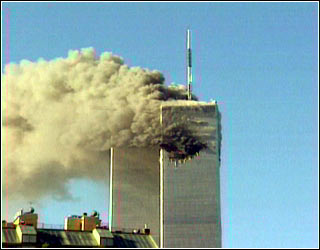
We believe in peace, but we are also historians, and we cannot ignore the fact that, historically, any country which has been attacked on its own soil and does not defend itself, will be invaded. Once invasion has taken place, occupation of at least some part of the country is inevitable. When a country becomes an occupied territory, war is entrenched, the country is weakened and becomes dependent upon the enemy occupation for food and other necessities of life. At this point, defeat is statistically unavoidable.