|
|
The Torre Attack {for Black} |
|
||
|
|
|
|
||
|
|
|
|
||
1. d4 d5 2. Nf3
Nf6 3. Bg5
The Torre attack
- an opening that has increased in popularrity enormously mainly due to the
efforts of Hodgson, Benjamin and others. White gets a positional sound opening
and avoids Queen's Gambit pet lines. White has an elastic pawn set-up, and he
may switch back into QG if he wishes. It is also difficult for Black to play a
sharp defence such as Grunfield or Modern Benoni etc. The White strategy is
fairly straightforward and leads to secure closed positions that many players
are comfortable with.
Black’s Choices
Black can play a
"defensive" defence to this - i.e a defence that is sound
defensively, though possible cramped and passive {cf French defence}. It may be
drawish to play this way and lead to positions that do not have active
counterplay or put pressure on the opponent. Such defences here are 3...e6,
3...c6.
Or Black may play an active defence. This
will be sharp, aggressive possibly double-edged and risky {cf King's Gambit Accepted}
with a high percentage chance of getting a result in the game. Here 3... Ne4,
3...c5 and 3... h6 are active.
Black may also play a positional defence.
Here the pieces are co-ordinated and combine well. The pawn structure is sound
with a decent influence in the centre. This often leads to profound middlegame
game positions where good strategic plans are required. Here 3...Bf5, 3... g6
and 3...Nbd7 can be considered to be positional attempts, though the first two
have limited success. The proof of the pudding is how these defences have done
in practice. This can be researched by examining the statistics in the CA
databases.
Having thus
established the most successful defences by playing
through the main lines and looking at the statistics the player should then
decide which of the successful defences most fits his style. Some which are
quite successful he may feel uncomfortable with, and so the final decision
should be the player deciding which kind of resulting position suits him best
in the statistically successful ones.
1st
Defence
3...e6 a passive
defence that has little to recommend it. 60% White in over 2000 games.
2nd Defence
3...
Ne4!? an aggressive and successful defence - 55% Black in 1190 games !
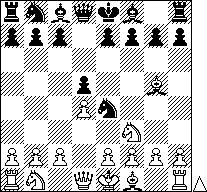
4. Bf4 c5 5. e3 (5. dc
Nc6 6. c3 Nxc5 7. Nd4 Qb6 8. Nb3 Nxb3 9. ab e5 10. Bd2 Be7 11. g3 Bc5 12. e3
O-O 13. b4 Be7 14. Bg2 Be6 15. O-O Qc7 16. Na3 Qd7 17. Be1 e4 18. Kh1 Ne5 19.
Qh5 ? Ng4 20. Bxe4 (20. h3 g6) 20...
g6 21. Qxg4 Bxg4 22. Bg2 h5 23. Rd1 Bxd1
0-1, Wijesuriya
Vincetha (SRI) - Levushkina E (UZB) 2280, Chennai (India) 2001) 5...
Qb6 6. Qc1 cd 7. ed Nc6 8. c3 Bf5 79% Black in 14 games.;
3rd
Defence
3... c6 a
passive defence that has scored poorly.
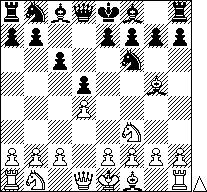
4. e3 is 60% White in 107
games;
4th
Defence
3... Bf5 This
seems a bright idea, but White has done well in this line.

4. c4 e6 5. Nc3 64% White in
236.;
5th
Defence
3... g6 This
calls White's bluff. The doubled pawns Black obtains are not much of a problem,
but Black's d-pawn comes under pressure with c4 and White may be better.
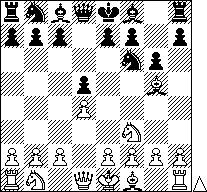
4. Bxf6 (4.
Nbd2 Bg7 5. e3 O-O 6. Bd3 c5 7. c3 Qb6 8. Rb1 Nc6 9. O-O Re8 10. b4 cb 11. cb
50% White 21 games.) 4... ef 5. e3 Bg7 6. c4 dc (6...
c6 7. Nc3 O-O 8. cd cd 9. Qb3 Nc6 10. Qxd5) 7. Bxc4 O-O 8.
Nc3 Nd7 9. O-O Nb6 10. Bb3 c6 11. Rc1 Qe7 is equal , but I don't particularly
like it.;
6th
Defence
3... c5 !? The
most aggressive defence. 60% Black in 91 games !!
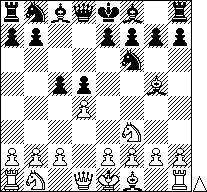
4. e3 (4.
Bxf6 gf 5. dc e5 6. b4 a5 7. c3 ab 8. cb Nc6 9. Qd2 b6; 4. dc
Nc6 5. a3 Ne4 6. Bf4 e6 7. b4 Qf6 0-1 Guest327- Peake ICC) 4... Qb6 5. Qc1 (5. Nc3
Qxb2 6. Nb5 Qb4 7. Qd2 Qxd2 8. Nxd2 Na6 9. dc Bd7 10. Bxf6 gf 11. Nb3 e6 12.
Nd6 Bxd6 13. cd Bc6 14. Bxa6 ba 15. Nc5 O-O-O 16. Nxa6 Kd7 17. Rb1 Kxd6) 5... Nc6 85%
Black in 10;
7th
Defence
3... Nbd7 This
avoids the doubled pawns, keeps transpositional possibilities to Cambridge
Springs, and also allows a fianchetto if Black wishes without doubled pawns,
and so is a good positional defence.
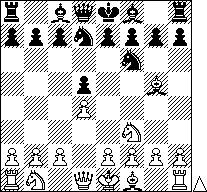
4. e3 g6 5. Nbd2 Bg7 6. Bd3
O-O 7. O-O c5 8. c3 b6 57% Black 154 games.;
8th
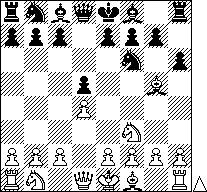
Defence
3... h6 This calls White's bluff , but loses a tempo. It is difficult to play the Black side with the lame pawn structure. I cannot recommend it. 58% White in 90 games.
Geoff
Peake’s HOME Chess web site
Click
http://www.geocities.com/rubberducker