King’s
Indian Saemisch E80
Panno
Variation
White Black
G.M.Peake - R. Van Kemenade (185 grade)
1:0
(Huddersfield v Bradford A
Woodhouse
Cup Bd 3)
17/ 2/2001
1. c4
g6 2. Nc3 Bg7 3. e4 d6 4. d4 Nf6 5. f3 Yup it's another King's Indian Samisch variation
- but which line will Black play ? Nc6
6.
Be3 e5 Normally Black will castle first, but this does not make any difference.
7.
Nge2 a6
[7... O-O would be the Traditional or Classical line as in Peake
Broadbent.]
8. Qd2 Rb8 So it's a Panno variation.
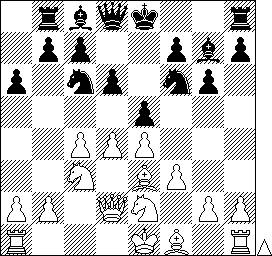
9. d5 Ne7 Novelty, Na5 is
more usual in the Panno variation - as in Peake - H. Carr.
[9... Nd4 10. Nxd4 ed 11. Bxd4 c5 12. Be3
O-O 13. a4 Nh5 14. Bg5 Qa5 15. Be7 Be5 16. Bxf8 Kxf8 17. g3 f5 18. f4 Bd4 19.
Be2 Nf6 20. e5 de 21. fe Bxe5 22. O-O Qc7 23. Kg2 Kg7 24. Bd3 h5 25. Rae1 h4
26. Ne2 b5 27. ab ab 28. b3 bc 29. bc Rb2 30. Qg5 Qd7 31. Bxf5 Qxf5 32. Rxf5
Bxf5 33. gh Rc2 34. Kg1 Rxc4 35. Ng3 Rg4 36. Rxe5
1-0,
Levtchouk George (CAN) 2345 - Benoit Alain, Quebec (Canada) 1985;
9...
Na5 10. Ng3 c5 11. dc (11. Bh6 O-O 12. h4 Bd7 13. h5 b5 14. cb ab 15. b3 Ra8 16. Rc1 Qb6
17. Bxg7 Kxg7 18. Bxb5 Bxb5 19. Qg5 Qd8 20. Nxb5 Kh8 21. hg fg 22. Qe3 Nb7 23.
Nc3 Qe7 24. Rb1 Rfc8 25. Rb2 Nd8 26. Qh6 Nf7 27. Qxg6 Rg8 28. Nf5 Qd8 29. Qxf7
Rf8 30. Qg7#
1-0,
Spickenbaum Edgar - Wagner Ole, NRW 1997 VL 1997/98 (play-off) ) 11... bc 12. b3 Be6 13. Rd1 Nb7 14. Bd3
O-O 15. O-O Qe7 16. Bh6 Bxh6 17. Qxh6 Nc5 18. Be2 Kh8 19. Qd2 Rfd8 20. f4 Ng8
21. f5 Bc8 22. Rf3 a5 23. Rdf1 f6 24. h4 a4 25. ba Nxa4 26. Nxa4 Qa7 27. Kh2
Qxa4 28. fg hg 29. Rxf6
1-0,
Seeck Klaus (GER) 2260 - Sahlender Frank (GER) 2305, Germany 1992]
10. Bh6 O-O
11. Ng3 Discourages b5 and
prepares h4 to h5 attack. c5 This looks dubious and slow to me . Black allows
the Queen to come to the Q-side, but White's attack must be quicker.
[11... Ne8!? 12. Bxg7 Nxg7 13. Bd3 f5
+0.28 Tiger 15.0;
11...
Re8 12. h4 Bh8 13. h5 c5 14. Bg5 Nd7 15. hg fg 16. Bd3 Nf8 17.
O-O-O Bd7 18. Nf1 b5 19. Ne3 Qc7 20. g4 Nc8 21. Rdg1 Nb6 22. Qh2 bc 23. Bc2 Bb5
24. Nf5 Bg7 25. Nxg7 Qxg7 26. f4 ef 27. Bxf4 Nc8 28. Bh6 Qe7 29. Rf1 Nb6 30. e5
de 31. d6 Qd7 32. Ne4 Re6 33. Nxc5 Qa7 34. Bxf8 Rxf8 35. Nxe6 Rf7 36. Qxh7
1-0,
Atia J A (IRQ) 2175 - Elarefi Jamal (LBA), Elista (Russia) 1998]
12. h4!? White does not
need to castle yet and hurries on with the attack. Kh8 A good defensive move,
but Black does not follow it up properly.
[12... Bxh6 13. Qxh6 Kh8 14. h5 Neg8 is
probably best.]
13. h5 Neg8? Better is Bxh6
and Ng8
14. Bg5 ! This keeps the
screws on. h6
15. hg ! White has the
advantage. fg
16. O-O-O Now White needs
the rooks connected. Qe8
17. Bd3 Now the Rooks are
connected. This Bishop is often in the way in the Samisch variation. In most
cases its best position is on d3.
Nh7
18. Be3 Rf4?! A rather
desperate exchange sacrifice. To be honest I only looked at taking the Rook for
a few seconds. Why activate Black's K-Bishop against the White King ? White
carries on with his attack instead.
19. Nce2
[19. Bxf4 ef 20. Qxf4 Be5 unclear]
19... g5
20. Nh5 White will remove
the Black squared Bishop to weaken Black's K-side.
[20. Bxf4 ef 21. Nh5 Be5 unclear]
20... b5?!
+3.50 Tiger 15.0
[20... Rf7!? 21. Nxg7 Kxg7 22. Rh2 b5
+1.70 Tiger 15.0]
21. Rdf1 ! Now White is ready
to open up Black K-side like a can opener with g3! bc
22. Bxc4 Rf7 An ignominious
retreat - but Black may be able to double Rooks on the Q-side - but he has lost
time - and he is dreaming as White can easily block the Black attack.
23. Nxg7 Kxg7
24. g3! The can opener has
arrived. Nhf6
25. Nc3 The e4 pawn needs
to be defended before the f4 break. Rfb7?!
+1.06 Tiger 15.0
[25... a5!? 26. b3 Bd7 27. Qc2 Rf8
+0.75 Tiger 15.0]
26. b3 Now all White's
pieces are ideally placed !
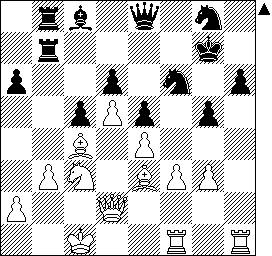
Nh5?! Black has run out of
ideas. I asked him after the game if had seen the Bishop sacrifice. He shrugged
his shoulders "What else had I got?" he said.
[26... a5 27. f4±]
27. Bxg5 ! This sacrifice
destroys Black's position. Nxg3
[27... hg 28. Qxg5 Qg6 29. Rxh5 (29. Qxh5 Qxh5 30. Rxh5 Nf6 31. Rg5 Kf8 32.
Rh1 Rg7 33. Rxg7 Kxg7 34. Kd2 Bb7
+2.56|d14)
29... Nf6 30. Qxg6 Kxg6 31. Rh8 Rh7 32. Rh1
Rxh1 33. Rxh1
+2.32|d9]
28. Bxh6 Black is
completely lost. Kh8
[28... Nxh6 29. Rxh6 Qd8 (29... Kf8 30. Rg1 Rg7 31. Rh8 Ke7 32. Rxe8
Kxe8 33. Qh2 Nf5 34. ef Rxg1 35. Qxg1 Kf8
+10.10|d14;
29... Nxf1 30. Qg5 Kf8 31. Qf6 Qf7 32. Rh8#; 29... Qg8 30. Qg5 Kf8 31. Qd8 Kf7 32. Qf6
Ke8 33. Rh8) 30.
Rg1 Kg8 31. Rxg3 Rg7 32. Qh2 Qe7 33. Rh8 Kf7
+6.16|d10]
29. Qg5 Nxh1
[29... Nh5 30. Rxh5 Qxh5 31. Qxh5 Rh7 32. Rg1
Bg4 33. Qxg4 Nxh6 34. Qg6 Rb6
+11.90|d9
(34... Ng8 35. Qxd6 Re8
+13.82|d14)]
30. Rxh1 Nxh6
[30... Bh3 31. Rxh3 Qh5 32. Rxh5 Nxh6 33.
Rxh6 Rh7 34. Qf6 Kg8 35. Rg6 Rg7 36. Rxg7
31. Qxh6 Kg8
32. Rg1 Kf7
33. Qg7#
[1:0]
Geoff
Peake’s HOME Chess web site
Click
http://www.geocities.com/rubberducker
For more immortal games go to
http://www.geocities.com/rubberducker/Immortal