Lundin (Kevitz-Mikenas)
/ Nimzowitsch defence
A40 (by transposition)
Peake GM v Kev-Blitz Match
Game 14
White Black
Kev-Blitz - GMP
0:1 (ICC 6 18 u) 19/ 7/2003
1. d4 d6
I sometimes play this move order d6 before Nc6 - it has more flexibility
against weird continuations.
2. c4 Nc6
This is my "positional" defence against 1.d4 in true Nimzowitsch style. My other defences
are the ultra-tactical Benoni, which can be a fearsome weapon, and the
technically solid 1. ...d5 defence 3.
d5 Nb8
Though White has gained time, he has done irreparable "damage"
to his PAWN STRUCTURE. He has weak black squares at e5, c5 , (and even e3, b2,
c3, d4 which can be exploited by a Queen at b6). Black can chip away at the
pawn centre with c6 and f5 (after e5 which is a key move). Black will
fianchetto his King bishop to exploit the weak black squares on the h8 a1
diagonal, as in the Modern Benoni. Note that Black has no damage to his pawn
structure, and retains flexibility in his PAWN STRUCTURE. The loss of time is
relatively unimportant in such a closed position. Note that computers always
evaluate such positions as slightly in White's favour. This is because of his
space advantage. But don't be fooled by this. Black has free play for all his
minor pieces and his position is very resourceful. Another advantage of the
Lundin (Kevitz-Mikenas) as ICC calls it or Nimzowitsch defence, as I call it,
is that it can be played against e4 or d4 - in fact any opening move.
4. Nc3 e5 A key move. Black stakes a traditional strong point in the
centre. Other ways are g6 and c6 etc.
5. e4
[5. dxe6 would
produce a more open game, with a wide variety of unexplored pawn structures
e.g. Bxe6 (5... fxe6 6. e4
c6 7. e5 d5 is possible) 6. Qb3 Qc8 7. e4 Nd7 8. Be3 Nc5 9. Qc2 a5 10. f3
Qd8 ]
5... g6
6. Bd3 Bg7 The
position is very much a King's Indian type, which produces profound middle
games, but here White has closed the centre early and so Black has a clear idea
immediately on how he should develop his position.
7. Nge2 ! Best as
this prevents f5, as White can play exf5 and Ng3, threatening both f5 and Qh5
check. ...Nf6
[7... f5 ? 8. exf5 Bxf5
(8... gxf5 9. Ng3 e4 10. Qh5 Kf8
11. Be2±)
9.
Bxf5 gxf5 10. Ng3 f4
(10... Ne7 11. Nxf5 Nxf5 12. Qh5)
11. Nf5 Qd7 12. Qh5 Kf8 13.
Nxg7 Qxg7 14. Qf5 Nf6 15. Qc8 Ne8 16. Qxb7]
8. f4 ? White goes
astray. A dubious move as White creates for Black a strongpoint for his pieces
at e5; the bishop's power on the diagonal is increased; Black has the e-file
for his rooks; White has a backward pawn at e4.
White's
compensation is an open f-file and d4 for a Knight (unless Black achieves c5).
Note that Ne2 does not fit in well with f4. The Knight should normally be on f3
behind the f-pawn. Bd3 is not great either as Ne5/c5 will attack the bishop, so
Be2 is better with the f4 move. f4 is normally played to enable e5 (as in
Sicilian), or to open f-file as in King's Gambit. In the King's Gambit,
however, White's d pawn is still on d2 so that he can play d4 and stop Black
using the e5 square. So f4 does not fit in well with a pawn on d5 either.
Now exf4 may be
most accurate as Black avoids f5 lines.
[8. f3 was the move I expected,
as I thought he would play it in Samisch attack style. Na6
9. O-O O-O
10. Be3 Nc5 11. Bc2 a5 12. a3 Nfd7 13. b4 Na6 14. Rb1 f5 with a
storm brewing up.]
8... Nbd7
[8... exf4!? 9.
Bxf4 O-O 10. O-O Nbd7 11. Bc2 Re8 I like Black.]
9. O-O O-O
[9... exf4 10.
Bxf4 O-O 11. Bc2 Nh5 12. Be3 Ne5]
10. fxe5 ? Now he
has a permanent hole at e5.
[10. f5! c6 with an unclear position.]
10... Nxe5 11. Bf4
[11. Bg5 h6 12.
Bh4 c6 13. dxc6 bxc6 14. Qd2 g5 15. Bg3 Nfg4
=+]
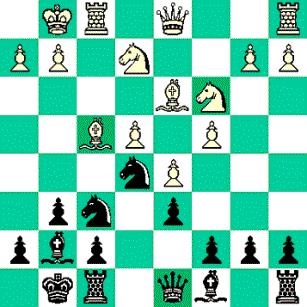
11... Nfg4 ! Now
Black ensures control of e5.
12. h3 Nxd3
13. Qxd3 Ne5
14. Qd2 ?
[14. Bxe5 looks positional
death on the black squares for White, but had to be played to avoid the loss of
the c pawn. Bxe5 15. Nd4 c5 16. dxc6 bxc6³]
14... Nxc4
15. Qc1 c6 !
This allows the
Black Queen to also use the black squares.
16. b3
[16. dxc6 bxc6 Black is much better because of the e5 hole, two bishops, better
centre etc.]
16... Ne5 Black's
knight is a monster and he has no weaknesses.
17. Bh6
[17. Qd2 c5³ taking away d4 from White's knights and creating a 3 to 2 pawn
majority on the q-side. ]
17... Qb6 What did I tell you about the black squares
?
18. Kh2
[18. Kh1 may be better. c5 19. Bxg7 Kxg7³;
18. Be3 c5 19. Bh6 c4³]
18... Bxh6
19. Qxh6 Bg4
a showy move - but it does have its point as
will soon be seen.
20. Rf4 ? Probably a losing move, but White
does get attacking chances if followed up properly.
[20. Ng3 ! looks best. Qd4 with only a slight advantage for Black as it will take time to
mobilise his rooks.]
20... Qe3 ! This
move totally cripples White on the black squares.
21. Re1 ? This
loses quickly.
[21. Raf1 ! Sacking the knight
had to be played - the point is that White can get his rook on h4 if Black eats
the knight. For example Bxe2 ? (21... Bh5 ! is
the correct move to win. 22. dxc6 (22. g4 Bxg4°) 22... bxc6 23. Ng3
(23. g4 Bxg4 24. Ng3 Nd3°)
23... Qxc3 24. Nxh5 gxh5 25. Qxh5 Ng6°)
22.
Nxe2 Qxe2 ?
(22... cxd5 23. exd5 Nd3 24. R1f3
Qxe2 25. Rh4 Qe5 26. Kg1 Qg7 27. Qxg7 Kxg7 28. Rxd3 f5µ)
23.
Rh4 Rfc8
(23... Rfe8 24. Qxh7 Kf8 25. Rxf7
Nxf7 26. Rf4 Re7 27. Qh8#)
24.
Qxh7 Kf8 25. Rhf4 and White would win !]
21... Nf3
22. Kh1
[22. gxf3 Qf2 23. Kh1 Qxe1 24. Kg2 Bh5°]
22... Nxe1
(evaluation -4.96 )
23. hxg4 Nd3
0-1
Geoff Peake’s HOME Chess web site
Click
http://www.geocities.com/rubberducker
For more games in the match click
http://www.geocities.com/rubberducker/Peake-Kev-Match.html