1. g3 Opening
This is NOT a comprehensive analysis of
this opening. Nevertheless I believe there is enough here to get a strong
feeling for how to play these excellent Black systems.
1. g3
A favourite of
Tomasz Markowski. One of a family of openings that can easily transpose into each
other - 1. c4 English, 1. Nf3 Reti, 1.b3 or Nf3 first Nimzowitsch-Larsen
attack, 1. e3 Van't Kruijs opening, Catalan opening, King's Indian Attack. The
game can also transpose into the Sicilian Closed variation. Its main drawback
is that White is committed to the
fianchetto and therefore lacks flexibility of other King bishop developments, and that it does not
stake a pawn in the centre and
therefore central action is slower than
normal. 1... c5
I believe that this
is the best reply. 1...e5 runs into 2. c4 which is an Accelerated Dragon
reversed, which I would not want to play against. Against 1....d5 Reti, KIA,
Nimzo-Larsen and Catalan are effective for White. 2. Bg2 g6 This is an excellent development, but Black
should not be in a rush to play Nc6 as White can often play c3 or e3 and d4.
This will produce a threat of d5 against the Knight on c6. Also Black should
not play an early Nf6 as the Knight is nearly always much better on e7 in this
line.
3. Nf3 This
position, of course, will arrive from the Reti and the KIA. I do not believe
that it is very effective for White here as the Knight is often better on e2.
[3.
c4 ! This is more effective than Nf3 as White can play e3 and Nge2 leading to
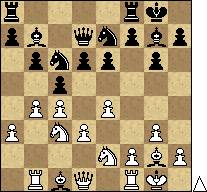
more possibilities than Nf3. Bg7 4. Nc3 Nc6 Now White can go for e4 (Botvinnik
Blockade Reversed !!) or e3. 5. e3 (5. e4 d6 6. Nge2
e6 7. O-O Nge7 8. d3 O-O 9. a3 (9. Be3 White
dreams of playing d4 Nd4 57% Black in 151 games) 9...
b6 10. Rb1 Bb7 11. b4 Qd7 56% in 88
games. Remember this a class Black set-up !
) 5...
e5 6. Nge2 Nge7 7. O-O (7. b3 delaying castling may be more effective. d6 8.
Bb2 Be6 9. Nd5 O-O 10. d3 Qd7 11. h4 (11.
h3 is the main alternative. Rab8 12. Qd2
(12. Nec3 a6 13. Qd2 =)
12... a6 =) 11...
f5 (11... h5 12. Qd2 Rab8 13.
Nec3 a6 14. O-O-O b5 15. f4 Bg4 16. Rdf1 Nxd5 17. Nxd5 Ne7 18. fe Nxd5 19. Bxd5
de 20. Rf2 Be6 21. e4 Bxd5 22. ed a5 23. Qxa5 Ra8 24. Qxb5 Qg4 25. Kb1 Qxg3 26.
Rd2 Bh6 27. Rdd1 Be3 28. Qd7 Qf2 29. Rhf1 Qg2 30. a3 Rab8 31. Qa4 Ra8 32. Qd7
1/2-1/2,
Larsen Bent (DEN) 2660 - Hecht Hans-Joachim (GER), Buesum (Germany) 1969) 12. Qd2 Bf7 13. h5 gh 14. f4 Nxd5 15. cd
Ne7 16. e4 Bg6 17. fe de 18. Qe3 Rac8 19. Bh3 Qd6 20. O-O Kh8 21. Kh2 Rf7 22.
Ng1 h4 23. gh Nxd5 24. Qe2 Nf4 25. Rxf4 ef 26. e5 Qc7 27. Re1 Re7 28. h5 Be8
29. Bxf5 Rd8 30. Nh3 f3 31. Qxf3 Bc6 32. Qf4 h6 33. Qg4 Rd4 34. Bxd4 cd 35. Nf4
Bxe5 36. Kh3 Bxf4 37. Rxe7 Qxe7 38. Qxf4 Qe3 39. Qxe3 de 40. Kg3 Kg7 41. Bg4
Kf6 42. Kf4 Be8 43. b4 b6 44. Be2 a5 45. ba ba 46. d4 Bf7 47. a3 Ke6 48. Kxe3
Kd6 49. Ke4 Be6 50. Bd1 Bd7 51. Bf3 Be6 52. Kf4 Bd7 53. Be4 Be8 54. Bg6 Bd7 55.
Bf7 Ke7 56. Bd5 Kd6 57. Bf3 Be6
1/2-1/2,
Bischoff Klaus (GER) 2535 - Malisauskas Vidmantas (LTU) 2515, Calcutta (India)
1997) O-O
8. a3 This is a much more enterprising system than the Nf3 lines.
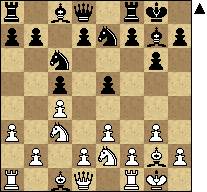
8... d6 9. Rb1 a5 10. d3 b6
11. Ne4 f5 with good play.]
3... Bg7 4. O-O
[4.
d4 If White wants to play d4 he had better play it now as Black will soon get a
clamp on the d4 square. cxd4 5. Nxd4 Nc6 There is no
pressure on the Black position, Black has good play. 53% Black 282 games
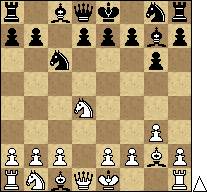
(5... d5 6. O-O e5 7. Nb5 a6 8. N5c3
d4 is an alternative, but Black may be overstretched);
4. c4 Nc6 5. e3 e5 6.
Nc3 Nge7 81% in 8 !]
4... Nc6 Now White has to make his mind up.
If he continues c4 the game will take on an English character. If he plays e4
the game will be akin to a Closed Sicilian, d3 is mainline KIA. 5. c4 This can arise from the Symmetrical English opening, where
White has neglected to take action in the centre with d4.
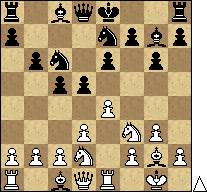
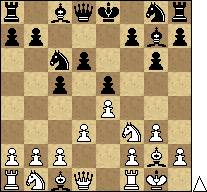
[5.
d3 King's Indian Attack d6 (5... d5 Black can
also take the centre if he wishes. 6. Nbd2 (6. e4
Nf6!) 6... e6 7. e4 Nge7 8. Re1 b6 is an excellent alternative
- >54% in 546 games
) 6.
e4 e5 Black is solid 58% in 623 games.
As can be seen the difference is that the Black Knight going to e7 gives better
possibilities than the White Knight slightly misplaced on f3.
;
5. e4 e5 6. c3 White
dreams of playing d4. Nge7 7. d3 O-O 8. a4 h6 9. Na3 d5 But Black makes the
break. 10. exd5 Nxd5 11. Re1 Re8 12. Nd2 Be6 13. Ndc4 Qd7 14. a5 Rad8 15. Qa4
a6 16. Be3 Bf8 17. Rad1 f5 18. Bc1 Bf7 19. Nb6 Nxb6 20. axb6 Bd5 21. Bxd5 Qxd5
22. Qc4 Na5 23. Qa4 Nc6 24. Qc4 Kg7 25. Qh4 Kh7 26. Nc4 Bg7 27. g4 f4 28. Qh3
e4 29. Bxf4 exd3 30. Ne3 Qf7 31. Bc7 Rd7 32. Rf1 c4 33. Qg3 Bf8 34. Qf4 Qxf4
35. Bxf4 Bc5 36. Rfe1 Re4 37. Bc7 Rde7 38. b3 Bxe3 39. Rxe3 Rxg4 40. Bg3 Rxe3 41.
fxe3 cxb3 42. Rb1 Ra4 43. Kf2 Na5 44. e4 Rxe4 45. Kf3 Re6 0-1,
Maherramzade Javad - Kotsur Pavel 2581 , Abudhabi 2003 It (open) ;
5. c3 e5 6. d3 Nge7 54%
in 88 games.]
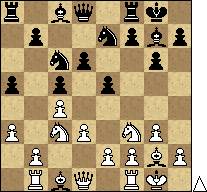
5... e5 ! This is called the Botvinnik Blockade
System. Black gets a hold on d4, and
can attack on either wing ! 55% in 364 games ! 6. Nc3 Nge7 All Black's
pieces are harmoniously developed. 7.
a3 O-O 8. d3 d6 9. Rb1 a5 Black will play moves like h6, Be6 f5 ! with
excellent prospects - 57% in 378 games.
Geoff
Peake’s HOME Chess web site
Click
http://www.geocities.com/rubberducker