 |
| Sweden |
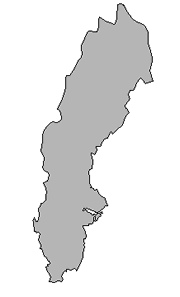
| Sweden is a diverse country that once ruled much of Europe. Today it is a beautiful part of Scandinavia.
I will spend 1 day in Malm�, 1 day in Gothenburg, 1 day in Kalmar, 1 day in Visby, 1 day in �rebro, 3 days in Stockholm, 1 day in Uppsala, 1 day in G�vle, and 1 day in Jokkmokk. With a buffer this is 13 days. It is an expensive area so I will have to move fast. |
| Malm�
Malm� was founded in the thirteenth century as a ferry town. During the Middle Ages German settlers came to the area. Around the year 1290 construction on St. Petri church began. It was the first gothic church to be built in Sweden�s present day borders. As the town grew it became a center for industry. Eventually it became a leading town in the Hanseatic League. In the 1530�s Malm� was part of Denmark. This is also where the reformation in Scandinavia began. It wasn�t until 1658 that the town became part of Sweden. Soon after this its importance declined because many of the cities trading privileges were taken away. Malm� remained a poor city until the 19th century when the railway arrived. Today it has several well persevered medieval buildings, that is the reason for coming here. Things to Do: Malm�hus Castle- Take a tour of the royal compartments. Stadsmuseum- This museum has a history of the city. St. Petri Church- This was the first gothic church built in Sweden. Gothenburg During the middle ages the town of L�d�se was located just north of present day Gothenburg. It was a center for trade. Eventually the town moved closer to the sea. However, the name Gothenburg was not yet in use. In 1621 the town was officially founded by King Gustavus Adolphus. The surrounding Danish lands fell to the Swedish in 1658. This allowed the town to grow. Due to the Swedish East India Company in the 18th century Gothenburg became the largest trading company in Sweden. Production continued into the twentieth century and during WWII Gothenburg provided arms for the war. Today it is a bustling metropolis with a fascinating history. Things to Do: Stadsmuseum- This museum has Sweden�s only Viking ship. Konstmuseet- This museum has an impressive collection of Nordic and European masters. �lvsborgs Nya F�stning- This fortress is located on an island and was built in the 1660�s. It was used to defend the city from foreign invaders. At one point it was also used as a prison. You must take a ferry to get here. Kalmar This area has been inhabited since the Stone Age. The earliest town was in the eleventh century. Then during the thirteenth century it grew into a wealthy city. In the 1440�s Kalmar was rebuilt in the renaissance style. Sweden annexed the city in 1658. Today it is a university town. Things to Do: Kalmar Slott- Be sure to see the paneled King Erik chamber. There is also a section on how women were punished for various crimes. Kalmar I�nsmuseum- Be sure to check out the old steam mill here. Domkrykon- This 17th century cathedral is the only one in Sweden without a Bishop. It brings visitors back to the time where Sweden was a world power. Visby Visby was a mercantile center by 900 A.D. During the twelfth century the cathedral was constructed. Due to the Hanseatic League the town flourished. In 1361 the area was conquered by Vladimir IV of Denmark. During the fifteenth century the city was overrun with pirates. This halted commerce and lead to the Hanseatic League renouncing their inclusion in 1470. Then in 1525 the Germans burnt down the city. In 1645 the Swedish recaptured it. All of this turmoil caused the town to develop slowly. Things to Do: Medieval Churches- The ruins of ten medieval churches can be found within the city walls. Gotlands Fornsal- This is one of the best regional museums in Sweden. Check out the relics found in tombs. Bro Church- This might be a bit of a hike outside of the city. Notice the fifth century picture stones and interior lime paintings. �rebro During the Middle Ages �rebro was a center of commerce. The castle was built in the 1560�s. Then in 1810 Bernadotte was elected King of Sweden in the town. He was also known as Charles XIV. At the end of the nineteenth century it became a center of shoe manufacturing. Today it is one of the largest cities in Sweden. Things to Do: Slottet- This is perhaps the most photographed castle in Sweden. It is possible to tour the inside. Kanstmuseet- Local art museum. Wadk�ping- This museum village has a working bakery and is not to be missed. Stockholm Stockholm was first mentioned in writing in the year 1252. At that point it was already an important trading center. By 1289 it was described as the most populated city in the Swedish region. In 1471 under Sten Sture the people of Stockholm gained independence from Denmark. Due to this the city grew dramatically in the 16th and 17th centuries. During the seventeenth century it became a European power. In 1634 Stockholm became the capital of Sweden. The city had a monopoly on Scandinavian trade and soon became wealthy. In 1713 the Black Death invaded the city soon followed by the Great Northern War in 1721. Economic growth halted. Despite this Stockholm still remained the political center of Sweden. During the 19th century the few industries in Stockholm moved to other cities. Towards the end of the century Stockholm built up a presence in the service industry and became the gateway to Sweden. Soon the city began to grow. During the 20th century it became known for its technology and cultural diversity. Things to Do: Royal Palace- This is the largest royal palace in the world. The state apartments are the most interesting part on the tour. There are also museums with the crown jewels and a basement exhibit about the medieval palace that burned down. Riddanholmskyrkan- This is the royal necropolis. Check out the sarcophagus of Gustav II, Sweden�s mightiest monarch. Jewish Museum- This is about Stockholm�s Jewish community. Boat Tour of the Archipelago- Pretty self explanatory. Day Trip: Sigtuna- Sweden�s oldest town. Uppsala Since the fifth century Uppsala has been an important religious and political center. There was a Viking settlement here. After Christianization it became the seat of the Archbishop of Sweden. In 1477 the university was founded, it is the oldest in Northern Europe. During the 16th and 17th centuries it grew in importance. Carl van Linne, inventor of the classification and nomenclature of flora and fauna, lived here. In 1602 there was a fire that destroyed much of the town. A new street plan was drawn up and most of the medieval city was lost. During WWII Sweden was neutral, therefore it was not affected by German or Allied bombs. Today Uppsala is a mix of old and new architecture. Things to Do: Gamla Uppsala- This city began here at three great grave mounds. A close by museum exhibits artifacts found in the area. Uppsala Slott- This is where the kings and queens lived. Be sure to check out the dungeons and the art museum. Cathedral- This structure dominates the skyline. Many important Swedes have been buried here. Gustavianum Museum- This museum has a nice antiques collection and features an anatomical theatre. G�rle G�rle was a small settlement until the 1700�s when a town was built. In 1776 a fire devastated the small town; it was rebuilt on a rectangular plan. Today it is very much an urban area. Things to Do: Gamla Gefle- This area shows what the town looked like before it was destroyed by a fire. L�nsmuseum- This small museum has an excellent art collection and some interesting historical exhibits. Jokkmokk The point of going here is to learn about the indigenous Sammi people. The town is also located just north of the Artic Circle. Things to Do: Ajtte- This museum gives the most thorough introduction to the Sammi culture as possible. There is also a lot of information on the surrounding area. Wooden Church- This is simple but worth a look. Hamestead Museum- Couldn�t find anything on this, just that it exists. |
 |
|
|
|
|
|
|
|