 |
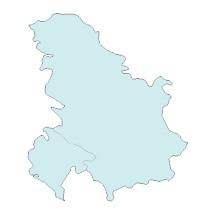
| Serbia and Montenegro |
| Serbia and Montenegro is another one of those small former Eastern Bloc countries that has a scared history. However, by the time I get there they might be two seperate countries. Still these cities and the people who live in them have overcome their hardships. This is part of what makes this area so fascinating.
I will spend 2 days in Novi Sad, 2 days in Belgrade, 3 days in Budva, and 1 day in Nis. With a buffer this equals 10 days in Serbia Montenegro. |
| Novi Sad
The Celts founded a fortress in this area. It was then extended by the Romans. They called in Cusum. In the fifth century Cusum was decimated by the Huns. The Byzantines reconstructed the city. Over the next centuries Novi Sad was conquered by the Ostrogoths, Gepids, Avars, Franks, Bulgarians, and then again by the Byzantines. This was followed by the Kingdom of Hungary in the twelfth century, the Ottoman�s in 1526, and then by the Habsburg Monarchy in 1687. Then in 1748 it was made into a Royal Free City. For much of the 18th and 19th century Novi Sad was mostly populated by ethnic Serbs. During the Revolution of 1848 to 1849 the city became part of Serbian Vojvodina, an autonomous region within the Habsburg Empire. After WWII Serbian troops entered the city and soon the Kingdom of Serbia was proclaimed. Soon that became part of Yugoslavia. In 1941 the Nazi�s invaded, they killed many of the citizens and then threw the corpses into the icy Danube. After the war Novi Sad once again became part of Yugoslavia. Then after 1992 Novi Sad became part of the Federal Republic of Yugoslavia, in 2003 this was transformed to the State Union of Serbia and Montenegro. Things to Do: Petrovordin Fortress- This is located on the ruins of a Roman fort. Novi Sad City Museum- This museum has artwork from the 18th to 20th centuries. There is also access to the underground military galleries. Vojvodina Museum- This museum has exhibits on archaeology, history and ethnology. Galerije Matice Srpska- This museum features Serbian art from the tenth to twentieth centuries. Belgrade During the middle ages this area suffered through occupation by a series of invaders. These included the Huns, Sarmatians, Ostrogoths, and the Avars. These were all before the Slavs arrived around 630. In 878 the town was named Beligrad, or white fortress. It was under the rule of the first Bulgarian Empire. For almost 400 years the city remained a subject of warfare between Byzantium, the First Bulgarian Empire and Royal Hungary. This ended in the 13th century when Belgrade passed to the Kingdom of Serbia. Despite most of the area falling to the Ottomans Belgrade remained under Serbian control and flourished. However they were not able to hold the city forever and in 1521 the Turks captured the city. Belgrade remained under Ottoman control for three centuries. The city began to decline. The Turks left in 1867 and soon the Kingdom of Serbia was created. After WWI Belgrade began to grow into a larger more industrialized city. During the 1920�s and 1930�s Belgrade was the capital of Yugoslavia. Then during WWII the city was occupied by the Nazi army. It was liberated by the Red Army and once again became part of Yugoslavia. Just like after WWI, Belgrade expireanced a new boom in growth. In 1991 massive demonstrations were held against the leader Slobodan Milosevic. This lead to the eventual break up of Yugoslavia. Things to Do: Kalemegdan- This lush park over looks the Danube and the Sava rivers. The port is centered on Belgrade fortress. The upper part has several monuments and a military museum. The Church of St. Bogorodica- This church has some relics of St. Andrew. Be sure to check out the worn frescos. War Museum- This museum covers the invasions by the Romans, Celts, Turks, Austro-Hungarians, the Russians and the Germans. Ethnographic Museum- This museum explains the cultural differences between various Balkan societies. Princess Ljubica�s Museum- The most interesting part is the Bosnian decoration. Budva Budva is one of the oldest urban settlements of the Adriatic Coast. In the middle ages the area was reigned by the Doclean kings, Serbian and Zetan aristocrats, and the Venetians. Eventually it fell under rule by the Habsburgs. In 1918 when that empire collapsed it became part of Yugoslavia. WWII claimed many lives from the surrounding areas. Today the town has been restored. Things to Do: Citadel Museum- This museum offers the best views of the old town. Day Trips Cetinje State Museum- This is a fascinating collection of objects from around the world. History and Art Museum- This museum concentrates on the former Yugoslavia. Kotar Cathedral of St. Triphon- This was built in 1106. It has been recently restored and is worth some time. Nis Nis began as a Greek colony founded in antiquity. The Romans later used the settlement as a base for operations. In 443 Attila the Hun destroyed the town. The seventh century saw a major migration of Slavs and Avars into the area. Then in the ninth century the Bulgarians conquered the city, this was followed by the Hungarians in the eleventh century. The Ottoman�s captured Nis in 1375 from the Serbians. The Turks ruled on and off for the next 300 years. Over the next several centuries Nis passed between many different hands. At the beginning of the 19th century Nis was once again controlled by the Turks. This was ended by a great battle in 1809; afterwards Nis became part of Yugoslavia. During WWII there was a concentration camp near Nis. In 1996 Nis was the first city in Serbia to stand against Slobodan Milosevic. Today Nis is a university town. Things to Do: Crveni Krst- The Nazi�s imprisoned about 30,000 people here. The Bubanj monument is for all those who died. Tower of Skulls- The Turks adorned a wall with the skulls of Serbian rebels. Fortress- This was built by the Turks, there are several interesting artifacts here. Town Museum- This has a good history of the town. |
 |
|
|