 |
| Slovenia |
| Slovenia is much like other countries in the area, it has seen much violence and overcome great amounts of adversity. This is part of what makes it an interesting area of the world to explore.
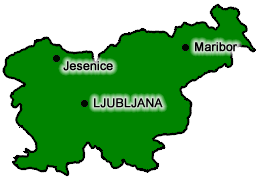
I will spend 1 day in Bled, 3 days in Ljubljana, and 2 days in Maribor. With a buffer this makes for 8 days in Slovenia. |
| Bled
Bled was first mentioned in 1004 when it was given to the Bishop of Brixen by German Emperor Henry II. It is famous for its glacial Lake Bled. Today it is a tourist center that offers a wide range of sporting events. Things to Do: Church of the Assumption- This is on Slovenia�s only island. Bled Castle- Be sure to enjoy the hike. There is also a small history museum here. Ljubljana This city began as a Roman settlement called Emona. The first mentions of the town under is modern name appeared in 1144. In 1335 it came under Habsburg rule. Over the next centuries it developed into a Slovenian cultural center. With the collapse of the Austro-Hungarian Empire in 1918 Ljubljana became part of the Kingdom of Yugoslavia. Then in 1941 during WWII it was captured by Italy. After WWII it became the Yugoslav Republic of Slovenia. In 1991 Ljubljana became the capital of Slovenia. Things to Do: Ljubljana Castle- At one time this castle even served as a prison. The virtual museum highlights the museums past. St. Nicholas� Cathedral- This is just amazing. Every centimeter contains something marvelous. National Museum - This is the countries oldest museum. It documents the city�s past. National Gallery- This museum has works from both Slovenian and European artists. Day Trip Postojna Caves and Predjama Castle- Be sure to bring a jacket for the caves. The castle is carved into the side of a rock. It is a maze of rooms. Maribor In 1164 a castle known as the Marchburch was built here. A market town grew around it. In the 16th century Maribor withstood sieges by the Ottoman Empire. The city remained under control of the Habsburgs for centuries. After the collapse of the Austro-Hungarian Empire the town was claimed by the Slovenes, Croats, Serbs, and the first Austrian Republic. In the end it became part of Yugoslavia. In 1941 the area was annexed by Nazi Germany. After liberation the city capitalized on its close proximity with Austria and developed into the industrial and cultural center of Eastern Slovenia. In 1991 Slovakia seceded from Yugoslavia. Today business is still lagging, but it is a wonderful city full of history to visit. Things to Do: Synagogue- This is one of the oldest in Europe, dating back to the 14th century. Maribor National Liberation Museum- This museum commemorates the city�s struggle against Nazi occupation in WWII. Day Trip Ptuj- Check out the castle here. The art collection is impressive. There is also a Dominican monastery. |
 |
|