 |
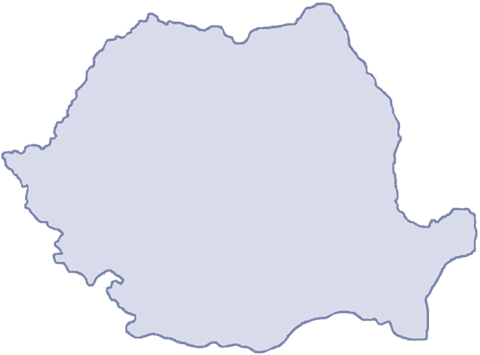
| Romania |
| Romania has not been its own country for very long. Despite this it retains a sense of unified culture and nationalism. Plus, Dracula was there.
I will spend 1 day in Suceava, 1 day in Gura Humorului, 1 day in Constanta, 2 days in Bucharest, 2 days in Brasov, 1 day in Sinaia, 1 day in Cluj, and 2 days in Sighet. With a buffer this equals 13 days in Romania. |
| Suceava
The name Suceava means the town of the skin workers. Suceava was the first capital of the state of Moldavia. From 1775 to 1918 it was under control of the Habsburg Monarchy. At then end of WWI it became part of Romania. Recently the city has evolved rapidly, although it is still a bit dreary. Things to Do: Citadel of the Throne- This was built in 1388. Take a taxi through the part as it isn�t safe to walk. Be sure to climb the ramparts for a great view. M�n�stirea Sf. Loan Cel Nou-This is the monastery of St. John the New. It was built in 1522 and has some amazing colored tiles. The body of St. John is also here. Gura Humorului In 1775 Gura Humorului was a sparsely populated area. To encourage development authorities subsidized immigration to the area. Many people of different ethnic groups took the government up on this option. It was not until 1835 that Jews were allowed to settle in the area. Quickly they became one third of the town�s population. In 1899 a fire destroyed much of the town; most of it was rebuilt with donations from the United States Jewish population. During WWII Gura Humorului was a battlefield between Austrian and Imperial Russian troops. After the war the town became part of Romania. Between the wars the Jewish population flourished. During WWII most of the Jewish population was killed. Less than 500 survived. Today it is still a small town. The point of coming here is to visit a few of the monasteries. Things to Do: Voronet- This monastery can be reached on foot. It is known as the Sistine Chapel of the east. Humar- This is also only a short walk away. Be sure to see the secret room. Constanta Constanta began as a Greek colony called Tomis. It was founded around 500 B.C. The Romans captured the area in 29 B.C. Later on the town was renamed. Slowly the city grew. Due to the railroad Constanta played a large role in the development of modern Romania. There wasn�t much history on this city. Things to Do: Museum of National and Archaeological History- Check out the Greek deity statues. Edificial Roman Mosaic- This is the world�s largest mosaic. Moscheia Carol I- This is a remnant of Turkish domination. It has the world�s largest oriental carpet. Climb the minaret for the great view. Mosque of Constanta- This Turkish mosque has a great look out tower. Bucharest Bucharest has a varied history, despite only recently becoming Romania�s principle city. According to legend the city was founded by a shepherd named Bucur in the 14th century. The first written mention of it was in 1459 when Vlad the Impaler lived there. At this point Bucharest was the summer residence of the royal family. The Turks burned the city in 1595 but it was restored and continued to grow. During the 17th century it became the most important trade center in the area and was chosen as the capital of Wallachia. This city was often fought over and was occupied by the Ottomans and the Russians on several occasions. In the 18th century Bucharest was given the nickname of the Paris of the east for its extravagant architecture and cosmopolitan makeup. During WWI the city was occupied by German forces. After the war it became part of the new Kingdom of Romania and was made the capital. During WWII the city suffered heavily under allied bombing. After the war Romania became part of the Soviet Union. Much of the historic city was destroyed and replaced with communist style buildings. In December of 1989 mass protests against communism began across the country. Eventually the regime was overthrown. Today the city is booming and undergoing a period of urban renewal. What is left of the historic districts are being restored. Things to Do: Parliamentary Palace and Civic Center- This is the world�s second largest building. Today it houses the Romanian Parliament. It is possible to tour the building. Biserica Curtea Veche- This is the oldest church in the city. Romanian kings have been crowned here for centuries. Village Museum- This open air museum contains about 100 authentic buildings from rural Romania. National Art Museum- This museum is about Romania�s not so distant rural past. National History Museum- This museum chronicles Romania�s history. Snagov Monastery- This is said to be the final resting place of Vlad Dracula. Museum of the Jewish Community- Romania had the second largest Jewish population in Europe until WWII. This museum tells their story. Brasov The first inhabitants of Brasov were Romanians. Romans did colonize the area briefly. The settlement grew steadily. In the 16th century German occupied the area. They took away many Romanian rights, even their religion. During the 17th century there was a campaign for national, political, and cultural rights. At this point Brasov was part of the Holy Roman Empire. They were somewhat successful, at least temporarily. In 1918 Transylvania became part of Romania. Between the wars the city flourished. During WWII many of the ethnic Germans were deported into the Soviet Union. The communist period saw rapid industrialization. Today it is mostly know for Dracula. Things to Do: Black Church- This 14th century cathedral is Romania�s largest. The inside has an amazing art collection. Brasov History Museum- This museum concentrates on the town�s history. Day Trip from Brasov Bran Castle- This is thought to be Dracula�s castle. It was built in the 14th century. Sinaia Sinaia is a mountain resort town. There are a couple of nice things to see here. This might be best done as a day trip from Brasov. I couldn�t find much on the history of the area. Things to Do: Sinaia Monastery- This was the first settlement in the region. Inside is a chapel, if you time it right you might get to hear a monk perform. Be sure to check out the museum as well. Peles Castle- This castle has a fairy tale fa�ade. Each room is more opulent than the next. Be sure to check out the hall of honor. Cluj-Napoca Settlements in the area reach back to prehistoric times. The Romans established a base here in the second century. In 1270 Cluj was given town privileges by Hungarian King Stephen V. It began to grow quickly. Then in 1541 it became part of Transylvania. Soon it became the main cultural and religious city in the area. From 1790 to 1848 Cluj was the capital of Transylvania. Transylvania was part of Hungary during this time. After WWI the city became part of Romania. During WWII the majority of the Jews were deported to Auschwitz. After WWII it became part of communist Romania. Today it is a diverse city with a large Hungarian population. Things to Do: Church of St. Michael- Check out the stained glass windows. National Art Museum- This museum specializes in Romanian works. Don�t miss the rooms dedicated to Nicolae Grigorescu. Pharmacy Museum- This was Cluj�s first chemist shop, it opened in 1573. History Museum- This has a good collection dating from the Bronze Age to the present. Sighetu Marmatiei This area has been inhabited since the Bronze Age. The first permanent settlement was in the 11th century. Romanians began to settle this territory between 1272 and 1290. During the 16th century the town was part of the Principality of Transylvania. By 1910 the city had fallen under Hungarian control. Romania gained the territory after WWI. More than 20,000 Jews from Sighet were sent to Auschwitz. This included Elie Wiesel. Things to Do: Memorial Museum- This museum deals with the aftermath of WWII. The building was used as a political prison by the communist regime. Casa Elie Wiesel- This is where Elie Wiesel lived. Sapanta- This town is located about 20 km away. While there visit the Merry Cemetery. These colorful graves have witty poems on them. The weird factor itself merits a trip. |
 |
|
|
|
|
|
|