 |
| Poland |
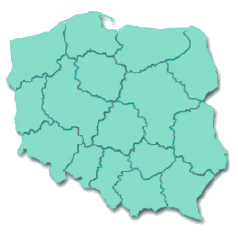
| Poland is a great country and I have a huge interest in seeing more of it. It sits as a bridge between east and west. This makes it a very interesting place to visit.
I will spend 2 days in Wroclaw, 2 days in Gdansk, 1 day in Torun, 6 days in Warsaw, 2 days in Krak�w, 1 day in Bielsko-Biata, and 2 days in Lublin. With a buffer this equals 18 days in Poland. |
| Wroclaw
A city was first recorded in this area in the tenth century. In 1241 the Mongols burned and sacked the city. After this, Wroclaw fell under the control of the Holy Roman Empire. Soon it became part of the Hanseatic League and began to prosper. The main rulers at this time were local dukes. In the 1740�s the area became part of Prussia. This didn�t last very long as Wroclaw became part of the German Empire in 1806. Soon it became a center of industry. During WWII the city was occupied by the Nazi�s. After the war the severely damaged city was destroyed. Things to Do: Raclawice Panorama and National Museum- This museum is a panorama of the 18th century peasant insurrection against the Russians. National Museum- There is a good collection of art from all around the country here. Cathedral of St. John the Baptist- Climb the tower for a great view of the city. Church of St. Mary of the Sands- One of the altars has been adorned with thousands of children�s toys. Ask a priest to hit a switch and watch it come to life. Gdansk Gdansk was a stronghold in the 980�s. 997 is thought to be the year that it was founded. During the 13th century German was the main language. By 1308 the city was a flourishing center of trade. In 1361 Gdansk became part of the Hanseatic League and was controlled by the Teutonic knights. The city continued to prosper over the next few centuries. In 1793 it was annexed to Prussia. Then in 1871 it became part of the German Empire. After WWI Gdansk became a free city under the control of the League of Nations. It wasn�t long before Poland regained control of the city. In 1933 at the outbreak of WWII Gdansk was once again taken by the Germans. After WWII twenty five of the population was dead. The city also became part of Poland. Today it is an important shipping center. Things to Do: Gdansk History Museum- This has a history of the city from its first mention to rebuilding after WWII. Church of the Blessed Virgin Mary- This is the largest brick church in Poland. Climb to the top for a great view. National Museum- This museum has a large collection of 16th through 20th century art and furniture. Be sure to notice Hans Memling�s Last Judgment. Westerplatte- This fort was the first target of WWII. There is a small museum about the week long battle. Torun The first settlement in this area dates back to 1100 B.C. Later on the area was abandoned. It wasn�t until 1230 when the Teutonic Order built a castle that a settlement once again began to grow. In the 14th century Torun joined the Hanseatic League. In 1557 the city adopted Protestantism despite the majority of Poland remaining catholic. During the 17th century religious tensions grew. The Catholics won and the Lutherans were put to death. Soon the protestant churches were consecrated as catholic places of worship. In 1870 Torun became part of the German Empire. Then in 1919 with the signing of the Treaty of Versailles it became part of Poland. During WWII it was occupied by the Nazi�s. Things to Do: Copernicus� House- This restored house is where the famous astronomer was born. The museum also paints a picture of 16th century Torun. Regional Museum- This museum contains information about the regions history. Teutonic Knights Castle- This 13th century castle only lasted two centuries. Today the ruins are spectacular. St. John the Baptist Cathedral- This is the most impressive church in the area. It gives a rich look at medieval architecture. Warsaw Warsaw began as a fortified settlement in the 13th century. During the 14th century it became the seat of the Dukes of Masovia. This family later became part of the Polish royal family. In 1596 Warsaw became the capital of the Polish-Lithuanian Commonwealth. Then in 1795 it was annexed to Prussia. In 1815 Warsaw once again became a Polish possession, and just a few years later in 1918 it became the capital of an independent Poland. WWII saw its capture and near destruction at the hands of the Germans. After WWII all of Poland became a Soviet Satellite State. In 2004 Poland became part of the EU. Things to Do: St. Johns Cathedral- This church was rebuilt after WWII. Be sure to check out the crypts of famous Poles. Palac Kazienkowski- This is often called the Palace on Water. It�s really quite breathtaking. Former Warsaw Ghetto- There are several aspects to this. � Nothing of the actual ghetto remains as it was destroyed by the uprising and other bombing. � Umschlagplatz- This was the railway platform that 300,000 Jews were transported to concentration camps from. � Command Bunker- A mound of earth with a monument marks where the bunker for the 1943 uprising was located. � Monument to the Ghetto Hero�s. Jewish Cemetery- Check out the bronze statue of Janusz Korczak here. He ran an orphanage during WWII for Jewish children. It was actually located in the ghetto itself. He perished with the children at Sobibor. Nozyk Synagogue- This restored building was the only to synagogue to survive the war in the city. Ghetto Wall- This is the only part of the original ghetto wall still standing. Royal Castle- Although destroyed in WWII it was rebuilt. It is really quite stunning. Warsaw Historical Museum- This huge museum contains artifacts from Warsaw�s seven centuries of existence. National Museum- This collection traces the development of European art form the earliest days. Museum of Pawiak Prison- Built in the 1830�s this prison was later used as Gestapo headquarters. Over 100,000 Poles were imprisoned and tortured here. John Paul II Collection- This is not a museum about the late Pope, but rather a diverse collection of art that was donated to the city in his name. Jewish History Museum- This museum holds mementos and artifacts from Warsaw�s Jews. Katyn Museum- This museum documents the massacre that took place in Katyn Woods. This is when the Soviet Army rounded up Polish officials and executed them. Independence Museum- This is dedicated to the last 200 years of Polish History. There are several branches of this museum. Day Trip from Warsaw Wilan�w- This is Warsaw�s answer to Versailles. Many Polish aristocrats have called it home. Be sure to check out the gardens. Krak�w The earliest known settlements in this area date back to the fourth century. By the 10th century Krak�w had become a commercial center. In 1038 it became the seat of Polish government. Then in 1364 the university was founded, it was the second in Eastern Europe. Due to this Krak�w became a center of science and the arts. In the 16th century the Swedes invaded and after this the city began to decline. Then in 1596 the capital was moved to Warsaw. Over the next several centuries the city changed hands often. In the 19th century Krak�w became the center of Polish architecture and art. During WWI Russian troops seized the city. In 1919 it became part of an independent Polish state. During WWII Nazi�s took over the city; however it was not destroyed the way that Warsaw was. Today it is the cultural capital of Poland. Things to Do: Wawel Castle- Last time you didn�t go in, so check it out this time. Czartoryskich Museum- There is some nice art to check out here. The collection is rather diverse. History Museum of Krak�w- This museum deals with the history of Krak�w. Czartoryski Palace- This is a collection compiled by the Czartoyski family. It includes works by Da Vinci and Rembrandt. Bielsko-Biata I wasn�t able to find anything on this town�s history. Things to Do: Castle- This 14th century building houses a history museum of the town. There is also an impressive art collection. St. Nicholas Cathedral- Austrian influence is easy to spot in this cathedral. Zywiec- This town is a few kilometers away. This is where the beer of the same name is made. Take a tour of the brewery. Lublin The first permanent settlements in this area were during the middle ages. During the 10th and 11th centuries Lublin became an important trade center. The town was also well fortified. This turned out to be a good thing as it was attacked by the Tatars, Ruthenia�s, Yotvingiens, and Lithuanians many times. In 1392 peace came finally and the city began to grow. It became a trade center between Poland and Lithuania. Over the next several centuries Lublin continued to grow. A large Jewish community also began to grow here during the 16th century. During WWII Nazi�s occupied the city and most of the Jews were killed. In 1989 the first strikes against communism took place here. Things to Do: Cathedral of St. John the Baptist- Built in 1586 this church has an amazing gilded altar. Historical Division of the Lublin Museum- This traces Lublin�s appearance since 1585. It also deals with its role during WWII. Be sure to climb the tower for a great view. Old Town Hall- This 18th century building also houses a history museum. Lublin Castle- Built in the 14th century this building functioned as a Gestapo jail during WWII. Day Trip from Lublin Majdonek- This was the second largest concentration camp. 235,000 people died here. The original structures are still standing. Majdonek had the highest percentage of children of all the camps. At the end is an open air mound of human ash. |
 |
|
|
|
|
|