| Lithuania is much like is Baltic brothers. Still there are aspects of it that are very unique to the country.
I will spend 1 day in Klaipeda, 2 days in Kaunas, and 7 days in Vilnius. With a buffer that equals 12 days in Lithuania. |
| Lithuania |
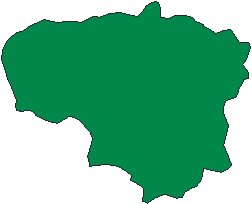 |
| Klaipeda
A small settlement may have existed as early as the seventh century. During the 13th century the Teutonic Knights moved in. Many German speaking people also came with them. In 1525 Klaipeda became a fief of Poland; this began a long period of prosperity. Then from 1625 through 1635 the town was occupied by Sweden. This happened again during the 30 Years War. In 1660 Klaipeda gained independence and became part of the Kingdom of Prussia, soon it became one of the strongest fortresses in the kingdom. Then in 1757 it was captured by Russian troops. The city became dependent on the Russian Empire. When Germany united in 1871 the town became part of the new country. However the town was neglected and the population became stagnant. In 1924 Klaipeda became part of Lithuania. During WWII the town was forcefully returned to German possession. In 1945 the Red Army took back the city. Eventually it became part of the Lithuanian puppet state. Things to Do: Klaipeda Picture Gallery- There are exhibits by local artists as well as rotating exhibits from international artists. History Museum of Lithuania- This museum mostly deals with the turbulent 20th century. Kaunas There may have been a settlement in this area dating as far back as the 10th century B.C. The town is said to have been founded in 1030, but the first time it shows up in written records is in 1361. In 1362 Kaunas was captured by the Teutonic Knights, they lost possession after a few years. During the 15th century a trade route ran through the town and it prospered. In the 17th century the Russians attacked many times. These problems persisted for centuries. In 1862 Kaunas became a railway hub between Germany and Russia. This once again brought some prosperity. Soon it became part of Lithuania was for a brief time was also the capital. Between the wars industries prospered and it became the largest city in Lithuania. During WWII the city suffered heavily under German occupation. After the war the Soviets industrialized the city. Things to Do: St. Michael the Arc Angel Church- The breath-taking neo-Byzantine exterior is a feast for the eyes. Kaunas Cathedral- Thought to have been built in the 1408 this is a beautiful place to check out. Be sure to visit the tombs. Ninth Fort- Constructed as a defense from the Germans this fort later became a concentration camp were 50,000 people died. Pa�aislis Monastery and Church- This complex was designed in the 17th century. It was later used as a KGB run psychiatric hospital. Devil Museum- This museum has devils, lots of them. Museum of Exiles and Political Prisoners- This museum collection has relics from the resistance to Soviet rule. There is a section on life in Siberia. Vitautas the Great War Museum- Next to the arms there are some interesting exhibits. The plane that two men failed to fly to America is here. There is also information on Napoleon�s Russian campaign. Siauliai Hill of Crosses- This is a monument to religious and human courage through the ages. Vilnius Vilnius was initially a Baltic settlement inhabited by the Slavs. It was first mentioned in written sources in 1323; at this point it was nothing more than a wooden hill fort. By 1503 it had grown into a city with substantial walls. Over the next several centuries Vilnius continued to grow. Soon the city opened itself for migrants. By the 19th century Vilnius was part of the Russian Empire. During WWI it was occupied by the Germans. Between the wars the city passed hands many times. Then in 1920 Lithuania was born. In 1922 the city was annexed to Poland. This brought on a short time of prosperity. In 1939 the city briefly became part of Lithuania again. In 1941 the city was seized by the Germans. Ninety-five percent of the Jewish population was murdered. In 1944 the city was captured by the Soviet army. In 1990 Lithuania became an independent state; however Russia did not recognize this until 1991. Things to Do: Higher Castle Museum and Gediminas Tower- A castle has been on this site since 200 B.C. The museum details the history of the city and the castle. The main attraction is the view. Cathedral- Be sure to check out the royal mausoleum. St. Nicholas- This Orthodox Church was built in 1320 and is Lithuania�s oldest. Check out the icons. Gates of Dawn and Beyond- This is the last of the city�s medieval gates to survive. A chapel was built in the gate in 1071 and has since become a point of pilgrimage. Parliament- In January of 1991 the building was barricaded to keep the Soviets out. Some of these are still in place. Hill of Three Crosses- White crosses were placed here during the 18th century to commemorate thirteen crucified Franciscans. TV Tower- On January 13, 1991 fourteen civilians were killed here by the Russians. There are memorials and crosses at the spot today. Frank Zappa Monument- This is just a really random thing to see. Synagogue- This 1903 building has been rebuilt since the war. Paneriai Genocide Museum- This sits on the site of the Paneriai concentration camp. 100,000 people died here. There is also a small museum. Museum of Genocide Victims- This was the city�s KGB headquarters. It is still in the condition that it was abandoned in. Lithuanian National Museum- This museum concentrates on traditional Lithuanian life and on the struggle for independence. Holocaust Museum- This is about the people that Lithuania lost. Vilnius Picture Gallery- This has works from the 18th and 19th centuries. The best part is the view. Vilna Gaon Jewish State Museum of Lithuania- This museum deals with the Jews who fought against the Nazi�s and the Soviet Union. KGB Museum- This former prison uses short explanations to let the grim reality speak for itself. Victim remains are on display. There is also a room outlining Soviet occupation. Day Trip Europos Parkas- This sculpture garden marks the center of Europe. |
 |
|