 |
| Italy |
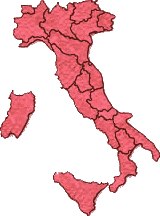
| Italy is a diverse country with many different regions. Each region seems to have it�s own flavor, purpose and spirit. While it would take forever to see every bit of this giant boot I will do my best. I will also take a short detour to Malta.
My Itinerary: Rome 5 days, Naples 3 days, Trani 1 day, Catania 2 days, Siracusa 1 day, Agrigento 1 day, Palermo 2 days, Malta 4 days, Assisi 2 days, Florence 6 days, Bologna 3 days, Milano 5 days, Padova 4 days, and Trento 1 day. I do have a few extra days buffered in and it all equals 43 days. |
| Rome
I spent about 8 days in Rome a few years ago and I really felt no need to work up a detailed history on it. Rome has been occupied for over 2800 years. It went from a small village in the 8th century B.C. to earning the name of the Eternal City. The traditional date for the founding of Rome is April 21, 753 B.C. In 64 A.D. there was a great fire that destroyed the city. Then in 800 Charlemagne was crowned Holy Roman Emperor at St. Peters Basilica. In 1084 the Normans sacked Rome. From 1420 to 1519 Rome became the center of the Italian renaissance. Napoleon�s army occupied the city from 1800-1814. During WWII Rome was bombed several times. Things to Do: Musei Capitolini- This title describes the town museums that reside in the Palazzo de Museo and Palazzo dei Coservatori. Look for the Capitoline Wolf, a bronze statue from the 6th century B.C. There is also an interesting bust of Brutus, Julius Caesar�s assassin here. Museo Nuovo- This museum focuses on sculpture. The best pieces, and really the point of this is to see the famous Dying Gaul and the Capitoline Venus. Museo e Galleria Borghese- This is a 17th century villa house. The sculpture room has several important classical works. Museo Nazionale Romano- This museum not only incorporates several rooms of a Roman bath but also contains a valuable collection of ancient art. Catacombs di San Callisto- These are the largest and most famous catacombs in Rome. They contain the tomb of St. Cecilia. Some 500,000 people where interred here. Please remember that not all of it has been excavated. Mausoleo delle Fosse Ardeatine- This was the site of the worst Nazi atrocity in Rome. Germans took 335 innocent prisoners in these caves and then shot them. Today they are buried in a mass grave on the site. Museo delle Anime dei Defunti- This is strangely named the museum of souls. It is in the church of Santa Cuore in Suffragio, Lungotevere Prati 12. Look to the right for a separate room. This museum has objects that have charred fingerprints on them. They are said to be the fingerprints of tortured souls in hell asking to be prayed for. St. Philip Neri�s Mummy- This is located in la Chiesa Nuova, on Piazza Chiesa Nuova. The mummy is in the chapel to the left. Go here to visit St. Philip. You can decide if he is incorrupt. Church of Santa Maria Sopra Minerva- This is where the patron saint of Rome is kept. Her name was St. Catherine of Siena. Also look for the remains of an unknown martyr. Balbi Crypt- This museum focuses on Rome in the dark ages. You will learn how such a large city could shrink to the size of a village. Day Trips from Rome: Tarquinia This is one of the most ancient Etruscan cities in Italy. During the 8th century B.C. it was heavily influenced by and traded with the Greeks. It was a very strong and prosperous city. Then in the 3rd century B.C. the Etruscans had many conflicts with Rome. Soon they fell to the up and coming power. The real point of coming here is to see the Etruscan sites. I think that they would be fascinating and a great way to learn about non-Roman Italian history. This is located about 100km from Rome, so about 60 miles. There is a train you can take. Also make sure to check out the medieval town center. Things to Do: Museo Nazionale Tarquiniese- This museum has relics from the local tombs. It is recommended that you stop both here and at the Etruscan museum in Rome first so that when you get to the tombs you can understand them better. Necropolis- These are the tombs of the Etruscans. About 60 of them are painted and there are many more. However, only a portion of them are open to the public. Viterbo This was the administrative center of the Etruscan world. It is located about 60 miles outside of Rome. It is also one of the best preserved medieval towns in Italy. Things to Do: Piazza del Plebiscito- This piazza is lined with 15th and 16th century palaces. Cattedrale di San Lorenzo- This 12th century cathedral was built to steal the popes away from Rome. It didn�t work, but now there is a breathtaking cathedral to explore. Museo Civico- This museum has a nice collection of local antiques. |
 |
| Naples
Naples is the third largest city in Italy. It was founded by the Greeks in the 8th century B.C. After this the Romans took over. Then in the 6th century it was conquered by the Byzantines. Naples was one of the last cities in Italy to fall to the Normans. However it did eventually fall. For the next several hundred years Naples was part of Spain, Austria, and the Bourbon Kingdom. In 1860 Naples joined the new unified Italy. Things to Do: Cappella di San Gennaro- This chapel holds the remains of St. Januarius, the cities patron saint. Each year they pray to him to protect the city. It is thought that on certain days his dried blood liquefies. That would be a day that you do not want to be there. Chiesa dei Girola Mini- This baroque cathedral has a small gallery with a few excellent works from the 16th to 18th centuries. Capella di San Severo- This church has the sculpture of a veiled Christ. It is so life like and stunning that expert�s still debate over how it was created. This is perhaps one of the best sculptures in Europe. Museo Archeologico Nazionale- This is the real reason for coming to Naples again. This museum houses the most comprehensive collection of Greco-Roman artifacts in the world. Most of the artifacts from Pompeii and Herculaneum can be seen here. This includes the plaster casts of humans. Castel Nuovo- This castle houses the Museo Civico. A lot of it is frescos from the 14th and 15th centuries. However there is also a large selection by Neapolitan artists. Museo Nazionale di San Martino- This museum has an area on naval history, the Kingdom of Naples, and a nice art collection. Be sure to check out the collection of carved Nativity Scenes. Catacombs di San Gennaro- These are nothing like the dark and claustrophobic catacombs of Rome. They date from the second century. There are wide hallways mixed in with chapels and tombs. Herculaneum (Day Trip from Naples) - This settlement is said to have been founded by Hercules himself. In 84 B.C. it became a Roman town. |
|
| Trani
This town is located on the Adriatic Sea. The first settlements here can be traced back to the 9th century. During the 11th century the port flourished and it was a good jumping off place for the crusades. Trani had always had a large Jewish population. Then in the 14th through 16th centuries they were persecuted under Anjou and Aragonese rule. The city declined sharply after this as the Jews were very important to their economy. Under the House of Bourbon the economy began to grow again. Then in 1799 the French troops provoked a massacre. The town itself is worth the trip. I think at this point after such big and busy cities it might be nice to have a day to just wander and to do some laundry or something. Cathedral- This structure was started in 1097 but was not completed until the 13th century. It is dedicated to S. Nicholas the Pilgrim. This is one of the most beautiful churches in Italy. |
|
| Catania
You might need to build in an extra day for travel here, however it does look like there is a night train available. This is the second largest city in Sicily. It was founded in the 8th century B.C. by the Greeks. The original name was �tna, after the local volcano. This volcano damaged the town several times, but the worst was in 1169 and 1693. Due to this there are centuries of relics and streets they lie well preserved beneath the modern day streets. The tops of a few amphitheaters can be seen at street level; however it is possible to explore some underground tunnels, that is if you don�t want to see the rest of Italy. Things to Do: Roman Theater- These ruins are really great to explore. Castello Ursino- Built in the 13th century this rather grim looking fort is surrounded by a moat. You might want to go to this area of the city with a group of people. Mt. Etna- This is the oldest active volcano in the world. If you like you can hike up to it. Museo Civico Belliniano- Many Catanians view this museum as a shrine. This is the small apartment where composer Vincenzo Bellini was born in 1801. You will be able to see original folio�s of his operas, childhood mementoes, and his death mask. |
|
| Siracusa
This city was originally settled in 734 B.C. by Greek settlers from Corinth. For some time it was the most powerful Greek settlement on the Mediterranean. After much war on the island with the Carthaginians the Greeks fell and the city declined. When the Romans gained control the city was still important politically but not economically. Eventually the port once again became an important trade center between the east and the west. After Rome fell there was a period of Vandal rule which was followed by Byzantine rule. In 878 after fiercely sacking the city the Moors took control for two centuries. They moved the capital to Palermo but Siracusa still remained an important trade center. In 1038 it was once again conquered by the Byzantines. Many of the older buildings were restored. Then in 1228 after two more centuries of struggle they fell to Aragonese rule. Several earthquakes decimated the city over the next few centuries. Then in 1865 Siracusa became part of a unified Italy. During WWII it was bombed heavily. Things to Do: Ortygia Duomo- This basilica incorporates bits of the Greek temple it was built on. It is a true melting pot of architectural styles. Parco Archeologico- This is an area with a lot of Greek ruins. Be sure to check out the theater. Museo Archeologico Paolo Orsi- This museum has the best archaeological collection in Sicily. It focuses on the various groups that have inhabited the island. Catacombe di San Giovanni- These catacombs contain about 20,000 tombs. They were originally Greek aqueducts. You enter through the ruins of a church abandoned in the 17th century. Make sure to leave well before closing as people have been known to be locked inside over night. |
|
| Agrigento
Agrigento was founded in 582 B.C. by Greek settlers. Under the Greeks the town flourished. However, during the Punic Wars it was destroyed many times. The city was then rebuilt and considered to be quite beautiful. Under Byzantine rule its importance began to decline. It was not until the Normans arrived that its importance was once again recognized. They built many beautiful churches here adding to the slight eclectic architecture. Things to Do: Valley of the Temples- The five Doric temples along the ridge were constructed around the 5th century B.C. They are in various states of ruin due to earthquakes and vandalism. The temples to the east are the best. Museo Archeologico- This museum has a collection of artifacts found in the area. Duomo- Originally built in the year 1000 this cathedral as been reconstructed many times. This gives it a look of being very fragile. Temple of Concord- Built in 430 B.C. this is one of the best preserved Greek temples outside of Greece. |
|
| Palermo
Palermo was founded in the 8th century B.C. by Phoenician tradesmen. It fell under Roman rule in the second century B.C. The next several centuries were pretty calm. After the Roman Empire fell Palermo was ruled by the Byzantines. Then in 878 most of the island was controlled by the Saracens. In 905 it was made the capital and became an important center of commerce and culture in the Arab world. In 1060 the Normans launched a crusade against the city. Then in 194 Palermo was ruled by the Holy Roman Empire. In 1479 it fell under Spanish rule. When Sicily united with Naples in 1734 Palermo became a provincial city. In 1860 it was annexed to the new Italy. Once again Palermo became the administrative center of Sicily. In 1943 there was an allied invasion of the island and Palermo suffered a lot of damage. Even today the mafia plays a large role in the running of the city. Things to Do: La Martorana- This is Palermo�s most famous church. The inside is decorated with Byzantine mosaics. Notice the Norman-Arab fusion. Duomo- Built in the 2nd half of the 12th century this cathedral is a hodgepodge of styles. Be sure to check out the royal tombs. Cappell Palatino- Inside this chapel are some of the finest Byzantine mosaics in existence. Museo Archeologico- This small museum mostly has Greek finds from throughout the island. It is definitely worth a look. Chiesa di San Domenico- This 17th century structure houses the tombs of important Sicilians. There is also a great deal of art. Catombe dei Cappuccini- There are many mummies and skeletons here hanging from the walls. They date from the 17th to 19th centuries. Many are just skeletons but some are remarkably intact. I should add that Rick Steves visited and they looked amazing. La Zisa- This 12th century Arab-Norman castle�s name means splendid. I think that it might be worth a look. Galleria Regionale Della Sicilia- This neo-gothic castle dates from the 15th century. Its art collection covers the medieval period through the 18th century. |
|
| Malta
The earliest signs of humans date back to about 5000 B.C. on this island, however very little is known about them. These people most likely came from Sicily. The Knights of St. John ruled the island for about 200 years. They built many of the forts and palaces on the island today. After the Knights the British gained possession. This is why today English is one of the official languages in the country. Then in 1814 Malta officially became part of the British Empire. During WWI Malta acted as a supply station in the Mediterranean and as a base for wounded soldiers to recover at. Then during WWII they island was awarded the George Cross for their bravery and service. On September 21, 1964 Malta gained its independence, however it is part of the British Commonwealth. The main island is pretty small so you should be able to say in one place and take day trips from there. Things to Do: Borgi in Nadur Temple- This temple is located in Birzebbugia and is in ruins. At one point the temple may have had four tiers and might have even been a bronze aged settlement. Gar Dalam Cave and Museum- This is located in Birzebbugal. This is where the earliest evidence of humans was found. During WWII the cave was used as an air raid shelter. The museum has artifacts that were found in and around the caves. It is possible to go in to the caves a short distance. Gyantija Temples- This is in Xaghra. These are thought to be the oldest free standing structures in the world. They are also the best site on the island. It looks like there are two temples and that they may have had roofs at one point. Roman Baths- These baths are located in Rabat. This was the site of a Roman villa. Most of it is gone now, however the baths that once connected to the structure are in great shape. St. Paul�s Catacombs- These are in Rabat. This underground Roman cemetery dates from about the 4th century A.D. These are the oldest Christian remains on the island. National Museum of Fine Arts- Located in Valletta. Most of this are is due to the Knights. There is a significant section on Maltese painters. Grand Masters Palace- This is in Valletta. Today this 16th century building is where the Maltese parliament meets. You can take a tour and see some great art. National War Museum- This is in Valletta in Fort St. Elmo. Most of the museum concentrates on WWII relics; however other aspects of history are touched on as well. Block in a day for travel from Malta to Assisi. Looks like you will need to fly to Rome and then take a train. |
|
| Assisi
This is the city of San Francesco and is a symbol of peace for the entire world. It was originally inhabited by the Umbrian�s. Eventually the city fell to Roman influence. After the fall of Rome the Goths and Longobards took over. This had all happened by 545. In 1180 St. Frances was born. He renounced his wealthy father and gave his life to serving the poor. Then in 1228 he was canonized. In 1348 the Black Death struck and the town began to decline. Not a whole lot happened until Rick Steves showed up and made is a must on the Italy tourist trail. Things to Do: Basilica di San Francesco- This basilica is made from two separate churches. The upper church has 28 frescoes depicting St. Frances� life. The lower focuses on the order itself. The basement holds the saints tomb. Roman Forum- Only parts of this structure have been excavated. Chiesa di Santa Chiora- You can visit St. Clare here. Take a look at the Byzantine cross. It is said to have spoken to St. Francis. Rocca Maggiore- This hilltop fortress has stunning views over the town. It is also an art gallery. Eremo dei Carceri- This is where St. Francis went after hearing the word of God. These caves served, and still serve as a retreat for his followers. The caves look much like they did during his lifetime. Day Trips from Assisi: Perugia This town first appeared as one of the twelve confederated cities of Etruria. In 216 B.C. they assisted Rome in the Hannibalic war. Nothing is really mentioned of them again until 40 B.C. when Octavian destroyed the city. Once again the name fell of the books. It reappeared in the 6th century when it was captured by the Lombard�s. Over time it became a great city that some how managed to have an independent life even though it was technically under the Pope�s jurisdiction. In 1797 the city was captured by French troops. Then in the 19th century several earthquakes struck the area. Today the city is famous for chocolate. Things to Do: Piazza IV Novembre- This is the heard of the cities old square. Galleria Nazionale dell�Umbria- This museum has a collection that consists mainly of Umbrian art. Rocca Paolina- This 16th century fortress is in ruins. Still it is worth a look. Cathedral of San Pietro- This 10th century gothic cathedral is worth a look. The frescoes in the entrance were only uncovered during the 1980�s. |
|
| Florence
This city began in 59 B.C. as a settlement for retired Roman soldiers. The strategic location helped the town to expand. During the 4th century they were attacked by the Ostrogoths, this decimated the city and only about 1000 people lived there at this time. In the 6th century peace returned. By 774 Florence had become part of the Duchy of Tuscany. The golden age of the city began around 1000 A.D. Over the next several centuries there were many political conflicts. Despite this the city became one of the most prosperous in Europe. In 1348 the Black Death decimated the city. Then in 1737 Tuscany fell under Austrian rule. Florence became part of a unified Italy in 1861. During WWII the Germans occupied the city for a full year. Chiesa di Santa Maria Novella- This 13th century church was completed around 1360. Check out the Trinity fresco by Masaccio. The crucifix was by Brunelleschi. Be sure to see the cloisters as they have some of the cities best frescos. Basilica di San Lorenzo- In 1425 the Medici family commissioned this basilica. It is an excellent example of harmonious renaissance architecture. Several members of the Medici family were buried here, along with the painter Donatello. Capella dei Principi- This richly decorated chapel was the principle burial place of Medici rulers. Check out some of Michelangelo�s first architectural works. Museo di San Marco- This was a Dominican convent. Check out the art collection. Even the monk�s cells were decorated with frescos. Duomo- This famous dome dominates Florence�s skyline. It is the 4th largest cathedral in the world and took 150 years to complete. You can also visit a 5th century crypt here. Museo dell�Opera del Duomo- This museum holds many of the Duomo�s treasures. The best piece is Michelangelo�s Pieta. Some of the supplies used to build the dome can also be found here. Chiesa di Santa Croce- The interior of this church is grand but austere. The floor is paved with tombs of famous Florentines from the last 500 years. Michelangelo�s tomb is here. Tore d�Arnolfo- This was built for the Florentine government. It became a palace for the Medici�s in the middle of the 16th century. The sumptuous rooms and courtyards are worth a look. Galleria degli Uffizi- This gallery houses the private art collection of the Medici�s. This is the world�s greatest collection of Florentine art. The museum is organized to show visitors how the works evolved. Casa di Dante- This small museum traces Dante�s life. Museo del Bargello- This is the most comprehensive collection of Tuscan renaissance sculpture in Italy. This is a not to be missed museum. Museo Archeologico- This is considered to be one of Italy�s best. Much of the collected was amassed by the Medici�s. Galleria dell�Accademia- No tour of Florence would be complete without a stop here. The main draw is Michelangelo�s David. Galleria Palatina- This is in a palace that the Medici�s once owned. There is a nice collection of 16th � 18th century art, but the main reason for visiting is to see how the Medici�s lived. La Specola- This zoological museum is Europe�s oldest. Take a look at antique specimens and wax works. Salvatore Ferragamo Museum- This museum has 10,000 pairs of shoes dating from the 1920�s. Day Trips from Florence Siena The area of Siena was first settled by the Etruscans from 900- 400 B.C. In 390 B.C. the Romans founded a city on the spot. The town did not prosper under Roman rule. Due to this Christianity didn�t penetrate the region until the 4th century A.D. In 774 Charlemagne occupied the area. Then in 1179 the town was controlled by the aristocratic families, they even had a written constitution. In the 13th and 14th centuries Sienna rivaled Florence in arts and culture. Today it is still an important cultural center. Things to Do: II Campo- This square has been the cities civic center since the 14th century. Notice the 15th century fountain. Museo Civico- This museum has a series of rooms with frescoes by the Sienese school. Be sure to check out Simome Martini�s Maest�. This museum is also located in city hall. Climb the bell tower for spectacular views. Duomo- This is one of Italy�s grandest gothic churches, and one of its most enchanting buildings as well. It was started in 1196 and work continued into the 19th century. Museo dell�Opera Metropolitana- This museum holds art that once adorned the Duomo. Be sure to check out the story of the passion. There are also manuscripts and tapestries to check out. Pinacoteca Nazionale- This gallery houses numerous pieces by Sienese artists. Look for the series of Madonna�s by Lorenzetti. Chiesa de San Domenico- This gothic church begun in the 13th century but has been much altered since then. St. Catherine�s head is here. Pisa Remains from the 5th century B.C. have been found in the area but the cities true origins are unknown. There are early records written by the Romans who talk of Pisa as a very old city. During the Roman era Pisa was used as a navel port. After the Romans fell from power the city did not decline as quickly as so many others had. It became the capital of Tuscany in 930. During the 11th century Pisa reached its apex, however due to constant warfare with neighboring states this all ended in the 13th century. The city began to decline. Several times the city worked to regain its former glory, but it was never to be. Eventually Pisa fell into a secondary role and Florence took the main stage. Things to Do: Duomo- Pisa�s cathedral was a model for Romanesque churches throughout Tuscany. It was begun in 1064 and altered over the years. There was also a fire in 1596. Some of the major works did survive. Torre di Pisa- Only three tiers were completed when the tower began to lean. This was probably caused by shifting soil. Many of the attempts to straighten it have only made it worse. Museo Nazionale di San Matteo- This is one of Tuscany�s finest galleries. There are works by many notable painters here. |
|
| Bologna
Bologna was founded by the Etruscans in 534 B.C. In the fourth century it was conquered by the Gauls. Then in 191 B.C. the Romans took the wheel. At this time the city had about 10,000 inhabitants. Soon the town began to decline. It wasn�t until the 5th century when bishops took control of the city that it began to recover. After Rome fell Bologna became a strategic location defensively and the town was fortified. Then in the 11th century the town began to grow again. This didn�t last very long, and by the 14th century they were asking for the Pope�s protection. This helped the city to flourish during the renaissance. However in 1506 papal troops sacked the city. For the next few centuries Bologna fell under several different jurisdictions. In 1859 it became part of a unified Italy. From there it went to become a very important city both economically, and culturally. They are also known for having the best food in Italy. Basilica di San Petronio- Building began in 1392, but was never finished. Be sure to check out the giant sun dial. San Vitale e Agricola- This is the oldest church in the city. You can see how the Roman structure was incorporated into it. Be sure to check out the saints tombs. Museo di Anatomia e Istologia Patologica- This is the real point of coming back to Bologna. This museum has an astounding collection of anatomical freaks. Some of this will be beyond your worst nightmares. It�s horrifying and mesmerizing. Museum of Comparative Anatomy- This museum allows you to compare the anatomy of various species. Basilica of San Domenico- There are some very creepy relics here to look at. Day Trips from Bologna: Ravenna Ravenna began as a Roman colony in the 2nd century B.C. Soon it became the capital of the western empire in 402. The city was a junction between the north and south. During the middle ages the town went through a time of deep decay and isolation. Then during the 15th century it fell under Venetian rule. Ravenna moved into a golden age the likes of which it had never seen before. This, however, was short lived. By the 16th century Venice had fallen and Ravenna with it. After WWII a large amount of natural resources were found and the city has grown economically ever since. Things to Do: Basilica di San Vitale- This basilica was consecrated in 547. The inside is covered in bright mosaics. Mausoleo di Galla- I�m not sure if anyone is buried here any longer but the mosaics are stunning. Duomo- Built in 1733 after its predecessor was destroyed in an earthquake. Might not really be worth a look. However the adjoining Museo Arcivescovile contains some amazing mosaics. Parma Parma was a Roman city founded in 183 B.C. About 2000 families settled here. After Rome fell the city was destroyed several times. By 569 it was part of the Lombard Kingdom. During the middle ages the town prospered as there were several important roads that ran through it. In 1341 Parma fell under Milanese rule. Then in the 15th century they managed to regain their freedom. The city moved into a new sort of feudalism, eventually these fiefs evolved into their own mini states. In 1731 Parma became part of the House of Bourbon. This brought the city a period of splendor. A few decades later under French influence Parma became a place of industry. In 1860 it joined a unified Italy. During WWII Parma was a center of partisan resistance, because of this it suffered many aerial raids. Things to Do: Piazza del Duomo- This Duomo was begun in 1059. Be sure to see the Assumption of the Virgin on the inside of the cupola. The restored woodwork is also worth a look. Galleria Nazionale- This museum holds an incredible collection of European art. Chiesa di Santa Maria della Steccata- This church contains some of Francesco Parmigianino�s best work. Many local rulers were interred here. Museo di Glauco Lombardi- After Napoleon was exiled his second wife, Marie-Louise of Austria, was left with the dukedom of Parma. Several of her belongings can be found here. |
|
| Milano
Milan was founded by the Celts of northern Italy around 600 B.C. In 222 B.C. it was conquered by the Romans. During the 4th century it was the capital of the western Roman Empire. Milan was the second largest city in Europe. In the 11th century it lead other Italian cities in a push to free themselves from the Holy Roman Empire. During the renaissance some of the great artists worked here. In the 16th century it was give to Spanish Hapsburg rule. During the Napoleonic wars Milan was made a satellite of France. In 1864 the city became part of a unified Italy. Then in WWII the city was continuously carpet bombed. Today Milan is the financial center of Italy. Things to Do: Duomo- This is the world�s 4th largest church. There are 135 spires and 3200 statues on the roof and fa�ade. Interestingly there is no bell tower here. Notice that the brass doors have scars from WWII bombs. Be sure to climb to the top of the dome. Museo de Duomo- The museum allows you to study more closely the history of the church. Pinacoteca Ambrosiana- This is one of Milan�s finest galleries. It has Italy�s first still life fruit basket. Museo Teatrale alla Scala- This museum boasts Verdi�s death mask along with other opera related objects. From here you can wander into the opera house. Castello Sforzesco- This fortress was remolded in the 15th century, parts of it were designed by da Vinci. The sculpture museum located here is worth a look. Pinacoteca di Brera- This gallery has grown since the 19th century. The Dead Christ by Andrea Mantegna is here. Cenacolo Vinciono- Leonardo�s Last Supper painting is here. It is amazing that it has survived all of these years. It was damaged in WWII and then by later restoration efforts. Museo della Criminologia e Armi Antiche- This museum is housed in medieval towers. There are all sorts of ghastly torture devices along with a sizable collection of armor. Day Trips from Milan: Bergamo Bergamo began as a Roman colony. It was destroyed in the 5th century by Attila the Hun. When the Venetian Empire gained control the city was heavily fortified. Bergamo has a prominent place in music history, but I couldn�t find a whole lot about it on the internet. Things to Do: Torre Civica- Climb up the tower for a great view of the town. Chiesa di Santa Maria Maggiore- Begun in 1137 the interior is stunning. Accademia Carrara- This museum contains an impressive range of Italian masters. Citt� Bassa- These three squares make up the center of town. Genoa The Greeks had a colony here in the 5th and 6th centuries B.C. In 209 B.C. the town was destroyed by the Carthaginians but then rebuilt by the Romans. After Rome fell the town was occupied by the Ostsrogoths and then the Lombards. Genoa was little more than a tiny fishing village at this point. However, slowing they began building a fleet of ships. By 1100 Genoa became a maritime republic, similar to Venice. They had one of the most powerful militaries in the Mediterranean. After the crusader states collapsed Genoa allied with the Byzantine Empire. This opened up expansion and trade. The city became very prosperous. In 1349 the Black Death came and was then followed by economic collapse. Soon the town accepted a doges system of rule. Shortly they fell under the power of the Milan. In 1528 through a close connection with Christopher Columbus (he might have been born there) Genoa became a satellite of the Spanish Empire. Once again the city became wealthy and began attracting artists and architects. When trade routs shifted the city went into a steady decline. In 1805 it was annexed to France. The in 1860 became part of a unified Italy. Things to Do: Cattedrale di San Lorenzo- This is the cities main cathedral. It is a bit of a shock with twisting gothic columns. Building began in the 12th century, but it has been altered. In the small museum there is a cup said to be the Holy Grail. Galleria di Palazzo Bianco- This is a good mix of both European and local art. Palazzo Doria Tursi- This is the town hall. They have a piece of Christopher Columbus�s skeleton. Galleria Nazionale di Palazzo Spinola- This 16th century house now displays Italian and Flemish renaissance works. Old City- The beset way to see these winding streets is to just set off and wander. Just don�t go there at night. Aquarium- This is one of the largest in Europe. Torino In the first century B.C. the Romans had a military camp here. After Rome fell it was occupied by the Lombards, Franks, and then ruled by bishops. At the end of the 13th century it became part of the Duchy of Savoy. In 1563 it became the capital. During the 19th century the citizens began to pursue the idea of a unified Italy. In 1861 they joined the new country and became the capital. However, the capital was moved to Rome in 1870. After suffering from some damage during WWII the city rebuilt its industries. Turin hosted the 2006 winter Olympics. Things to Do: Palazzo Carignano- This was the seat of Italy�s first parliament. You can see paintings and the room in the Museo Nazionale del Risorgimento Italiano. There is also an extensive display of arms, paintings, and documents dating from 1848-WWII. Museo Egizio- This is one of the best museums about Ancient Egypt outside the ones in Cairo and in London. Duomo di San Giovanni- This cathedral houses the Shroud of Turin. The shroud is not on display but a replica is. La Palazzina di Coccia di Stupinigi- This was the Savoy�s hunting lodge. It has been restored and is worth a look. Borgo e Rocca Medioevale- This water front area transports visitors back to the medieval ages. However all of it is false. |
|
| Padova
Padova claims to be the oldest city in northern Italy. Around 45 B.C. it fell under Roman jurisdiction. Several centuries later it suffered greatly when Attila the Hun�s military invaded. In 568 Padova became part of the Byzantine Empire. During Lombard rule there was a bloody revolt that destroyed much of the city. After this it was almost completely abandoned. For the next few centuries not much went on. In the 10th century the city grew in power but was never able to gain the freedom that they sought. In 1405 Padova fell under Venetian rule. It remained this way until 1797 when the republic fell. In 1866 they finally shook off the Austrian yoke and became part of a unified Italy. Things to Do: Cappella degli Scrovegni- The frescos in this chapel are amazing. Chiesa Eremitani- This church was heavily bombed in WWII. It is still worth a look around. Basilica del Santo- This house the corpse of St. Anthony. Construction began in 1232 Day Trips from Padova: Verona Verona became part of the Roman Empire in 300 B.C. It was important because it sat at the intersection of many different roads. In the year 489 gothic architecture began to dominate the city. Then in 569 after a very bloody battle it became part of the Lombard Kingdom. 951 A.D. Verona was ceded to the Duchy of Bavaria. Around 1100 the city was organized into a commune. During the 14th century the city was beautified with churches and palaces. Once again Verona spent centuries under foreign control. In 1860 the city became part of a unified Italy. Things to Do: Roman Arena- This pink marble amphitheater was built in the 1st century. It is now used as an opera house. It is amazingly preserved. Casa di Giulietta- This is where they say Juliet�s balcony is. Arco della Costa- Notice the whale rib hanging from the arch. It is said that it will fall when the first just person walks under it. This has not happened for several hundred years now despite the number of popes that have given it a try. Torre dei Lamberti- Climb up this for great views of the city. Castel Vecchio- This 14th century fortress was damaged during WWII. It now houses a museum with a diverse collection of art. Venice Venice was founded in 568 after the invasion of the Lombards sent a large number of refugees into the marshes. As the community developed an anti-eastern character emerged. This lead towards a push for independence and the decision to create a government based on elections, not inheritance. Its strategic position made it a navel powerhouse, and the city grew rich. During the crusades Venetian ships were the used to transport troops to various places. In 1797 Napoleon occupied the city and ended Venice�s golden age. After this it became part of the Austrian kingdom. The city went into steep decline. Today it is a beautiful, if not a bit run down city to visit. Things to Do: Galleria dell�Accademia- This amazing collection follows Venetian art from the 14th to 18th centuries. It was closed the last time you were here. Santa Maria Gloriosa dei Frari- This gothic church is rich in art treasures. Titian is buried here. Museo Ebraico- This museum is about Jewish life in Venice Pick one of the Lagoon islands to check out for a day. |
|
| Trento
Trento was conquered by the Romans in the first century B.C. In 1027 after being conquered several times it became part of the Holy Roman Empire. Then in 1200 Trento became a mining town of some significance. During the 16th century it was home to the council of Trent which helped to give rise to the Counter Reformation. Over the next several centuries the city industrialized. Trento was also one of the founding cities of the idea of Italian unification. Despite this it was not annexed to Italy until after WWI. During WWII the city was bombed heavily. Today Trento had great economic growth. Things to Do: Duomo- The Council of Trent was held here. You can also see the foundations of the earlier church. Museo Diocesano- This museum has paintings depicting the Council of Trent, and Flemish works. Castello de BGuanconsiglio- This was a Bishop�s fortress. Today it houses a few small museums. The most interesting is the Museo Provincial d�Arte. It has a nice collection of local art. |