 |
| Ireland |
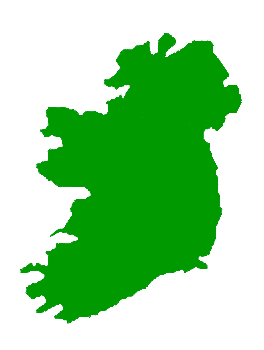
| Ireland is a country that pits ancient mysticism against modern technology. It is a bloody country, where each hill, stone, and citizen has a tale to tell. It is also the country of my ancestors. Come with me as I explore my roots, and in some ways, the roots of my country. My Itinerary: Dublin 2 days, Kilkenny 1 day, Cashel 1 day, Cork 3 days, Ring of Kerry 3 days, Dingle Peninsula 1 day, Limerick 1 day, The Burren 2 days, Galway 1 day, Sligo 2 days, Bally Castle 3 days, Derry 1 day, Belfast 2 days, then back to Dublin for a day before my flight out. I also have a buffer day built in so I have 25 days in Ireland. |
| Dublin The first settlers in there area were Norman Vikings. At that time the town was called Eblana. In the 9th century the town was captured by the Danes. Over the next few centuries the Irish gained the city back from the Danes several times. Then in 1171 the Danes were expelled by the Anglo-Normans lead by Henry II of England. Until the 17th century Dublin was a small walled medieval town. In 1649, after the English Civil War, the town was taken over by Oliver Cromwell. At this time the population was about 9,000 and it was in very bad condition. Then, at the end of the 17th century Dublin began to swell with refuges from the continent. Slowly the city grew in size and wealth, eventually becoming the second city of the British Empire. In 1800 the Irish parliament was abolished, this reduces Dublin�s status and the city began to decline once again. This all began to change when in 1916 uprisings and the War for Independence began. Dublin was the scene of the most severe fighting. After the war Dublin became the political, economic, and cultural center of Ireland. The city retains those labels to this day. Things to Do: National Museum of Archeology and History- This museum contains artifacts spanning the last two millennia. Look for the Tara Brooch, Ardagh Hoard, and other Celtic gold work. There is also a section dedicated to the War for Independence. National Gallery- There are over 2,400 paintings here including Brugel, Rembrandt, and El Greco. It looks like they have a decent collection, but that it might not be all that exciting. Dublin Writers Museum- This describes the cities rich literary heritage. You can see a lot of early manuscripts and rare editions here. Irish Jewish Museum- This is located in a former synagogue and discuses the importance of the small Jewish community in Dublin over the centuries. Kilkenny Kilkenny is Irelands best preserved medieval town. The name derives from the Irish �cill chaminnighi� meaning the church of Cainneach. The church of Cainneach was a site of catholic worship founded in the 6th century. Around 1052 this became the seat of the diocese of Ossary, an ancient Kingdom of Ireland. Then in 1170 the Normans invaded. In 1208 a charter was created to attract settlers and trade to the region. The Statue of Kilkenny was passed in 1336 forbidding the Anglo-Irish population from marriage, and outlawed the Gaelic language. Henry VIII, in 1541, was the first English king to declare himself monarch of Ireland. During the 16th century there were many Gaelic rebellions. The English tried to impose Protestantism throughout the whole country, but it was met with fierce opposition. In 1601 Queen Elizabeth�s military defeated the Irish in the battle of Kinsale. For the first time Ireland was under control of a strong English government. Then in 1609 Kilkenny was made a city. In 1641 there was a provisional government trying to resist the English. It sat for six years and that time is viewed as the cities golden age. Oliver Cromwell arrived in 1650 with a strong desire to oppress nationalistic extremism. He denied Catholics their political rights. During the 18th century the seat of Irish government moved to Dublin Castle. Kilkenny became keenly aware of the repercussions of British rule. In 1704 penal rules barred Catholics from politics, education, and the military. Soon the city was busy with revolutionary activity. The United Irishmen staged an unsuccessful rebellion in 1798. Due to this the city was placed under marshal law. In 1801 the Act of Union passed politically unifying England, Scotland, Wales, and Ireland. This also boosted the cost of land for Catholics and the country sunk deep into poverty. After much struggle the Independent Irish Republic was formed in 1949. Kilkenny began to prosper despite its long and sharp decline. Things to Do: Kilkenny Castle- This castle house the earls of Ormonde from 1300-1932. Three of the four original towers from the 12th century survive. The people who built it were from the first Norman invasion. St. Canice�s Cathedral- This area gives you a panoramic view of the city. The cathedral was built in the 13th century. It is made of limestone and in the early gothic style. Some of Ireland�s finest 16th century monuments are located here. Dunmore Cave- in 928 these caves were the site of a terrible Viking massacre. Now you can explore the millions of years old chambers full of moodily lit calcite formations. Kilkieran- Three crosses overlook the Suir Valley. They date from the 9th century and are all that is left of the monastery. Cashel This was once the seat of the kings of Munster. The town was given a charter by Charles II in 1663. I had a really difficult time finding much information on this city. Things to Do: Rock of Cashel- This is a large limestone outcropping topped with medieval buildings. Check out Cormac�s chapel, which was consecrated in 1134. Ruins of Hore Abbey- This abbey was built by Cistercian monks who were apparently very fond of arches. Now mostly sheep worship here. Cork Cork is one of the Irelands oldest cities. The name derives from the Irish �cocach mor mumhan� and refers to the center of the city which is built on islands. There is no evidence to suggest that there was a prehistoric settlement here. Saint Finbarre is credited with the foundation of the monastery. This was around the 7th century. The monastery at Cork is the earliest existing evidence of human occupation. It was first mentioned in 682, but may be older. The Vikings often attacked the monastery, but eventually they were all able to live in peace. Then in 914 there was a devastating raid from Scandinavia. By the 12th century the natives and Vikings had intermixed and became known as the Ostmen. Cork had become an important trading town. The MacCathy�s of Desmond made Cork their capital and built a residence and fort nearby. Ostman Cork ended in 1173 when the last leader, Gilbert MacTungar was killed by Norman invaders. By 1177 the Normans had conquered the city and expelled the citizens. Henry II kept the city for himself but gave away most of the kingdom. In 1185 Cork was granted a charter. Medieval Cork had a grid like street plan; it was rather modern for its time. Also, Cork traded extensively with Bristol. None of the medieval structures remain today. In the middle of the 14th century Cork began to decline. In 1349 the black plague decimated the city. Around 1354 a fire destroyed many of the buildings in the town. The decline continued well into the 15th century. Towards the end of the 15th century a few wealthy merchants where running the town. In 1536 the Irish parliament declared Henry VIII the head of the church and his authority was forced on the town. Both Queens Mary and Elizabeth changed the religious persuasion of the area. However, despite all of the flip flopping by the end of the 16th century most people were catholic. At this point the damage had been done; a poisonous religious division had been added to society. Over the next centuries Cork struggled with its religious identity and there were several rebellions lead by each side of the debate. In 1644 the Catholic population was exiled and the merchant government was broken. At this point activity in the port increased and the city began to slowly prosper. Then came Cromwell. Cork was held under military governance from 1644-1656 and the protestant citizens were favored. This turbulence set back the economy, but not for long. Once Cromwell had left the city began to expand rapidly and took on a more modern appearance. After the Napoleonic Wars (1815) the cities economy once again began to slump. Then the potato famine hit. There was death and starvation to a level that is almost unimaginable today. By 1850 the worst was over and the city began to recover. Modern day Cork is awash with history and a great place to get learn about Ireland. Things to Do: St. Anne�s Church- Notice that the 4 clocks each have a different time. You can climb the stairs to get a great view of the city and to ring the church bells. Crawford Municipal Building- This museum specializes in Irish masters, but has some contemporary art as well. Make sure to see the Greek and Roman sculpture casts from the Vatican Museum. Cork City Gaol- You can tour the old gaol here. There is also a section on Cork�s social history. The museum is renowned for its wax figures. Blarney Castle (Day Trip) - Take a day to explore Blarney Castle. It�s one of the oldest in Ireland. The drive is beautiful and a great way to take in some of Irelands signature countryside. Don�t forget to kiss the blarney stone to get the gift of gab! Kinsale (Day Trip)- Take the coastal Scilly walk to see the 17th century Charles Fort. This gives an amazing view of the town. Also take a look at Desomond Castle which at one time was a French Prison. Limerick The Vikings were the first to establish a settlement in Limerick. They used it as a base to raid local monasteries. In the late 12th century the English (Normans) took over. Then in 1197 Limerick was declared a city. King John visited in 1210 and ordered a castle and bridge to be built here. In the 15th century agricultural exports brought money into the area. Today Limerick is a nice look at medieval Ireland. Things to Do: King John�s Castle- This castle lies at the heard of Limericks medieval core. It is in ruins but there is still plenty to explore and discover. There is also a museum about the castle. This is the most impressive Anglo-Norman fortification in Ireland. Hunt Museum- This is located in the restored old custom house. The collection consists of ancient, medieval, and modern treasures. The objects are both from Ireland and abroad. St. Mary�s Cathedral- This cathedral was founded in the 12th century on the site of a palace. Notice the Roman doorway, the pre reformation alter, and a huge stone lid coffin. Limerick Museum- This museum concentrates on the history of the town. It does this through archaeology, natural history, civic treasures, and traditional crafts. Check out the cities original charters and the sword from Elizabeth I. Cratloe Woods House- This 17th century longhouse is an example of Irish architecture that is almost obsolete. It has been owned by the O�Brian clan for centuries and is filled with portraits and family curios. Admission is by appointment only. The Burren This is a really amazing area of Ireland that consists of about 300 square kilometers of karst limestone. The limestone pavements have corroded into a pattern known as karren. There are caves to explore, dozens of megalithic tombs, and Celtic crosses to wonder at. There are also a few towns that were abandoned during the famine. The best way to do this is to make a base at Kinvara and head out to The Burren from there. Renting a car is a good idea for this place, and not very expensive. Galway City Galway is the capital of west Ireland. Native Irish settled here long before the Normans and the English arrived. Although the size of the settlement is unknown, we do know that the O�Connor�s and O�Flaherty�s occupied a fortification here. The city really began as a fishing village. In 1124 the castle of Bun Gaillimhe was built. Then in 1228 the Normans gained control of the city. Medieval Galway began to take shape in 1270 when the city walls were constructed. It became the English outpost of the west. In the 13th and 14th centuries Galway morphed into a major port that traded with mainland Europe. Slowly Galway developed into an independent city-state that was run by wealthy merchants. In 1473 there was a huge fire and much of the town was destroyed. Galway was a wealthy city at this point and they rebuilt using limestone. During the 16th century it was described as compact and well laid out. By the early 17th century Galway had become a magnificent city. Then in July of 1651 Cromwellian forces besieged the city and blockaded the ports. After they surrendered the city fell into a steep decline. Over the next few centuries very little rebuilding took place. Unlike other Irish towns the Georgian architecture is noticeably missing. Today Galway is no longer a melancholy and run down city. It is being restored to its former glory. Things to Do: Galway Cathedral- Built in 1965 this cathedral is on the site of a former prison. This is also the largest building in the city. There is a visitor�s center where you can learn more about the building. Galway Museum- This is mainly a folk museum with a lot of information on the shipping industry. It does have a nice cross section of antiques to aid in understanding the city. Make sure to check out the military and medieval sections. Walks- There are several nice nature walks close to the city. Stop at the tourist center for a map and pick one. Sligo This is a very small town that I was unable to find much information on. It is mostly a place of literary pilgrimage for William Butler Yeats fans. The point of going here is for the stunning local scenery. There is a lot of diverse history to check out here. What to Do: Sligo Abbey- This abbey was founded in 1252 as a Dominican house. It was then destroyed by fire in 1414, but rebuilt soon after. By the 17th century it was run down and in 1641 was officially closed. This abbey has one of the only medieval alters left in Ireland. Drumcliffe Churchyard- This is the church that Yeats was buried in. It is definitely worth a look around. Carrowmore Megalithic Cemetery- This cemetery is estimated to be about 7,400 years old. It is the earliest piece of free standing stone architecture in the world. There is also a visitor�s center that offers tours and exhibits. Sligo County Museum and Niland Gallery- This museum mostly concentrates on the history of Sligo. There is also a section devoted to Yeats, the counties favorite son. There is also a small collection of 20th century Irish art. Belfast Belfast is the largest city in Northern Ireland. Its name originates from the Irish beal feirste. This site has been occupied since the Bronze Age. It is possible to still see Iron Age forts here. The city was first mentioned in the 15th century but there was a castle with a village before that. The castle had been built around 1177. Belfast�s history really begins in 1603 when the castle and lands were controlled by Sir Arthur Chicester. He brought settlers from Devon and Scotland. In the 17th century there was an influx of Huguenot immigrants. Industrialization began in the 18th century. The city grew by leaps and bounds. Many impressive buildings were constructed at this time. Despite this expansion Belfast is a small city by global standards. Belfast is also where most of the recent problems have taken place. Things to Do: Donegal Square- Take a look at Belfast City Hall. The outside is indicative of the city. Also notice the statue of Queen Victoria. Cornmarket- This place has been a market since Belfast�s early days. Look for the entrances where you can see relics of old Belfast. Belfast Cathedral- Notice the ten interior pillars that name the cities ten fields of professionalism, try and pick the one out that symbolizes �womanhood.� Belfast Castle- The ancient King Matudan had a fort here. In 1795 the local caves were used to plan the rebellion of the same year. There are trails to follow to check out the fort and the caves, however only one is open. West Belfast- This area is separated from the rest of the city by a highway. This is also where most of the northern political problems are concentrated. There is a peace line that separates the protestant from catholic neighborhoods. Be discreet when taking pictures of the murals. Ulster Museum- This gallery has a rich display of archaeology, ethnography, art, history, and natural sciences. Don�t miss the early Irish exhibits, or the objects salvaged from wrecks of the Spanish Armada. It looks like this could be a really interesting and time consuming visit. Derry This area is one of the longest continuously occupied areas of Ireland. The earliest reference was in the 6th century, but there is evidence of prehistoric people from centuries earlier. The name derives from the old Irish word Daire, meaning oak grove. Oaks were sacred to the Celts, and Derry was full of them. In the 6th century a Christian monastery was founded here. Legend has it that St. Columbo himself was the founder. The Vikings did raid the area, but it escaped major damage. During the middle ages the city prospered and grew. Then the reigning families began to decline, and the city went with them. In 1500 there was a slight revival but nothing significant. Queen Elizabeth�s military occupied the area around 1566. A second wave of British military left in the year 1603 and the town was given city status. Shortly after that English and Scottish migrants began to populate the area, most of them were protestant. This was organized by guilds in London. It was this was connection with London that earned the city the name of Londonderry. The city was laid out according to modern street planning ideas as it grew. However, the new city was slow to prosper. In 1689 the Jacobites attacked the city for 105 days. During the 18th century the city was rebuilt. In 1921 Derry became a border city with the partition of Ireland. Today it is a beautiful city to explore. This could also work as a day trip from Belfast. Things to Do: City Walls- These were built between the 16th and 17th centuries. They have never been breached and are in great shape. St. Columb�s Cathedral- There is a tower museum that exhibits Derry�s history. Workhouse Museum and Library- This waterside museum occupies the inmate dorms and masters quarters of a 19th century workhouse complex. It was built to employ and maintain the poor, but was little more than a concentration camp. Bally Castle This is a small seaside town that is a good place to explore some of the surrounding area. This includes Giants Causeway. Things to Do: Rathlin Island- This island is a haven for 20,000 puffins and about 100 humans. It�s a great place to see them in their own habitat. Carrick-a-Rede Island- Cross the scary rope bridge to take in the views from this island. Just make sure that it is not too windy and that you don�t look down. Giants Causeway- This is the 8th natural wonder of the world and a definite must do while in Ireland. It consists of 40,000 hexagonal basalt columns that form a path from the cliffs to the sea. This is a good day trip, perhaps from Ballycastle. Ring of Kerry This area holds a lot of wonderful small villages, ancient forts, and amazing scenery. The best thing to do is to rent a car and drive around the ring stopping at the most interesting sites. Cahersiveen is one of the small towns along the way and a really great place to stop for an evening. Make sure to check out Ballycarbery Castle from there. A good day trip would be to Little Skelliy. Here you can climb 650 steps past the native birds to explore a 6th century monastery. Dingle Peninsula This is an area dotted with amazing landscapes and ancient sites. Dingle Town is a good regional base. The easiest way is to hope on a tour bus that will take you to the best of the sites in one day. |
 |
|
|
|
|
|
|
|
|
|
|
|