 |
| Hungary |
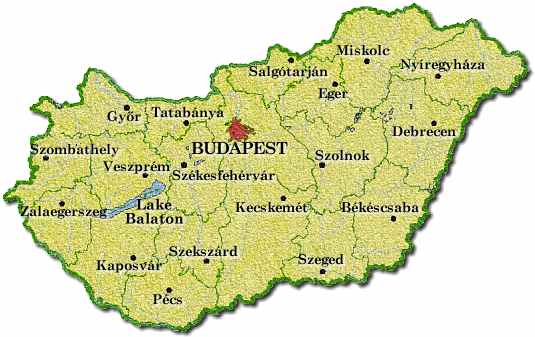
| Hungary is much like several of the countries in this area. Much fought over and very diverse. This means that each city should be very different.
I will spend 2 days in Pecs, 1 day in Sopron, 2 days in Gyor, 5 days in Budapest, and 1 day in Eger. With a buffer this equals 13 days in Hungary. |
| P�cs
P�cs was inhabited 6,000 years ago by ancient Celts. During the Roman era they founded several wine producing colonies in the area. Charlemagne annexed the area to the Holy Roman Empire. From early on P�cs was a Christian city. During the middle ages Hungary controlled the city. After the Battle of Mohacs in 1526 the Ottomans gained control of the city. They fortified it and turned it into a typical Ottoman city. When the Ottomans were forced out in 1686 they burned the city. Eventually the city began to prosper again. In the 18th century a new city was built. During WWI the country was occupied by Serbian troops. P�cs did not become part of Hungary until 1921. During WWII it suffered only minor damages. After the war development was fast and the city grew. Things to Do: Mosque of Ghazi Kossim- This former Turkish mosque now serves as a Christian church. Cathedral and Bishops Place- This 14th century chapel is worth a look. Be sure to visit the small museum. Synagogue- This is now a museum about Jewish life in the town before WWII and how the population was affected by the Holocaust. Roman Ruins- Be sure to check out the crypt and the well preserved paintings. Mining Museum- This museum shows how mining was done in the city. The underground labyrinths are interesting. P�cs Cathedral- This cathedral dates back to the eleventh century. It has been rebuilt and destroyed many times. Early Christian Burial Tombs- These ancient caverns are covered with biblical etchings. There are three different areas to explore. Sopron The area of Sopron has been inhabited since ancient times. At one point it was part of the Roman Empire, however after it fell the settlement was abandoned. Hungarians arrived in the 9th century and strengthened what was left of the Roman fortifications. During Ottoman occupation the Turks ravaged the city but did not occupy it. Due to this people from the occupied cities flocked to Sopron and its importance grew. In 1676 the town was destroyed by fire. The modern day city was born from this. After the Austro-Hungarian Empire collapsed Sopron became part of Hungary. During WWII it was bombed many times. The communist regime was unable to industrialize the city making it a great tourist destination today. Things to Do: Fire Watch Tower- Squeeze up the stair case for a great view. Fabricius House- The top two floors are a well organized archaeological museum with items dating back to the Bronze Age. Check out the underground Roman section as well. Benedictine Church- This 13th century church has been restored recently. Old and New Synagogues- These 14th century synagogues were two of the few to survive WWII. Today they house museums. Gyor The area surrounding Gyor has been inhabited since ancient times. Celts were the first to build settlements in the area. Romans moved in during the first century B.C. They abandoned the area in the fourth century due to constant barbarian attacks. The town still had inhabitants despite this. Over the next several centuries the area was occupied by the Slavs, the Lombards, the Avars, and the Franks. Around 900 the Magyars occupied the town and fortified the abandoned Roman fort. This is when the town became part of Hungary. When the Ottoman�s invaded, the Hungarians burned the city to the ground. After this the town rebuilt and during the following centuries became prosperous. In the mid 1800�s its importance skyrocketed when steamships began operation on the Danube. However this was trumped by the railway system a few decades later. During WWII several buildings were destroyed. It wasn�t until the 1970�s that reconstruction of the historic buildings began. Today it is a beautiful baroque city. Things to Do: Episcopal Cathedral- Additions have been made to this structure since 1030. Check out the frescos and the weeping Madonna of Gyor from Ireland. Day Trip from Gyor Archabby of Pannanholma- This Benedictine order was established in 966. Today about 60 monks live and work here. Be sure to check out the basilica and the library. Budapest Budapest began as the Roman town Aquincum around 89 A.D. on the site of an earlier Celtic settlement. Around the year 900 the area was occupied by the Magyars of central Asia. These are the cultural ancestors of today Hungarians. In 1361 Buda became the capital of Hungary. During the 16th century the Ottoman Empire conquered the area. It was recaptured in 1686 by Austria�s Habsburg rulers. Pest became a bustling commercial town in the 18th and 19th century. The cities were fused in 1849. This caused the population to explode. During WWII the city was occupied by the Germans and there was some destruction. After WWII the Soviet Union used Hungary as a satellite state. This was met with severe dislike and the Hungarians fought back as much as possible. In the end they did have more freedoms than any other Soviet satellite. Today it is the capital of an independent Hungary. It is a wonderful city, but still bears the scars from its difficult path. Things to Do: St. Ivan�s Cave Church- The Soviets closed this important church in the 1960�s. It is located on Gellert Hill. Citadel- Also on Gellert Hill a citadel was built in 1848 as a symbol of Habsburg pwer after a failed revolution. Inside is a museum on the history of the hill. You can also get a great view of Budapest from here. Great Synagogue- This is the largest in Europe. A tour is worth the cost. National Museum- This museum chronicles the history of Hungary. Notice the rooms on Soviet propaganda. Museum of Fine Arts- This museum has a diverse collection of European art. Jewish Museum- This museum deals with Hungarian Jewish history. There is also a section on the Holocaust. Hungarian National Gallery- This museum houses works dating form the 10th century to the present day. Holocaust Museum- This museum brings the past back to life. It tells the story of Hungarian Jews during WWII. Day Trips from Budapest Szentendre- This small town has several good art museums to check out. Be sure to visit the national wine museum as well. Esztergam- This town is often called the Hungarian Rome. Saint-King Stephen was born here. Be sure to check out the Basilica�s of Esztergam, it is Hungary�s largest cathedral. The crypt is worth a look as well. Eger The area around Eger has been inhabited since the Stone Age. During the middle ages it was inhabited by German, Avar, and Slavonic tribes. The Hungarians arrived in the tenth century. Eger has been an important religious center since its founding. The 14th through 16th centuries brought great prosperity. It became known for its winegrowing. The town was built up during the renaissance. During the Turkish occupation Eger became a border fortress. The first time around a band of 2,100 men women and children fought off 80,000 Turks. The second time the castle was surrendered. They occupied the city for eighty years. In 1687 the Habsburgs took back the town. It once again began to flourish. The ninetieth century brought many problems. First a fire destroyed much of the town. It was also under the rule of a bishop that was not well liked. During both WWI and WWII the town was affected, but there was little destruction. Today it is a prospering town with a fantastic baroque center. Things to Do: Valley of Beautiful Women- This is an evening activity. There are several underground wine cellars, each have their own vintage to try. Eger Castle- Inside you can find barracks, crypts, and a wine cellar. There are also a few museums to check out. The Varmuzeum is the best. Eger Cathedral- The paintings are worth a look. |
 |
|
|
|