 |
| France |
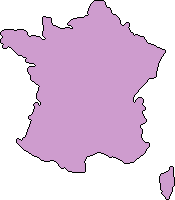
| France is a country of diverse regions. It would take forever to explore everyone, but I�m going to try and get an overview. The country has been a major area of Europe since humans have occupied the area. It takes this history, combined with the aforementioned diversity to make modern day France.
I will spend 2 days in Lyon, 1 day in Grenoble, 4 days in Nice, 4 days in Avignon, 2 days in Toulouse, 2 days in Bordeaux, 1 day in Nantes, 2 days in Quimper, 1 day at Mont Saint Michel, 1 day in Bayeux, 2 days in Tours, 8 days in Paris, 1 day in Rouen, 2 days in Arras, 2 days in Reims, 2 days in Dijon, 2 days in Strasbourg, and 1 day in Metz. With two days built in as a buffer this totals 42 days in France. |
| Lyon
Lyon or Lyons was founded as a Roman colony in 43 B.C. Soon it became an administrative city. During the second century the town was Christianized. Due to its longstanding administrative role Lyon played a significant role in French development. Then during the Middle Ages it was a cornerstone of French economics. The renaissance allowed the town to create a profitable silk trade. It was this industry that helped push Lyon into the industrial revolution. During WWII the city was a stronghold of resistance. Things to Do: Mus�e Gadagne- This museum has two sections. One is on puppets and might not be all that interesting; the other is on local history and could be a good introduction to France. Fourvi�re- This hill overlooks the city. You can take a funicular up if you are feeling particularly lazy. Mus�e Gallo-Romain-This is an excellent museum about Gallo-Roman civilization. Most of the artifacts were found locally. Mus�e des Beaux-Arts- This museum has a good collection of sculptures and paintings from every period of European art. Mus�e de l�Imprimerie- Printing became an established trade in Lyon during the 1480�s. This museum has some of the first books ever printed. Centre d�Histoire de la R�sistance et de la D�portation- This was the WWII headquarters of Lyons Gestapo chief Klaus Barbie. The museum covers both Nazi atrocities (some happening in the building) and French resistance. |
 |
| Grenoble
When the Romans collapsed Grenoble became part of the Burundian Empire. After that it was taken by the Franks, and eventually ended up in the possession of the Carolingian kings. In 1349 Grenoble became the capital of the Dauphic region of France. There wasn�t much out there on this small town. Things to Do: Fort de la Bastille- This fort was built in the 16th century. You can see an amazing view of the city from here. Mus�e Dauphinois- This is basically a history museum with some decorative arts included. The focus is on mountain people�s traditional way of life. Mus�e de Grenoble- This museum has a great collection of paintings and sculptures. There is a concentration on Rubens. The modern collection is also worth a look. Cath�drale Notre Dame et Ancien �v�ch�- This cathedral has three museums in it. The crypt holds an archeological museum; there is also a religious museum, and a collection of local art. Mus�e de la R�sistance et de la D�portation- This museum examines the deportation of Jews and others to concentration camps during WWII. |
|
| Nice
Traces of prehistoric settlements have been found dating back 400,000 years. The town was officially founded in the 5th century B.C. by the Greeks. Quickly it became a very important port town. During the 7th century Nice became part of the Genoese League. Then in the middle ages there were several wars with Italy. In 1388 the city ended up under the control of the Counts of Savoy. Due to a problem with pirates Nice�s maritime strength and fortifications were increased. The city further prospered when in 1626 the ports were opened for trade, rather than just with specific cities. In 1713 Nice once again became part of Savoy. Then in 1860 it was annexed from Italy to France. Things to Do: Mus�e Mass�na- This is considered to be an art history museum. It has an eclectic collection of paintings, ceramics, furniture, and religious art. Mus�e Matisse- This museum has works by Henry Matisse. You need to check this one out. Mus�e et site Arch�ologiques- This museum is at some Gall-Roman ruins. You can check out not only the relics, but see where they came from. Mus�e Terra Amata- This museum has artifacts form the predecessors of Homo sapiens. They date back 400,000 years. Cannes- This might make a nice daytrip depending on time. Daytrips from Nice: Monaco Monaco was founded in the 6th century B.C. by the Greeks. In 1215 it was founded again as a colony of Genoa. Then in 1297 the House of Grimaldi seized the fortress and they have ruled ever since. At different points the country was under French and Sardinian control. It wasn�t until 1861 that Monaco�s sovereignty was officially recognized. Then in 1918 a treaty was signed that gave France limited protection over Monaco. In 1993 the principality became part of the United Nations. Things to Do: Mus�e Oc�anographique- This is one of the most interesting aquariums in the world. Be sure to see the sharks! Palais du Prince- This is the princes palace. You can watch the changing of the guards. Mus�e des Souvenirs Napol�oniens- This museum has some of Napoleon�s personal effects. There is also some bric-a-brac that the princely dynasty has collected over the centuries. Casino- You might just want a tour of this during the day. However, if you do go in remember to dress as neatly as possible. |
|
| Avignon
Avignon probably began as a Celtic hill fort. It flourished under the Romans but very little of that remains today. During the 5th century the town was badly damaged by several barbarian raids. In 737 Avignon was destroyed by the Franks. Then in 1033 it became part of the Germanic Empire, but because of how far away it was the rulers didn�t pay much attention to them and they set up their own government. By the end of the 11th century Avignon had declared itself an independent state. Avignon was taken over by the French crown in 1271. Then in 1309 Pope Clement V choose this city as his residence. Due to papal influence the city became indescribably corrupt. Over all 7 popes lived here. Even though the papacy was eventually restored to Rome the city remained a papal possession. France tried unsuccessfully to annex it several times. It wasn�t until 1797 that they were successful. However, this move was not recognized by the popes until 1814. Things to Do: Saint B�n�zet�s Bridge- This bridge was originally built in 1177. It has been rebuilt several times since then. It is the one from the nursery rhyme. Palais des Popes- This palace was built during the 4th century as a fortified palace for the papal court. Mus�e du Petit Palais- This museum has a nice collection of Italian religious paintings. Rocher des Doms- This small park on a hill gives a great view of the city. Chartreuse du Val de B�diction- This monastery was founded in 1356 by Pope Innocent VI. Be sure to check out his mausoleum. Tour de Philippe le Bel- This 14th century tower can be climbed for an excellent view of the walled city. Fort Saint Andr�- French kings built this fort to keep an eye on papal activities across the river. It�s an excellent example of medieval architecture. Day Trips from Avignon Aix This city was founded in 123 B.C. by the Romans. In the 4th century it began to thrive. Then in 477 the Visigoths took control. For the next several centuries the city was sacked continuously. During the 12th century under Aragonese rule it became an artistic and intellectual center. In 1487 it was annexed by France. Things to Do: Mus�e Granet- This museum is housed in a 17th century priory of the Knights of Malta. Exhibits include Roman and Celtic artifacts, as well as paintings. There are several C�zann�s. Cath�drale Saint Sauveur- This cathedral boasts features from every major architectural period from the 5th to 18th centuries. Be sure to check out the tapestries. Paul C�zanne- C�zane was born in Aix and did much of his painting around the town. There are bronze markers in the pavement that detail his life. You can also visit his last studio. No art work remains, but his tools do. Mus�e de Vieil Aix- This museum is an odd assortment of local treasures. N�mes N�mes became a Roman colony in 50 B.C. Under the Romans the town was very prosperous. During the third century after Rome had fallen various barbarian groups sacked the city several times. With all the violence the locals became very religious and dependent on the Christian church. In 710 the Moors occupied the city, strangely this brought about a short period of expansion. 754 the Carolingians brought a time of relative piece. However, by the 12th century feudalism has brought in fighting and economic hardships. During the 14th and 15th centuries the Rhone Valley underwent a series of invasions that caused a famine. This was only made worse by the plague. In the 17th century the city began to prosper again. Of course this only lasted until the revolution. During the 19th century industries in the city expanded. Today some say that N�mes is in a golden age. Things to Do: Ar�nes- This Roman amphitheater was built around 100 A.D. It is the best preserved structure of its kind in France. Sometimes it is still used. Maison Carr�e- This Greek style temple is the most remarkably preserved Roman Temple in the western world. It was built around 5 A.D. Jardin de la Fontain- This is where the rest of the Roman ruins can be found. There is a spring, a temple, and baths. Mus�e du N�mes- This is the city�s most impressive museum. The content changes often but it always focuses on some aspect of local history. Mus�e d�Arch�ologie- This museum holds the Roman artifacts excavated in and around N�mes. |
|
| Toulouse
In 118 B.C. Toulouse fell under Roman rule, but the native Tolosates allied with them and were left to govern themselves. Under the Romans it became a great city. Then in the 5th century Toulouse was taken over by the Visigoths. Despite this the city still thrived. During the 6th century it was conquered by the Franks, and in the 8th century there were many Moorish raids. The middle ages brought feudalism and little prosperity. For a bit the city exported to the new world but this didn�t last. The city was decimated by the plague. When the revolution came to the city it forever changed the role of Toulouse. They had once had a parliament and power in government, but this had ended. During the 18th and 19th centuries the industrial revolution passed over the city. This is what has allowed it to retain a very clean and healthy environment. Today Toulouse is Europe�s capital of aerospace industry. Things to Do: Basilique Saint Sernin- This is the largest Romanesque structure in France. It was built between 1089 and 1096. Be sure to check out the crypt. �glise des Jacobins- This church was begun in 1230. The relics of St. Thomas Aquinas are here. Mus�e des Augustines- Many of the artifacts here were seized by the government or from vandalized monuments. Be sure to check out the gardens. Cath�drale Saint �tienne- This cathedral has a rather odd layout. Take note of the gothic vaulting and the rose window. Medical History Museum- This place has some pretty gruesome artifacts. It also tracks various medical crazes. Foundation Bembery- Only opened in 1995 this quickly became one of the cities most important museums. It offers an overview of five centuries of European art. |
|
| Bordeaux
Bordeaux was founded around 300 B.C. by Celtic tribes. Then around 60 B.C. it fell under Roman rule. From the 12th to 15th centuries Bordeaux was under English rule. The 18th century became known as its golden age because the wine trade began to take off. During the wars of 1870, WWI, and WWII the French government withdrew here. Things to Do: Mus�e des Beaux-Arts- This fine arts museum occupies two buildings. It has a good sample of western European art. Center National Jean Moulin- This museum has exhibits on WWII France. Cath�drale Saint Andr�- King Louis VII married Eleanor of Aquitaine here. The interior is worth a look. Mus�e d�Aquitaine- This excellent museum follows the history of Bordeaux beginning 2500 years ago. It is only in French. |
|
| Nantes
Nantes was originally founded around 70 B.C. by the Celts. Then in 56 B.C. it was conquered by Julius Caesar. During the third century the area was Christianized. Over the next several centuries the town passed between Saxon, Frankish, Briton, and Norman rule. In 937 the Normans were driven out and the Duchy of Brittany was founded. It wasn�t until 1598 that the area was annexed by France. The Edict of Nantes was signed here in 1598; this edict gave Protestants the right to religious freedom. During the 18th century Nantes became the slave capital of France. Nantes supported the revolution and many of those who opposed them were drowned in the Loire. In the 19th century it became an industrialized city. The first public transportation system in the world may have been set up here in 1826, it was called the Omnibus. During WWII German troops occupied the city. They were liberated by the Americans in 1944. After WWII Nantes lost its industrial base. Things to Do: Ch�teau des Ducs de Bretagne- This comes across as a typical 15th century castle, however, the interior courtyard is in full renaissance splendor. You can also walk around the ramparts. Mus�e d�Art Populaire R�gional- This museum has Breton costumes and other objects native to the area. Cath�drale Saint Pierre et Saint Paul- This gothic cathedral took four centuries to complete. Check out the tomb of Fran�ois II, ruler of Brittany 1458-1488. It is considered to be a masterpiece of renaissance art. Mus�um d�Histoire Naturelle- This old fashioned museum was founded in 1799. It has a really interesting collection. |
|
| Quimper
Quimper is the capital of Brittany�s most traditional region. It was originally settled during Roman times. Then in 495 it became a Bishopric. During the 11th century it was united with the Duchy of Brittany. Today it is the best place to get a real feel of Brittany. Things to Do: Cath�drale Saint Corentin- This cathedral is decorated to promote Breton myths. Make sure that you don�t take the bread. Mus�e Departmental Breton- This museum houses Breton artifacts. It will help you to understand the history of the area. Mus�e des Beaux Arts- This museum focuses on western European painters. |
|
| Mont Saint Michel
During the 6th and 7th centuries this was used as a British stronghold. In the 8th century the first monastery was completed. Normans annexed it in 933, placing it on the frontier of Brittany. During the reformation its popularity with pilgrims waned and by the time of the revolution there were scarcely any monks left. The abbey was then closed and converted into a prison. In 1836 a campaign was launched to restore it. Overall, it took over thirty years but in 1863 the prison was closed and in 1874 the abbey was declared a historical landmark. In 1979 it was named a UNESCO World Heritage site. Things to Do: Mont Saint Michel- This massive abbey sits on top of a summit. It would be impossible to not be in awe of it. Abbaye du Mont Saint Michel- This is the abbey itself. Go ahead and spring for the guided tour. �glise Abbatiale- This church was built on the tip of a mountain. It is quite stunning. |
|
| Bayeux
Romans conquered a settlement that had previously been there. During the 4th century Bayeux became the headquarters for an early Roman Catholic Bishop. In 880 the Vikings captured the town shortly after it became a Norman stronghold. Then in 1106 Henry I of England pillaged the town. During both the Hundred Years War (1337-1453) and the Wars of Religion (1562-1598) the town was besieged and taken several times by many different sides. Germans occupied the city during WWII. Bayeux was the first town to be liberated by the allied forces and the first town to greet General Charles de Gaulle�s return to France. Today it is a sleepy town with cobbled streets and homes from the 17th century. Things to Do: Bayeux Tapestry- This dramatic tapestry is reason enough for coming to Bayeux. It recounts the Norman invasion of France and the events leading up to it. This is from the Norman�s perspective. Cath�drale Notre Dame- This 13th century cathedral was built in the Norman gothic style. Take a look at the south portal, there is a window that depicts Thomas � Becket�s assassination. Mus�e Memorial 1944 Bataille de Normandie- This huge museum has artifacts from the Normandy invasion. It also has maps and does a great job of explaining logistics. British War Cemetery- This is the most important British WWII cemetery on French soil. |
|
| Tours
Originally a Gallic tribe Tours was conquered by the Romans. The name means towers. Tours became a place of worship because St. Martin was buried there. In 732 the Franks stopped the invading Norman army here. Between the years 751 and 987 the area was its own country. During the 12th century it was taken over by France. In the 16th and 17th centuries Tours had a significant Huguenot population. When the Edict of Nantes was passed in 1685 thousands of Protestants in the city were slaughtered. This slaughter caused the city to decline. Thing to Do: Mus�e des Beaux-Arts- This fine arts museum has a good collection dating from the 14th to 20th centuries. There are even two paintings by Mantegna that Napoleon nicked from Italy. Cat�drale Saint Gatien- This cathedral is a mix of styles dating back to the 13th century. Be sure to check out the stained glass windows. Mus�e des Vins de Touraine- This wine museum occupies a series of 13th century cellars. The displays concentrate on the significance and tradition of wine. Day Trips from Tours: Blois Blois was first mentioned in the 6th century; however it didn�t have a significant role until about the 9th century. In 1171 the Jews were accused of sacrificing humans and thirty one people were burned to death. Joan of Arc used Blois as her base of operations in 1492. During the 16th century the town became a resort for the French court. Many of the residents were Calvinists during the reformation. The Germany army occupied the city during WWII; in August of 1944 the Americans liberated it. Things to Do: Ch�teau de Blois- This is Blois� most stunning attraction. It has four distinct sections, medieval, flamboyant gothic, early renaissance, and classical. Besides the palace rooms there is an archeological museum. There is also a fine arts museum. Maison de la Magic- This museum concentrates on Jean-Eug�ne Robert-Houdin, the man Houdini name himself after. Cath�drale Saint Louis- The crypts date back to the 10th century and are worth a look. |
|
| Paris
The area of Paris was first settled around 250 B.C. by the Celtic Parisii. They established the settlement to control river commerce. In 52 B.C. Roman forces conquered the region. The city expanded during the Gallo-Roman cohabitation. The in the 3rd century Germanic invasions caused a sharp decline, the city was reduced to a small garrison town. However, in 512 Paris became the capital of the Frankish empire, Clovis I was king at the time. He ordered the first cathedral and abbey to be built. When he died the kingdom was divided. By the 9th century Paris was little more than a feudal stronghold. However, during the Carolingian dynasty Paris began to rise again. In 987 Hugh Carpet was elected king; this began a long running dynasty of the French monarchy. Over the next few centuries Paris grew in size, economics, and importance. During the Hundred Years War it was occupied by the Burundians. In 1437 the city was conquered and the kings moved to the Loire Valley. During the French Wars of Religion Paris remained a Catholic stronghold. King Henry IV reestablished the royal court in Paris in 1594. Due to rebellions Louis XIV moved the court permanently to Versailles. The city was at the center stage of the revolution. In 1792 the monarchy was overthrown. The industrial revolution brought Paris the greatest period of development in its history. In the 1840�s huge amounts of people from the countryside began to pour into the city. During WWI Paris was at the forefront of the war effort and was not invaded. Between the wars Paris became known for its cultural and artistic communities. In June of 1940 the Germany army began its occupation of Paris. This lasted until 1944. The city suffered almost no damage because General von Choltitz refused Hitler�s orders to destroy all monuments. After WWII the city expanded. Things to Do: Mus�e du Lourve- This will be your second trip. Be sure to find the Mona Lisa this time! Mus�e de O�Orangerie- This museum has an important collection of impressionist work. Be sure to check out the water lily series by Monet. �glise Saint Eustache- This is one of the most attractive cathedrals in Paris. It was built between 1532 and 1637. Louis XIV�s finance minister, Jean-Baptise Colbert is buried here. Centre Pompidou- This center is dedicated to promoting and displaying modern art. This is one of the most visited sites in Paris. Mus�e Carnavalet- This is Paris�s history museum. It charts time from the Gallo-Roman era to the 20th century. The museum also has a very important and impressive collection of artifacts from the French Revolution. Mus�e Picasso- This museum houses an unparalleled collection of Picasso�s work. These were all donated by his heir�s in instead of an inheritance tax. A few pieces from his personal collection are also here. Mus�e de l�Histoire d�France- You can visit documents from the middle ages here. Crypte Arch�ologique- This crypt is under Notre Dame. You can see the remains of the early Gallo-Roman structure that was here as well. Mus�e National du Moyen Age- This is the museum of the middle ages, it is also know as Mus�e de Clung. One of the two buildings that it occupies has Roman baths from around 200 A.D. There are also some illuminated manuscripts, arms, and objects d� art. Mus�e Rodin- This museum has works by Rodin and Camille Claudel. Seems like most of his famous works are here. Tombeau de Napol�on 1er- This is Napoleons extravagant tomb. Eiffel Tower- I know that you have already done it, but the sky was grey. Catacombs- In 1785 the city was overrun with corpses. This is the solution that they came up with. Mus�e du Vieux Montmartre- This museum houses objects that portray Montmartre�s bohemian and revolutionary past. It is, however, only in French. Mus�e Marmottan- This museum has the largest collection of Monet�s works in the world. Fragonard Veterinary Museum- Mus�e Fragonard d� Alfort. This museum has all sorts of macabre veterinary things to check out. Mus�e de la Curiosit� et de la Magie- This magic museum solves the question of how did they do that? It also traces the history of magic. Subterranean Wine Museum- (Mus�e du Vin) These underground chambers used to house a wine producing abbey. Mannequins portray the wine making process. Day Trips from Paris: Saint Denis This small suburb used to be the burial place of the monarchs. Basilique Saint Denis- This basilica served as the burial place for almost all French kings from 629-1824. This has turned into one of Europe�s most important collections of funerary sculpture. Although a chapel had already existed here the current building is from 1135. Most of the human remains were destroyed by the revolution, however the mausoleums are still intact. Mus�e d�Art History- This museum occupies a restored convent. This is a rather eclectic museum. There is an archeology section, a restored apothecary, and some politically charged art. Chartres Cath�drale Notre Dame- This 130 meter long cathedral is one of the western civilizations greatest architectural achievements. It was built in the 13th century to replace a Romanesque cathedral that had been devastated by fire. This is France�s best preserved medieval cathedral. Take note of the enshrined cloth- said to be what the virgin was wearing at the birth. Mus�e de Beaux-Arts- This is a small fine arts museum. It has a lot of wood sculptures form the middle ages. Old City- Take a walk around the beautifully restored old town. |
|
| Rouen
Rouen was probably founded by the Romans who called it Rotomagmus. During the 5th century it became the seat of a bishop. Then in the 9th century it was overrun by the Normans, they made it the capital of Normandy. In 1204 Rouen was annexed to the French kingdom. During the Hundred Years War Rouen surrendered to Henry V of England, he then made Normandy an extension of England. Joan of Arc was burned at the stake there in 1431. During WWII the city was heavily damaged on D-Day. The cathedral was rebuilt after the war. Things to Do: Mus�e Jeanne d�Arc- This museum is about Joan of Arc�s life. It is a bit kitschy but almost informative. Cath�drale Notre Dame- Claude Monet painted a series on this cathedral. If you time it right you can see the crypt. Mus�e le Secq des Tournells- This is a surprisingly interesting museum about the blacksmith trade. La Tour Jeanne d�Arc- Joan of Arc was imprisoned here before her death. |
|
| Arras
Arras was originally settled by Celtic tribes. It later became a Roman garrison. The city didn�t become officially French until the late 17th century. Before that it spent some time under Spanish rule. During WWI the city was on the front and heavily damaged. Then in WWII it was occupied by the Germans. Today Arras is one of northern Frances most picturesque towns. Things to Do: H�tel de Ville- Take a lift to the top of the Belfry for a great view of the town. You can also see a slide show about the city�s past. Mus�e des Beaux-Arts- There is a lot of medieval woodwork to check out here. There are also some Gallo-Roman artifacts. The town�s cathedral is also worth a look. Day Trip from Arras: Lille Legend has it that the city was founded in 640 but there are no records of its existence until 1066. During the 12th century the cloth industry flourished. At this point the city was ruled by counts. Eventually the town fell to the Duchy of Burgundy and became one of the three capitals; Lille was the administrative and financial capital. In 1477 the city was ruled by Spain. Then in 1542 the Protestants revolted against the monarchy. Louis XIV (the Sun King) laid siege on Lille and annexed it to France in 1667. The city remained Catholic due to its Spanish ties. They never joined the French revolution. Soon the textile industry began to grow, Lillie profited greatly from the industrial revolution. During WWI German bombs destroyed over 2,200 homes; they also occupied the fallen city. Then in WWII German troops once again occupied the city, it was liberated by the Americas in 1944. After the war the region was faced with a decline in industry. Things to Do: Mus�e des Beaux-Arts- This museum has a wonderful collection of 15th � 20th century paintings. There are also a few exhibits on archeology and medieval sculptures. Mus�e Charles de Gaulle- This is the house that Charles de Gaulle was born in. It has some mementoes and facts about his life. |
|
| Reims
The Romans conquered the local Remi tribe to gain control of this city. Christianity was established here in the 3rd century. Then in 406 Vandals captured the town, soon after Attila the Hun set it on fire. By the 10th century it had become a place of intellectual culture. In 1420 Reims was ceded to the English. During WWI it was greatly damaged. In WWII the German army surrendered here. Reims has also been the traditional site of French royal coronations. Things to Do: Cath�drale Notre Dame- Construction was begun on this cathedral in 1211; however it was not finished for about 100 years. For centuries this was the site of French coronations. It was damaged during WWI but then restored. Take note of the excellent statues inside. Palais du Tau- This is where the kings would stay during their ceremonies. There were many tapastries and other objects from the cathedral on display here. Basilique Saint R�mi- This former Benedictine monastery is worn but still stunning. It has been a major pilgrim site for centuries. The chandelier has 96 candles, one for each year of St. R�mis life. His tomb is here as well. Salle de Reddition- On May 7, 1945 the Nazi army surrendered in this room. This was General Eisenhower�s war room. The original battle maps are still on the walls. Mumm- This is the largest champagne producer in Reims. They offer tours with a bubbly ending. |
|
| Dijon
The Romans founded a settlement here. In 1137 the first dukes of Burgundy rebuilt the city after a fire. The dukes never spent much time here but they did add to its cultural importance. When France annexed the region the local parliament was transferred to Dijon. During the 17th and 18th centuries the city underwent significant development. Today it is a university town with a diverse assortment of museums. Things to Do: Palais des Ducs- This was the palace of the dukes of Burgundy. Tour Philippe le Bon- Climb this tower for a great view of the city. Mus�e des Beaux-Arts- This is one of the richest museums in France. Be sure to check out the guard�s room. �glise Notre Dame- This cathedral was built between 1220 and 1240. The fa�ade is extraordinary. There is also a great clock to check out. Cath�drale Saint B�nigne- This 13th century cathedral has the tombs of Burgundy�s great figures. There is also a crypt. Mus�e Arch�ologique- This museum has a lot of rare Celtic artifacts. There is also a part of an abbey here. Mus�e de la Vie Bourguignonne- This museum illustrates how rural people lived in Burgundy over the past several centuries. It is all in French. Chartreuse de Champmol- This monastery was almost destroyed during the revolution. Some excellent medieval pieces did survive. Check out the well of Moses, and the chapel doorway. |
|
| Strasbourg
The Romans established a military outpost here by the name of Argentoratum. From the 4th century it was the seat of a bishopric. During the 5th century the town was occupied by the Alamanni, the Huns, and the Franks. The later gave it its name. In 842 Strasbourg was the site of the Oath of Strasbourg, the oldest written document in the French language. Under the Holy Roman Empire the town became a major commercial center. Eventually it became an important imperial free city. This didn�t seem to be enough so in 1332 they went a step further declared itself a free republic. In the 1520�s Strasbourg citizens embraced the teachings of Martin Luther. During the Thirty Years War they remained neutral. The cities population tripled in the 19th century. Strasbourg�s status as a free city was revoked during the revolution. In 1871 it was annexed to Germany during the Franco-Prussian War. Then in 1919 the Treaty of Versailles restored it to France. WWII once again saw it fall into German control. Today Strasbourg is the seat of the European Parliament. Things to Do: Cath�drale Notre Dame- This rose colored cathedral looks too delicate to touch. It was begun in 1176, but various elements were added over the next several centuries. Mus�e de l�CEuvre Notre- Dame- This excellent museum houses a collection of Romanesque, gothic, and renaissance sculptures. Ch�teau des Rohan- Built in 132 as a residence for the cities princely bishops it stands out from the rest of the buildings. There are three museums houses here. You might want to check them out. Mus�e Alsacien- This museum offers a fascinating glance into Alsatian life over the centuries. Mus�e Historique- This museum deals with the history of Strasbourg. It was recently redone. La Petite France- This is a perfect area for a great walk. |
|
| Metz
Metz was originally founded by the Celts. It became a principle Roman town and was one of the last Roman strongholds to surrender to Germanic tribes. Eventually the area passed to the Franks. It was the residence for the Merovingion kings. In 843 Metz became the capital for Lothaingia. Numerous Christian transcripts were written here. The Holy Roman Empire took over the area in 925. During the 12th century the burgesses worked to free the town from bishopric control. The town seemed to occupy an independent position between France and Germany. In 1552 it became French. Soon after Metz was changed into an important fortress town. Then in 1871 it became a German city. After WWI it was returned to France. During WWII the Germans once again occupied the city, but it was liberated in 1944. Things to Do: Cath�drale Saint �tienne- This 13th century cathedral is huge. In reality it is two separate churches fused together. Mus�e d�Art et d�Histoire- This museum is located in a former convent and has a good collection of local artifacts. There are also some Roman baths to check out. �glise Saint Pierre Aux Nonnains- This is one of the oldest churches in France. Parts of it date back to the 4th century. Maginot Line- This is about 30 miles northeast of the city. The largest bastion is located here. |