 |
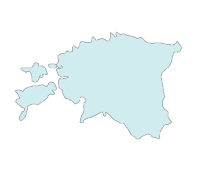
| Estonia |
| Estonia is a country filled with interesting places. Part of this comes from its diverse and sometimes bloody background.
I will spend 3 days in Tallinn, 2 days in Kuressaare, 1 day in Narva, and 2 days in Tartu. When you add a buffer that is 10 days in Estonia. |
| Tallinn
In 1285 Tallinn became the northern most member of the Hanseatic League. Then in 1345 the land was sold to the Teutonic Order by the Danes. Due to its strategic location it was very well fortified. In 1561 the city came under Swedish control. Then during the Great Northern War Swedish troops used the city to get into Imperial Russia. This didn�t really work and they retreated. The 19th century brought industrialization and a strong Russian influence. Estonia became an independent republic for the first time in 1920. During WWII the city was occupied by both the Soviets and the Nazi�s. After the war Tallinn was annexed to the Soviet Union. In 1991 Estonia once again became an independent state. Things to Do: Town Hall- Built in the 14th century this is the oldest town hall in Europe. Several of the rooms are decorated in classic medieval style. St. Olaf�s Church- This is the tallest church in town. Notice the murals on the outside that depict the architects fall from the tower during construction. Climb the tower, but don�t repeat his missteps! St. Nicholas� Church- This was originally a gothic church but it was destroyed in WWII. After the war it was rebuilt as a museum. It now holds Estonia�s most important artwork. Check out the Dance of Death by Bernt Notke. Kiek in de K�k- This tower was built in 1483. It now houses a museum on the history of Tallinn. Kadriory Palace- This was built as a summer palace for Tsar Peter the Great. The grand hall is one of the best examples of Baroque architecture in Europe. Estonian Art Museum- This is located in the Kadriory Palace and is home to Estonia�s foreign art collection. It mostly has Dutch and Flemish works. Tallinn City Museum- This museum outlines Tallinn�s history from its founding in 1219 to its current role of capital of the country. Peter the Great House Museum- The Tsar stayed here as there was not a completed palace in Tallinn. Many original furnishings can be seen. Dominican Monastery Museum- This museum deals with the history of Dominicans in Tallinn. Museum of Occupation- This museum deals with what life was like during the Nazi occupation. There is also a section on how the city evolved due to this. Kuressaare This city developed around a bishop�s castle and was first mentioned in 1381. Then in 1559 Kuressaare was sold to Denmark. In 1645 the town was passed to the Swedes. Russians took control in 1721. These factors lead to a very diverse population. In the 18th century it became a popular resort town. Then in 1990 Kuressaare was the first Estonian town to regain its self-governing status. Kuressaare is located on Saaremaa Island. Things to Do: Town Hall- Built in 1670 this building now houses an art gallery with Estonian works. Bishopric Castle- Built in 1220 this castle later became the bishopric�s administrative center. Today it has a museum on the islands history. You can even take a boat ride around the moat if you would like. Narva Narva is located on the Russian border. It was founded in the thirteenth century and was under Danish rule. From 1704 to 1918 Narva was part of Russia. Most of the people in this area are Russian speaking. During WWII much of the city was destroyed. Things to Do: Narva Castle- This castle was built in the 13th century. Be sure to check out the Narva Museum inside to learn about the history of the town. Momento Mori- This monument is to the victims of Stalin�s terror. The first Estonians sent to Siberia were from Narva. Tartu The first permanent settlement in this area dates back to the fifth century and may be the oldest city in the Baltic area. By the seventh century wooden fortifications had been built. During the Middle Ages Tartu joined the Hanseatic League and became a prominent commercial center. This brought a large German community to the area. In 1721 Tartu became the cultural center for Estonia. After WWII much of the city was destroyed. Today the city focuses on its cultural heritage. Things to Do: Tartu Art Museum- This art museum is in a building that leans a bit to the left. Tartu University- Visit the student lockup where they were put for breaking the rules. In 1870 the Estonian National Awakening began here. Cathedral of St. Peter and Paul- This building is in ruins but is worth a look. Tartu City Museum- This museum deals with the history of the city and the role it played in Estonian independence. |
 |
|
|