 |
| Czech Republic |
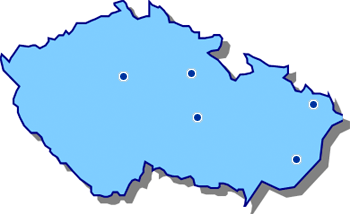
| Brno Brno became a town in 1243; however the area has been settled since the fifth century. During the fourteenth century it became a center for Moravian regional assemblies. During the Thirty Years War in Brno was the only city to successfully defend itself from the Swedish besiegements. After the war the city became an impregnable baroque fortress. In the 18th century industry and trade began to develop. Soon the town became one of the industrial centers of Moravia. During the �First Republic� from 1981 to 1938 Brno continued to gain importance. Soon it became a center of education and culture along with industry and commerce. During WWII Brno suffered serious damage. Many Czech citizens were executed. The communist era ended in 1989 with the Velvet Revolution. Today Brno is the second largest city in the Czech Republic. Things to Do: Spilberk Castle- This is where the Czech and Habsburg kings lived. Later on it served as both a fortress and a prison. During WWII the Nazi�s kept prisoners here. Capuchin Monastery Crypt- These preserved monks are fascinating. Mendelianum- This is where Johann Gregor Mendel lived. Be sure to stop by the brewery next door. Abbey of St. Thomas- This thirteenth century abbey holds many of historic treasures including manuscripts and prints. Prague Around 200 B.C. the Celts had a settlement in the area. They were later expelled by Germanics. In the fourth century the Slavs conquered the site. According to legend Prague was founded by Princess Luibuse. This might not be true, however Prague was founded in the nth century when a castle was built. Soon the city became the seat of the Kings of Bohemia. The city was also an important place for trade. During the 14th century the town flourished. Under Charles IV Prague was the capital of the Holy Roman Empire. During the 16th century Prague became a place for the sciences. Over the next two centuries the city suffered through the Thirty Years War, Saxon and Swedish occupation, and religious disputes. In 1648 the court was moved to Vienna. The city began to decline. In 1689 a great fire destroyed much of the city, soon it was rebuilt. This new Prague attracted rich merchants and noblemen causing the city to grow again. Soon the industrial revolution began to affect the city in a big way. WWI ended in the defeat of the Austria-Hungarian Empire and the creation of Czechoslovakia. Prague was the capital. In 1939 the Nazi�s occupied the city. Much of the Jewish population was killed in the Holocaust or fled the city. In 1945 the Soviet Army entered the city. After this Prague became a communist city. Then in 1967 Alexander Dubcek had a new idea for the city, it was called �socialism with a human face.� Today it is often called the Prague Spring. Many government institutions went under democratic reform. The Soviet Union didn�t like this and violently occupied the city to put down the movement. It was during the Velvet Revolution in 1989 that the Czechoslovakia freed itself from Soviet Influence. In 1993 Czechoslovakia split and Prague became the capital of the Czech Republic. Things to Do: Church of the Lady of the Snow- This church was founded in 1347. It has very tall walls but is oddly short for its length. Old Jewish Cemetery- 20,000 graves, stacked in layers, can be found here. Maisel Synagogue- This has the history of the local Jewish community. Check out the section on the ghetto. Museum of Communism-This museum exposes the flaws of communism. Czech Museum of Fine Arts- This museum has both classical and modern art. The Saint Michael Mystery- Let Kafka lead you through a Prague that no longer exists. Prague City Museum- Be sure to see the model of Prague from the 1800�s. National Museum- Look at the columns for WWII shell marks. There is a large concentration on Czech history and important figures. Kafka�s House- This has exhibits on his life. Day Trip Krivoklat- This 12th century hunting lodge has an amazing interior. There is also a long and bloody history to learn. Plzen Plzen was first mentioned in 976 as a castle, it did not become a town until 1295 when King Wenceslaus II granted it a charter. It grew quickly as it sat on the trade route between Nurnberg and Regensburg. During the Thirty Years War the town was besieged. At the end of the 17th century the architecture began to be influenced by the Baroque style. This is what you see today. At the end of WWII Plzen was liberated by General Patton�s 3rd Army. Be sure to find the monument that commemorates this. Today it is the second largest city in Bohemia. Things to Do: Pilsner Urquell Brewery- This is beer heaven. You can even drink it right out of the barrel. Visit the bar after the tour for some cheap beers. Brewery Museum- Learn everything you could ever want to know about brewing. Plzen Historical Underground- These 13th century labyrinths are over 20 km long. Museum of West Bohemia- This museum concentrates on the history of the area. Cesky Krumlov The castle began to go up in the late 13th century. This is when most of the architecture around the town dates from. During the communist era the town fell into disrepair. However now it has been beautifully restored. Things to Do: Castle- This was built in the 13th century. There are two different tours you can take. I say do both! Be sure to check out the crypt as well. Church of St. Vitus- This 15th century church has an amazing alter. |
| I�ve been to the Czech Republic and found it to be amazing. Even though it spent decades in disrepair the cities are surprisingly untouched by the wars that destroyed so many European cities. This is a wonderful place to explore the Europe of old. I will spend 2 days in Brno, 4 days in Prague 2 days in Plzen, and 2 days in Cesky Krumlov. With a buffer this equals 12 days in the Czech Republic. |
 |
|
|