| Capital: Prague Language: Czech Currency: Czech Koruna By the 6th century the area was completely inhabited by Slavic people. The first unified state was established under the Frankish merchant Samo. After his death this collapsed. In the 9th century the Moravian Empire emerged encompassing today�s Slovakia, Moravia, and Bohemia. This lasted until the 10th century when Slovakia was annexed to the Magyar kingdom. A more stable state was then formed in Bohemia, Moravia, and Silesia. The rulers extended control over the whole area. It was ruled by the Premysol house of Bohemia. They pursued independence for six centuries. In the 14th century it reached its peak when Charles IV, King of Bohemia, became the Holy Roman Emperor. In 1415 the Hussite Wars broke out. This was almost a precursor to the protestant reformation. Jan Hus was a religious reformer who was burned at the stake by the church for being a heritic. Many people where killed. These battles are particularly interesting because this was the first European war to use gunpowder weapons. In 1620 the Austrians crushed the Bohemians in the battle of White Mountain. The Austrian Hapsburgs occupied Bohemia and ascended to the throne. This brought severe Catholicization and Germanification. Despite this the Czechs managed to hold on to their heritage. After the Austro-Hungarian defeat in WWI, the Czechs and Slovaks declared independence in 1918. They had been separated for 1000 years. The first president was Tomas Garrigue Masaryk, and the country was Czechoslovakia. Quickly it became a democracy. In September of 1938 Hitler demanded the surrender of the borderland, Sudetenland. This area was mostly inhabited by those of German descent. At the Munich Conference France, Germany, Great Britain, and Italy decided that Hitler could have the land as long as he promised peace. In March of 1939 Hitler reneged on his promise of peace and took over the rest of Czechoslovakia as an extension of the 3rd Reich. Only the area of Slovakia was able to remain somewhat independent as a puppet state. The president, Tiso, was later condemned for war crimes. After WWII ended Czechoslovakia was reestablished with its pre 1938 boundaries. Benes resumed the presidency. During the Yalta Conference, which was a discussion between Churchill, Roosevelt, and Stalin on how Europe should look after the war, the country fell under control of the U.S.S.R. They filled government posts with their own supporters and managed to take over the government. Czechoslovakia became a Soviet satellite state. There was a brief relief from communism in 1968. Ludvik Svoboda became president. Due to his more liberal ideas this time was named �Prague Spring.� In August 600,000 Warsaw Pact troops invaded to prevent any further freedoms. A more conservative Gustov Husak was then made president. The Warsaw Pact was a military organization established for the eastern European soviet bloc countries to counter the perceived threat from NATO. This lasted throughout the cold war and was formally dissolved in 1991. Under Gustov Husak people began to immigrate in extremely high numbers. Then, in 1977, intellectuals signed a manifesto entitled, Charter 77, this was to protest the suppression. In 1989 helped along with changes in the GDR, Poland, Hungary, and the Soviet Union itself, demonstrators took to the streets demanding a more liberal country. In December dissident leader and playwright Vaclav Havel was elected president. Come June 1990 the first free elections in 42 years were held. The Czech Republic is the only former communist country that has not reelected a previous communist leader. In 1992 a law was passed dissolving Czechoslovakia. Therefore, on January 1, 1993 the Czech Republic and the Slovak Republic was born. Today the Czech Republic is a member on the European Union, and a favorite destination for travelers. |
Torture Museum: This one was very well done. They had more items and better explanations for those than some of the other similar museums I have seen. Sex Machine Museum: This place was full of vibrators and all sorts of crazy things, not much of it looked like it was for sex, but instead like it belonged in the Torture Museum. Old Town Square: This was amazing. There is a clock that at each hour the 12 apostles come to the windows and the death blows a horn. It was worth the crowd and standing around for about 30 minutes. Prague Castle: It was really beautiful. It sits up on a hill over the city making it even more amazing. It was also over 1000 years old. There were many things nearby to see inside the walls that are included with admission. We started with the St. Vitus Cathedral. It was huge; I have never seen such high arched ceilings. I did climb the huge tower, and feel that I deserve a pat on the back for that. The view of Prague was amazing. After that was the old Royal Palace. There were a few rooms that had pieces of the old paintings; however there was not much explanation if you didn�t want to rent the audio guide. Next was the somewhat boring St. Georges Basilica. It was pretty and I know that it has been influential, the nuns there were aristocratic.. The last part was the Golden Lane. These were little old houses that alchemist had worked in. Now they are very touristy little shops. Sad really. Terezin: Terezin was a military fortification that the Nazi�s used as a transit camp. If you had to be in a concentration camp then you would have wanted to be here. However, these people were then sent to the death camps of Poland. The museum and all of the monuments were very modern and I felt much removed from the entire event. Afterwards there was the ghetto museum. It was also very modern and I felt like it was some story, not a true event. Kunta Hora: Quite a while ago a patron of the small church brought back some ground from Jerusalem. All the sudden everyone wanted to be buried there. Then the plague happened. There just wasn�t enough space for the bodies. To solve these problems the monks began to arrange the bones in decorative designs. |
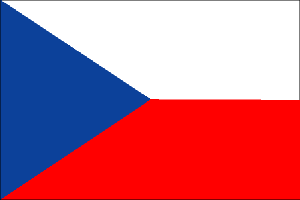 |
| Czech Republic |
| History |
| What I Saw |
| If you have any comments or questions please contact me at [email protected]. |