 |
| Croatia |
| Croatia is a new country with a very violent past. It is said that the most beautiful people of Eastern Europe are from here.
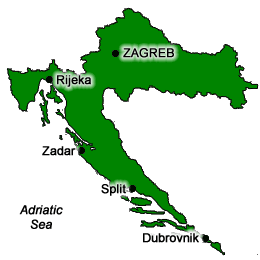
I will spend 5 days in Zagreb, 2 days in Pula, 2 days in Zadar, 4 days in Split, and 2 days in Dubrovnik. With a buffer this makes for 17 days in Croatia. |
| Zagreb
Zagreb was founded in 1094 by the Hungarian King Ladislaus as a bishopric. However, humans have been in the area since prehistoric times. During the 14th and 15th centuries the settlement thrived. By the 17th century the city was quite large. Parts of the city were destroyed during WWII. However, much growth has happened since then. Today Zagreb is the capital of Croatia. Things to Do: Cathedral of the Assumption- Despite centuries of renovations the interior is stunning. Lotrscak Tower- Climb this 13th century tower for a great view. St. Catherine�s Church- It just seems like a place I should visit. Mimara Museum- This museum has art from all over the world. Strossmager Gallery- This museum has European art dating from the renaissance through the Baroque period. Ethnographic Museum- This museum exhibits traditional cultures of Croatia. Don�t miss the cultures of the world gallery. Croation History Museum- This museum is in a former palace. It concentrates on local history. Old Masters Gallery- This museum has a great collection of the old masters. Day Trips from Zagreb There are several castles around the city. Trakoscan and Medvedgrad are the best. Pula The earliest settlements in Pula date back to the tenth century B.C. Soon the Romans built a significant settlement in the area. After the fall of Rome the city was ruled by the Ostrogoths, Franks, and the Venetians. The Slavs arrived in the seventh century. In 1150 Pula became a Venetian possession. This tied the city and its fate and fortunes to Venice. When Venice collapsed in 1797 the city became part of the Habsburg Monarchy, and then part of the Kingdom of Italy in 1805. This didn�t last long and soon the city was under Austro-Hungarian rule. After that empire collapsed Pula became part of a unified Italy. At the end of WWII the city was administered by the United Nations, but was also united with the rest of Croatia. In 1947 the city was ceded to Yugoslavia, at this point it was largely made up of ethnic Italians. Many of the residents abandoned the city. Today Pula is part of the modern Republic of Croatia. Things to Do: Amphitheater- This Roman arena was used for gladiatorial combat. It was completed in the first century. There is a wine museum in the tunnels beneath it. Temple of Augustus- Inside this well preserved temple is a small museum about ancient Rome. Historical Museum of Istria- This is a small military history museum. Archeological Museum- This is an overview of Pula�s history. Brijuni Archipelago- This is one of Croatia�s most beautiful regions. You might want to find a day long tour. Zadar The Romans founded a settlement here in 48 B.C. It maintained autonomy throughout the middle ages. When the Roman Empire fell Zadar became the capital of the Byzantine province of Dalmatia. In the ninth century it fell under rule of the Franks, but was given back to Byzantium in 812. In 1105 the town recognized the rule of the Hungarian-Croatian king Coloman. Soon the city was in frequent wars with Venice. Zadar was under the Republic of Venice from 1111 to 1154 and between 1160 and 1183. Then in 1202 the crusaders took and destroyed the city. Pope Innocent III excommunicated everyone involved. This is w hen the town began to decline. In the early 16th century the Turks captured the city. Soon the town became a stronghold. When Venice fell Zadar fell under Austrian rule. During WWII the Nazi�s occupied the city. It was bombed 72 times by allied forces. After the war it became part of Croatia, which was part of Yugoslavia. Since WWII it has developed as a tourist and economic center. Things to Do: Forum- These ruins are very interesting. St. Donat�s Church- This church sits on top of a Roman ruin. Notice that it is circular. Archeological Museum- This museum documents the early history of Zadar. National Museum- This museum offers a strangely entertaining view of the city�s history. Karnati National Park- It might be worth it to spring for a boat tour. Split This area was probably a Greek colony before the Romans arrived. The Roman emperor Diocletian, who was known for reforms and persecution of Christains, ordered a place to be built here in 293. He had plans to retire there. After the fall of Rome the structure was abonadoned for several hundred years. In 639 the interior was converted into a town. Over the centuries the city spread out. During the medieval period the area was occupied by the Croats. At the beginning of the twelth century it was controlled by Hungary. The Venetian Republic took control in 1420. In 1797 when Venice fell the city was transferred to the Austro-Hungarian Empire. By now Split had developed into an important port city. After WWI the area became part of the Kingdom of Serbs, Croats, and Slovenes. Later the name was changed to Yugoslavia. In 1941 Split was occupied by Italy and annexed one month later. Some of the town was damaged due to allied bombing. After WWII the city became part of Croatia. Despite the trials of communism the city grew into a commercial and cultural center. In 1991 when Croatia parted from Yugoslavia some of the Yugoslav People�s Army was still in the city. These actions lead to several months of an intense standoff. Things to Do: Diocletian�s Palace- This Roman fortress is huge. Today it is a living museum with various types of architecture. Cellars- This labyrinth was once the floor for the emperors. Cathedral- One of the oldest Catholic cathedrals in the world, it was originally the mausoleum of Diocletian. This is sort of odd as he was known for persecuting Christians. Mestrovic Gallery- Check out the wood carvings depicting scenes from the bible. Archaeological Museum- This museum makes shards of pottery fascinating. Be sure to check out the garden. City Museum- This museum tells the story of Split. The building itself is interesting. Day Trip from Split Trogir- The main reason for visiting this town is to see the cramped medieval streets. Cathedral of St. Lawrence- Begun in 1213 this structure was not completed until 1598. The entrance is the best part. Chapel of St. John of Trogir- climb the bell tower for a great view. City Museum of Trogir- This has information on the city�s past. Dubrovnik Dubrovnik was founded when two small towns, Laus and Dubrava joined together. The town was under protection of the Byzantine Empire. After the crusades it came under the sovereignty of Venice. Then in 1358 it became part of the Hungarian-Croatian Kingdom. Between the 14th century and 1808 Dubrovnik ruled itself as a free state. At its height it rivaled other maritime republics. In 1808 Napoleon�s forces took the area. Then in 1815 Dubrovnik was annexed to Austria. Soon it became part of Yugoslavia. During WWII the city was occupied by both the Italians and the Germans. In 1991 it became part of an independent Croatia. Today the city has been rebuilt and restored. Things to Do: City Walls- These wall include 3 fortresses, 12 forts, 5 bastions, 2 land gates, 2 port gates, and the kitchen sink. Walk the wall. Cathedral of the Assumption of the Virgin Mary- Several cathedrals have sat on this spot. Check out the relics in the treasury. Franciscan Monastery- It is possible to see the shell holes from the recent troubles. The gardens are amazing. Sephardic Synagogue- Some of the pieces on display here were hidden from the Nazi�s. |
 |
|
|
|