 |
| Bosnia and Herzegovina |
| At this point I would have already been to Bosnia and Herzegovina. I think that it is a place that we can really learn from. Often violent history, like WWII and other European conflicts seem to be very far removed from our own lives. This is a country where you will be able to truly understand it.
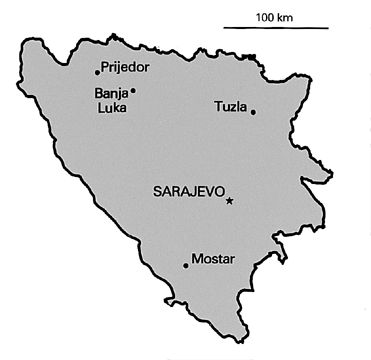
I will spend 2 days in Mostar and 2 days in Sarajevo. With a buffer this is 6 days in Bosnia and Herzegovina. |
| Mostar
Mostar was founded in the 15th century. It was the main administrative city for the Ottoman Empire in the Herzegovina region. The city was absorbed by the Austro-Hungarian Empire in 1878 and then became part of Yugoslavia after WWI. After WWII the city became an important industrial center. In 1992 Bosnia and Herzegovina declared independence from Yugoslavia. The town was then subjected to 18 months of siege. Much of the city was destroyed. After the Serbs were driven out, the heavily armed Croat forces turned their guns at the Bosniaks. What followed was mass execution, ethnic cleansing and rape on the Bosniak people. Since the end of the war in 1995 great progress has been made in reconstructing the city. Things to Do: Karadzozbeg Mosque- Built in 1557 this mosque was completely destroyed by the War. The Turkish government paid to rebuild it. Old Bazaar Kujundziluk- This is the Muslim area of the city. It is worth checking out. Sarajevo The area of present day Sarajevo has history dating back to the Stone Age. During Roman times a town named Aquae Sulphurae was on the site. The city was founded in 1461 when the first Ottoman governor of Bosnia made the small settlement into a state capital. Sarajevo flourished in the 16th century. Then in 1697 the town was burned down by the Prince of Savoy. The Austro-Hungarian Empire took control of the city in 1878 and quickly made it an industrial center. The event that triggered WWI happened here when Archduke Franz Ferdinand of Austria and his wife were assassinated here on June 28, 1914. After the war Sarajevo became part of the Kingdom of Yugoslavia. When WWII ended the city became a thriving industrial city. On April 6, 1992, the Bosnian Serb army surrounded the city. The warfare lasted for three years, destruction was everywhere. Reconstruction began shortly after the war ended. Things to Do: Eternal Flame- This is a memorial to those who died in WWII. Remnants of the Siege- Notice the splashed of red concrete, someone was killed on that spot. National Library- Not much of what was once is still here. However it is an important place in Sarajevo history. Places of Worship- Long known for religious tolerance Sarajevo has some interesting things to visit. The orthodox cathedral is worth a look, as is the Old Synagogue and the Church of St. Michael the Arch Angel. Turkish Quarter Bazaar- Bargain hard for the things that you want. Assassination Site- This is where Archduke Franz Ferdinand was shot. His assassination kicked off WWI. National Museum- There is a great ethnographic museum here. History Museum- This museum focuses on the recent siege. |
 |