 |
| Belgium |
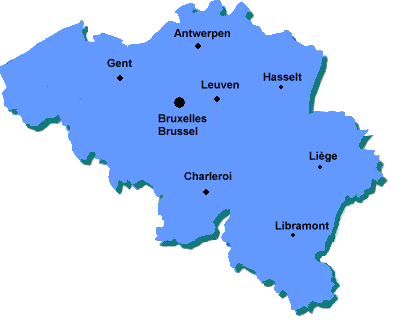
| Belgium is a small country whose strategic location is evident by the many conquering forces to rule it. The multi-cultural influence is very apparent throughout the country.
I will spend 4 days in Brussels, 1 in Dinant, 1 in Ypres, 1 in Bruges, 1 in Ghent, and 1 day in Antwerp. With an extra day for a buffer that makes 9 days. |
| Brussels
In 979 a small castle was built here by Charles of Lotharingia, the son of French King Louis IV. At the end of the 10th century it was taken over by Lambert I of Veuven. He was the first to build city walls. During the 12th century Brussels became an important stop on the road from Cologne to Bruges. In 1695 the city was attacked by Louis XIV and much of the medieval city was burned. Then in 1831 L�opold I, the first king of Belgium, began making improvements on the city. During WWII the German army heavily bombed the city. Today Brussels is the capital of the European Union. Things to Do: Mus�es Rayaux des Beaux Arts- There is a huge section on the Flemish masters in this museum. Be sure to notice Bruegel the Elder�s landscape with the fall of Icarus. There is also a modern art section with Dutch and Flemish impressionist. Check out the Van Gogh�s and Seurat�s. From the 4th floor your can get a panoramic view of the city. Mus�e de la Ville- This museum focuses on the history of Brussels. Check out the old photos, maps, and models. There are also costumes from the closet of Manneken-Pis. Mus�e du Cinquantenair- This huge museum covers a wide variety of periods and regions. Be sure to check out the �Salle au Tregor.� Mini-Europe- Ok, so this is super cheesy, but I think it would be good for a laugh. This is a strange collection of miniature landmarks throughout Europe. Cath�dral Saint Michel- This cathedral mixes Gothic and modern styles. Jeanneke Pis- This is the female version of the Manneken Pis statue. This is located at the end of Impasse de la Fidelit�, off rue des Bouchers. Mus�e des �gouts- This sewer museum has both above and below ground exhibits. It seems a bit weird, but I think it would be interesting and a good change from all of the art and history museums. Daytrips: Warterloo- There is a visitor�s center here that explains the battle. You can also check out the battlefield. This should take most of the day. Be sure to also visit the nearby Mus�e Wellington. This was the British Generals headquarters. Today it holds artifacts from the battle. Mechelen- This is just a nice little town with a few good attractions. St. Rumold�s Cathedral- This church ahs amazing stained glass windows. Be sure to check out the bells. You can and should climb the tower. Jewish Museum of Deportation and Resistance- These 18th century military barracks were used as a camp for Jews while on their way to Auschwitz. Dinant This area was strategically located and often fought over and pillaged. In 1466 an uprising was punished by Philip the Good. Eight hundred Burghers were thrown into the Meuse and the city was burned. During the late medieval ages the city was known for its needlework. In 1914 Dinant fell to the Germans during the Siege of Namur. Locals fought back and the Germans pillaged the city many different times. They rounded up 612 men, women, and children and then killed them. The youngest was three weeks old. Today the biggest industry is tourism. This works as a nice daytrip from Brussels. Things to Do: Citadel- It is possible to take a tour of this fortress. La Grotte Merveilleuse- This is the reason for visiting Dinant. The caves here are amazing. |
 |
| Ypres
Ypres is a very ancient town. In the first century B.C. it was raided by the Romans. During the middle ages it was a prosperous city known for its linen trade with England. The population was around 80,000. In 1385 the city began to fortify in order to keep out invaders. Some of these fortifications still survive. During the 13th century cats were thrown from the cloth hall to ward off evil. Today there is a cat parade once a year to commemorate this tradition. Then in the 17th and 18th centuries it was further fortified under the occupation of the Hapsburgs and the French. In WWI Ypres was the center of intense and sustained battles between the Germans and the British. The town was all but obliterated. Many of the buildings we rebuilt closely to their original designs. Today Ypres is a city of peace and has close ties with Hiroshima. Things to Do: Flanders Field Museum- This museum documents WWI and the fighting that was in the area. St. George�s Memorial Church- This was constructed in 1928 as a memorial to the victims of the war. Each brass plate and pillow commemorates a unit or person. Menin Gate- The names of 54,896 British soldiers who were lost in the trenches and never received burial are listed here. Nearby is the Rose Coombs walk which leads you to the Ramparts Cemetery. This is only one of the over 150 British cemeteries around Ypres. |
|
| Bruges
Bruges was founded in the 9th century by the Vikings. Due to the city�s location in proximity to the North Sea it quickly became an important international harbor. During the 12th century Bruges gained city rights and a protective wall was built. Due to the city�s location in proximity to the North Sea it quickly became an important international harbor. During the 12th century Bruges gained city rights and a protective wall was built. Then the passage to the North Sea, the Zwin, started to silt up. This would have been a major problem, but the city adapted by creating out ports. They also transported more goods over land. In the 14th century Bruges became a starting point for transferring goods to the Rhineland. Quickly it once again became an international financial and trading center. Many countries had representation there and the city became a European center. Decline set in during the 15th century when much of the harbor activity moved to Antwerp. This was also the time of the Flemish painting school. By the 16th century the city�s former glory was only a memory. The 19th century brought poverty to the city. In the 20th century new life was brought to Bruges as it was dubbed the Venice of the north. Tourism has flourished since then. Things to Do: Belfort- This 88 meter medieval bell tower is a good place to get an overview of the city. You just need to climb 366 steps. Basilica of the Holy Blood- This basilica houses a relic that is said to hold Christ�s blood. Groeninge Museum- This museum has a collection of Belgian and Dutch paintings from the last six centuries. There is also several by Jan Van Eyck. Memling Museum- This is one of the oldest surviving medieval hospitals in Europe. Church of Our Lady- This church contains Michelangelo�s Madonna and Child. There are also medieval frescoes and tomb fragments. |
|
| Ghent
Archeological evidence shows that there has been a human presence in the area of Ghent since the Stone and Iron Ages. During the Roman period the area was still inhabited but no written records exists from this time. The Franks invaded in the fourth century and brought with them the ancient Dutch language. Around 650 two Abby�s were founded by St. Amand. The city grew from these. In 851 and 879 the city was plundered by the Vikings. Ghent was able to recover and once the eleventh century hit the city flourished. Soon it became the largest city in Europe after Paris. During the middle ages it was an important city for cloth. Then in 1540 Charles V, Holy Roman Emperor and King of Spain, punished the rebellion by making the citizens walk by him barefoot with a noose around their necks. The religious wars of the 16th and 17th centuries brought many problems. Eventually the Spanish army enforced Catholicism. The War of 1812 between Britain and America was ended here with the signing of the Treaty of Ghent. Then in 1830 Ghent became part of Belgium after the Belgium Revolution broke apart the kingdom of the Netherlands. During WWII parts of the city was destroyed by bombs from both the Allies and the Germans. Today Ghent is a beautiful city rich in history. Things to Do: Gravensteen- This medieval fortress will give you chills just looking at it. It was built by Philip of Alsace after he returned from the Crusades in 1180. There is a torture chamber that you can tour. It is also possible to climb the ramparts. Belfort- Climb this tower to get a great view of the city. Saint Bavo�s Catrhedral- This church has some amazing artwork to check out. There is also a crypt to visit. Museum voor Schone Kunsten- This art museum houses both ancient and modern masterpieces. Notice the Rubens and Van Dyck�s among other notable artists. |
|
| Antwerp
According to folklore the city got its name from a mythical giant called Antigoon that lived near the river. The giant took tolls from those who wanted to pass the river. If they would refuse to pay he cut off their hands. Eventually a hero named Brambo cut off the giants head and threw it into the river. This might not be true, but it is known that people have occupied this as early as the second or third centuries. Around the seventh century the town was fortified. This is also when the city was Christianized. In the ninth century it was part of the Lorraine Valley and was destroyed by the Normans. At the end of the 10th century it became a border province of the Holy Roman Empire. During the 12th century Saint Norbertus founded St. Michael�s Abby. The city continued to expand. However the first real economic boom was not until the first half of the 14th century. Antwerp became the most important trading and financial center in Europe. Then in 1356 the city was annexed to the county of Flanders. Soon it became a world class city at every level, sort of a 16th century Manhattan. 1560 was the year of highest prosperity. All of this wealth was reserved mostly for the very wealthy and the less skilled workers suffered. In 1566 the Reformation erupted violently. Then in 1572 the 80 Years War broke out. This was the war that freed The Netherlands from rule by the Spanish King. In 1576 the Spanish plundered the city, killing 6000 people. Then to make matters worse trade was ended on the Scheld when the Treaty of Munster was signed. By 1800 the city had reached its lowest point. During WWI it was taken by the Germans, then again in WWII. During the second war it was badly damaged. Things to Do: Steen Castle- This 13th century castle houses a maritime museum. Cathedral of Our Lady- Check out Ruben�s decent from the cross here. Royal Museum of Fine Arts- This museum has one of the world�s finest collections of Flemish old masters paintings. |