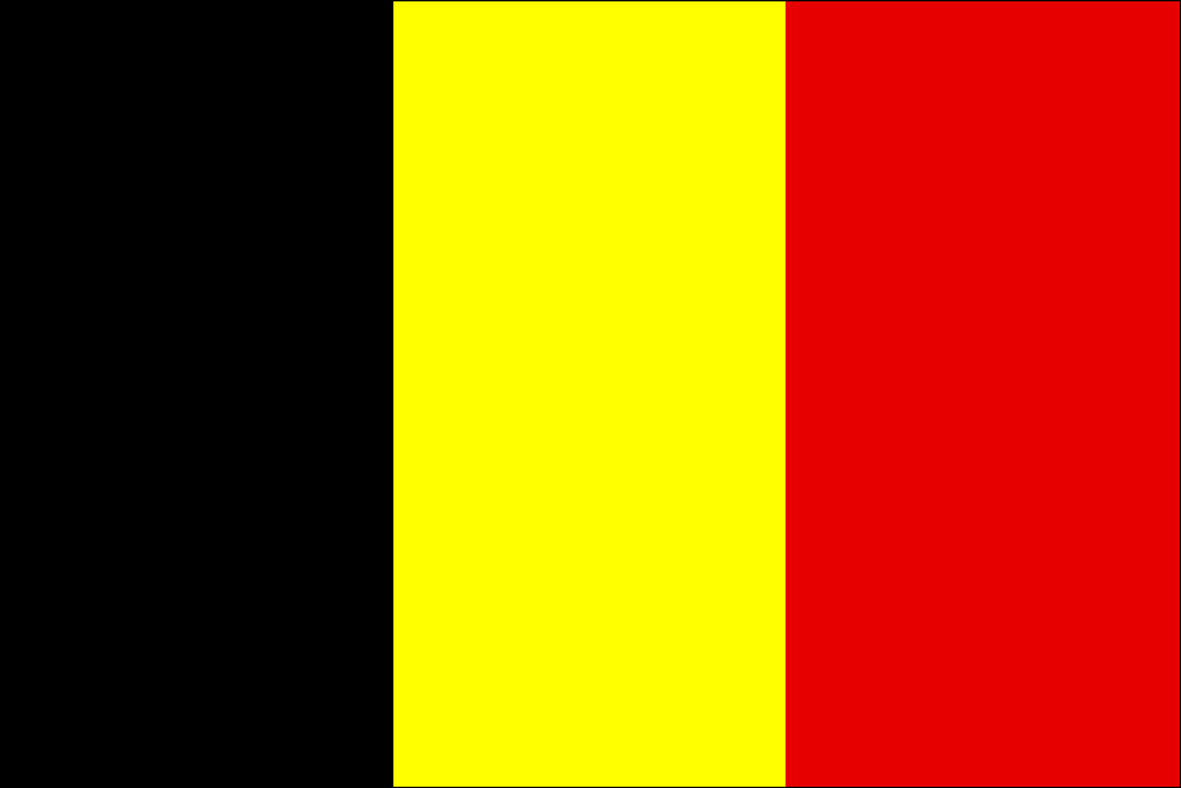
| Official Name: Kingdom of Belgium Capital: Brussels Language: Dutch, French, German Currency: Euro Around 57 B.C. Julius Caesar extended Roman rule into Belgium. By 431 the Germanic Franks had taken over and established a capital at Tarnai. This city can still be visited today. In 768 Charlemagne, who ruled for almost 50 years, had a territory that included most of Europe. He began the tradition of using Belgium�s rivers for trade routes. After Charlemagne�s death three of his grandsons split the land with the Treaty of Verdun in 843. This didn�t last for very long, as some parts were held under the rule of German kings. The split set forth by the Treaty of Verdun was to affect Belgium for the rest of its existence. The northwest belonged to France and the Counts of Flanders rose to power through this alliance. They created fortified towns; Ghent, Bruges, and Ypres are examples of this. The southeast part was ruled by German kings. In 977 Charles, duke of Lorraine, built a fortress that was to become Brussels. The southwest part was split many different ways, one small area is the current day Liege. By 1300 the Flemish cities had become wealthy thru trade. They brought wool from England and then wove it for sale on the continent. This allowed the Flemish cities to develop without aristocratic rule. However, this ability didn�t make the seemingly disposed aristocrats very happy. In 1302 French nobility attacked but the cites were able to fight them off the at the Battle of the Golden Spurs. In 1329 the cities could hold out no longer and the French took over. England was not pleased and stopped sending wool. The English began a long attempt too break French power. This became known as the Hundred Years War (1337-1453). This ended when Philip the Bold of Burgundy became ruler of the Flanders in 1384. The Burgundian Empire in Belgium expanded and flourished. Philip the Good (1419-1467) gained control of Brussels, Namur, and Liege. He brought all of the cites under central rule to be governed from Brussels. Cultural development flourished. This is the time of Van Eyck and Rogier van der Weyden. In the 1490�s Bruges� waterways silted up and Antwerp emerged as the center of trade. Soon the battle between the Catholics and Protestants reached Belgium. The north managed to hang on to their independence, but the south became known as the Spanish Netherlands. In 1648 the Treaty of Munster the Spanish admitted that the north was indeed independent, but also that they would no longer run trade ships through Antwerp and Ghent. Those cities soon lost their important role in trade. France became the most powerful state and under the rule of Louis XIV (1659-1715) tired to control the Spanish Netherlands. Neither England nor the Dutch wanted this and Belgium became one large battlefield. This reached its climax during the war of Spanish Succession (1702-1713) when King Charles II of Spain died childless. His appointed successor, Philip of Anjou, was Louis� grandson and soon turned over the Spanish Netherlands to France. The Dutch, English, and Austrian armies tried to reject Frances�s rule. In 1713 with the Treaty of Utrecht France ceded its claim to the Hapsburgs of Austria. When the French Revolution (1789) broke out the country rose up against the Austrians. In 1790 independence was declared for Belgium. However the government was week and France took over once again. Rule was harsh and Belgium was used as a source of revenue and troops. With Napoleon French rule became more constructive. When Napoleon had been captured the allies decided that Belgium should be ruled as a part of the Netherlands. By 1830 this wasn�t good enough for the people and revolution broke out. On January 20, 1831 Belgium became an independent nation. Leopold of Saxe-Cobury was to be the first king, he would rule with limited powers. . During WWI Belgium was ruled harshly by the Germans despite resistance. In 1940 Belgium was invade by Germany again. The government left for the relative safety of London. They also surrendered to the German forces, much to the distaste of the Belgium people. Allied forces liberated Belgium at the end of 1944. Now Brussels is the capital of Europe as the EU government is located there. Belgium is also part of the Benelux Union, which also includes Luxemburg and the Netherlands. The royal family is still in existence; however their powers limited. They can suggest ideas and propose steps that the country should take but cannot truly create law. |
 |
| Belgium |
| History |
| I didn�t spend much time in Belgium, only about 3 hours, so it is definitely a place that I would like to go to again. Here is a list of the things that I did see: Brussels Mannequin Pis- This statue of a young boy urinating has become a fun mascot of the city. He has a huge wardrobe of donated clothes; however, he was naked when I saw him. Waffles- I went to a proper restaurant and was rather disappointed. The ones being sold on the street smelled much better. |
| What I Did |
| If you have anything to add or any questions e-mail me at [email protected]. |