| Official Name: Republick �sterreich 8.2 Million People, Size is about double that of the Netherlands. The Capital is Vienna Currency: Euro Language: German The Romans settled in present day Austria in about 200 B.C. By the mid 500�s A.D. Germanic tribes from Bavaria had moved in and taken over. Around 800 Charlemagne, King of Frank and soon to be Holy Roman Emperor, founded Ostmark. It is easy to see where the current country name came from. In the 12th century the capital was moved to Vienna, where it remains in present day. This is when the Cathedral of St. Stephen was built. About 100 years later the Hapsburgs began their 640 years of rule. Vienna became their imperial stronghold from the beginning. After winning the Turkish Wars in 1699 Hungary became part of Austria and the Austro-Hungarian Empire was born. Arts and culture surged. This is when Schlossbrunn was built. Further enlightened rule and reform came from both Empress Maria Theresia (1717-1780) and her son Joseph II. The French Revolution in 1789 meant great change for Austro-Hungary. After Napoleon was defeated the Chancellor, Metternich, tried to reconsolidate the once much larger country. The people rebelled and were met with harshly enforced censorship. Eventually Emperor Franz I abdicated his thrown to the much more popular Franz Joseph. Franz Joseph ruled for 68 years. With his wife, Sisi, he created the image of Imperial Austria that is still seen today. In June 1914 the Austrian Duke Franz Ferdinand was assassinated in Sarajevo. Austria declared war against Serbia. The declaration came more from the possibility of government responsibility for the assassination than for the act itself. World War one began. After the war in 1918 the first Republic of Austria was established. However, it was a difficult place to live. The depression several years later made food and jobs scarce. In 1938 Austria was annexed by the Nazi�s and became part of Nazi Germany. After WWII it was occupied by the allied armies until 1955. Now Austria is a neutral country. It is also a very wealthy country with much to offer visitors. In 1995 Austria became part of the European Union. |
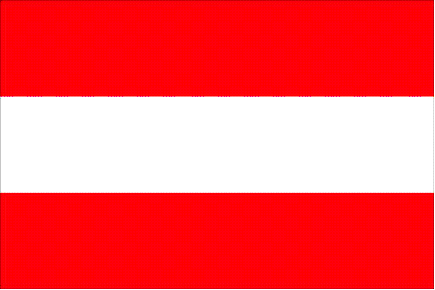 |
| Austria |
| Everyone thinks of Vienna as an amazingly beautiful imperial city, and it really is. Here are a few of the things that I did while I was there and my thoughts of them. Altstaddt: This is the old area of any German speaking town. Vienna is no exception. The old town is clearly marked on a map. There is a street call der Ringe that encircles it. Once you step in there you are in old Vienna. Kaisergruft: This is where the bones of the Emperors and Empresses of the Hapsburg Empire are buried. I mention the bones because their hearts and intestines are buried elsewhere. Many of the monarchs are in ornate tombs covered in forever weeping women and skulls to remind us of mortality. Some notables buried here are: Emperor Franz Joseph, and Empress Maria Theresa. I tend to really like the creepy aspect of history so I did enjoy seeing this and would recommend it to anyone. Jewish Museum: This place was a bit odd. I had expected something typical with displays on Jewish life and then the Holocaust. Instead the main exhibit was a room with about 23 holograms in it. Each object was explained. I think that the idea was sort of interesting. An object may be historical but it can�t be historic, that would be the story behind it. Hofburg Palace: This building has been worked on for the past 800 years and was occupied by the Kaiser until 1918. Although there are several attractions within the building most people choose to visit the very impressive Kaiser�s Apartments. That is what I did as well. It was beautiful; however I would have preferred more explanation for what I was looking at without having to rent a walking tour thing. As far as imperial palaces go it was much like every other one that I have seen. If you love this sort of thing by all means go, if not, buy some strudel instead. Juden Platz: These are the remains of a synagogue that was destroyed in 1421. The museum was very small and was centered on the medieval synagogue. It did focus on the structure itself, but also what Jewish life in Vienna would have been like. The most interesting bit of the visit is to see the ruins themselves. These are nothing more than a small stone outline. It was very interesting, if not terribly exciting. Criminal Museum: None of this is in English so I had to struggle with my German. As my German is pretty bad that took away from the displays quite a bit. I knew that it would be a bit gruesome, but not like this. There was even a mummified head of a victim. Dozens of skulls from both murderers and the murdered sat next to lengthy explanations. This is a bit out of the way and might not be great for those of the faint of heart, or lacking in German. Stephansdom: This is an amazing old cathedral. I wanted to take a tour of the catacombs so I ended up sitting there for about 45 minutes. It really forced me to study the paintings, sculptures and architecture. It really was amazing. Finally my wait was over at it was time for the catacombs. There were some important Cardinals and the guts of the Hapsburgs that I mentioned earlier. The creepiest was the rooms filled to the brim with decaying bones. It was very interesting. Most of the bones were from the plague. Schloss Brun: This was the summer residence of the Hapsburgs. The palace was something else. That�s really saying something as I insist on walking into every single palace that I cross. Some of it is in the process of being redone. So many important things have happened there. Kings and queens of course. Also this is the first place that Mozart played at age 6. The last Hapsburg king stepped down here as well. Most recent was a cold war meeting between JFK and Kruchev. The tour came with an audio guide making it more interesting. I even spent some time in the gardens, despite the cold. Medical History Museum: Apparently there are two of these. One is 400 year old wax figures made in Vienna, the other about anatomical abnormalities. Nothing was in English and I found it to be rather boring. There is just so much time that you can spend looking at body parts. Art History Museum: Most of the pieces represented had all belonged to the Hapsburgs; can you imagine having a collection like that? Also headsets were free. I had never had them at a museum before. I ended up spending three hours in there! I learned so much about the paintings and I didn't even listen to everything. I think it would be impossible to do that. Many of the paintings were of biblical stories, actually way more than I would have thought. I really learned a lot. I think that I have a new appreciation for art museums now, even though I have always loved them. |
| Vienna |
 |
|
| Salzburg |
| When you think Salzburg one of two things can come to mind, The Sound of Music, and Mozart. Maybe they are closely related. What people don�t tend to think is about a small town in the middle of the mountains that is just breathtaking. This is one city where you could just get a cup of tea and sit and stare forever without getting bored. I didn�t have as much time as I would have liked because of the flood in 2002. I had to hurry back to Dresden to make sure that I could get to work in time. Sound of Music Tour: Just don�t, take my word for it. It is too terrible to speak of. Catacombs: I don't know why they called them that; all they really know is that hermits had lived there. There was also two alters. The cemetery surrounding it was really the best part. The graves were ornate and well taken care of. Some of them even dated back to the 1600's, when the cemetery began. I found out that the families rent the plots for 60 years at a time; if they do no renew it then they lose the plot. Dom: This is the cathedral that owns the cemetery. It was amazing with arches and lofty ceilings. I must confess that I am not big into ecclesiastical art so there are very few cathedrals that really enthrall me. Hohen Salzburg Fortress: This was built to protect the archbishops of Salzburg and is the largest of its kind still intact. The two museums in the Festung were a bit boring. The one on the history was very well done, but there wasn't much to it. There was also a museum about Austrian Military History. There is also a small puppet museum which wasn't worth the money. The fortress did however offer a free tour, the best part was the torture chamber, but it was never used. At one point you can climb up a tower to get to a panoramic view of the city. That was the best bit. Resedenz: This is another palace. It was also quite nice, I learned more about the building than about those that had lived there. On the top floor there is a small art museum. None of the art is that impressive but they have papers you can keep explaining different types of art and movements. |
| Do you want to ask me any questions about Austria? Have anything to add? [email protected] |
| History |