The Articles of Confederation
A
WEB QUEST BY RACHEL TINSLEY, SCIENCE SKILLS CENTER HS,
BROOKLYN, NY,
11201
|
|
Before
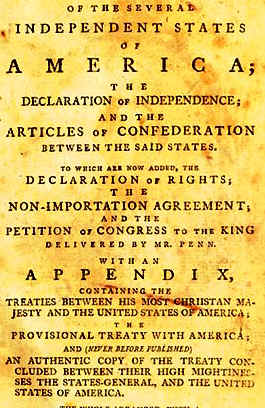
the Constitution....there was The Articles of Confederation-- in effect, the
first constitution of the United States. Drafted in 1777 by the same
Continental Congress that passed the Declaration of Independence, the articles
established a "firm league of friendship" between and among the 13
states.
THE TASK:
You will use the Internet and your textbook to research the Articles of Confederation and Shays' Rebellion. You will use the information gathered from the Internet along with other resources to assess whether or not the Articles of Confederation provided the newly created United States with an effective government.
THE PROCESS:
Part one: You will use the Internet to research the Articles of Confederation and Shays' Rebellion. Individually you will answer the questions listed in this part.
Part two: Once the questions from part one are answered, the class will be divided into groups of three. Each group will be assigned a specific focus question taken from the individual question list. The groups will discuss their group question and come up with a group answer. Using their collective information, the Internet, and your textbook, each group will write 4 or 5 important details to elaborate upon their group response.
The class will complete a PowerPoint presentation on the Articles of Confederation and Shays' Rebellion. Each group's information will be placed into your group slide. Each group is to insert a graphic into their slide. The groups will select a presenter to explain their slide to the rest of the class. Each group is required to answer the summary questions together. You will hand in the answers to your individual and group summary questions at the end of the period.
HISTORICAL THINKING STANDARDS
This lesson addresses the following standards:
Standard 2D, 2G: Evidence historical perspectives; Draw upon visual sources
Standard 3B, 3D, 3E, 3J: Compare and contrast differing sets of ideas, values, personalities, behaviors, and institutions; consider multiple perspectives; Analyze cause and effect relationships and multiple causation, including the importance of the individual, the influence of ideas, and the role of chance; Hypothesize the influence of the past
Standard 4B, 4C: Obtain historical data; Interrogate historical data
Standard 5A, 5B, 5D, 5E, 5F: Identify issues and problems in the past; marshal evidence of antecedent circumstances and contemporary factors contributing to problems and alternative courses of action; Evaluate alternative courses of action, Formulate a position or a course of action on an issue, Evaluate the implementation of a decision