|
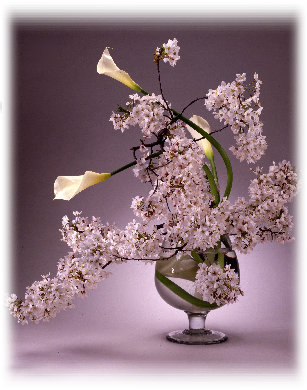
WHAT IS IKEBANA?
"Whatever you see,
let flowers be in it.
Whatever you think of,
let the moon be in it."
BashoIkebana, the Japanese word for arranging
living things, is based upon universal principles
of all art forms which are recognized all
over the world. While painting is an expression of art drawn on a canvas with a brush,
Ikebana is an expression in three dimensions with branch material, flowers, and
leaves arranged in a container of water. The
sculptural quality of Ikebana, using live materials makes this a unique beauty that only
live plants can express. One learns to respect and appreciate the natural beauty of
the seasons and the way that plants
grow.
Although all seasons have their own beauty, it seems that
spring is the season that most expresses the
beauty of line that the Japanese love.....bare
branches of winter with a few buds breaking
through with the promise of spring. That is
why the cherry blossom in Japan is always
expected with great anticipation.
This art is
steeped in the philosophy of developing
closeness with nature. In cutting branches
the yard or woods and combining that with
beautiful flowers you have created a scene
from nature to enjoy in the home.
In the class studying Ikebana, we learn
measurements, placement, and compatibility
with the container to create a harmonious
picture. Plants are always used as if they are
growing in the beginning stages of Ikebana.
Later the more advanced classes enjoy
creative arranging.
This study helps
one to appreciate the insignificant in nature
as well as many surprises!
A BRIEF HISTORY
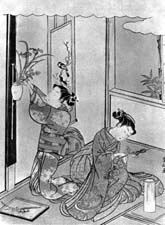 | The origin of ikebana is the ritual flower offerings in Buddhist temples, which began in the sixth century. In these arrangements, both the flowers and the branches were made to point toward heaven as an indication of faith. |
A more sophisticated style of flower arrangement, called rikka (standing flowers), appeared in the fifteenth century. The rikka style reflects the magnificence of nature and their display. For example, pine branches symbolize rocks and stones, and white chrysanthemums symbolize a river or small stream. The rikka style became popular in the seventeenth century, and it was considered as a decoration for ceremonial and festive occasions.
The most significant changes in the history of ikebana took place during the fifteenth century, when the Muromachi shogun Ashikaga Yoshimasa (1436- 1490) ruled Japan. The large buildings and small houses that Yoshimasa had built expressed his love for simplicity. These small houses contained a tokonoma, or alcove, where people could place objects of art and flower arrangements. It was during this period that the rules of ikebana were simplified so that people of all classes could enjoy the art.
Another major development took place in the late sixteenth century. A more simple style of flower arrangement called nageire (meaning to throw in or fling in) appeared as part of the tea ceremony. According to this style, flowers are arranged in a vase as naturally as possible, no matter what materials are used. Because of its association with the tea ceremony, this style is also called cha-bana.
The opening of Japan to Western influence from the beginning of the Meiji era (1868-1912) brought great changes to all aspects of national life. In ikebana, the style called moribana, literally "piled-up flowers,"created by Ohara Unshin (1861-1916), founder of the Ohara school, totally revolutionized the art. Whereas in all traditional styles, the materials were gathered to emerge from the container at a single point, Ohara used various kinds of supports to arrange cut plants over an extended surface in wide, shallow containers called suiban, literally "water basin." This allowed for the use of new, imported materials that could not be accommodated to traditional styles. It also permitted the creation of landscape styles, shakei, that depicted scenes from nature in a naturalistic rather than symbolic fashion. Another important innovator was Adachi Choka (1887-1969), who adopted moribana, and described his work simply as "decorative."
Innovations continued with the appearance of many other modern schools. Teshigahara Sofu (1900-1979), founder of the Sogetsu school, promoted ikebana as modern art that should encourage free, creative expression.
The contemporary scene is dominated by three large schools-Ikenobo, Ohara and Sogetsu -- each claiming over one million members, but there are also thousands of other schools large and small.
|
|