Looking for jazz CDs?

|
Looking for jazz books ?
 |
|
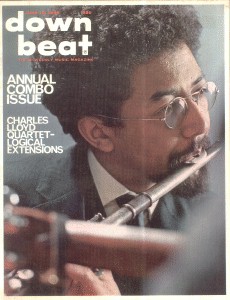
by Burt Korall
Down Beat, June 16, 1966,
p. 20-21
Photos: Columbia Records, Lee Tanner
IT IS NOT Charles Lloyd's way to make public declarations about himself or to give sermons in print concerning the extramusical implications of what he plays and composes. Tall, lean, bespectacled, he carries himself with quiet dignity, speaks softly and without malice. In the tradition of musicians, be prefers to search within himself and reveal through music what is on his mind.
A composer, saxophonist, and flutist, Lloyd came on the national scene with the Chico Hamilton group in 1961 and then spent a year with Cannonball Adderley's before forming his own quartet last year.
Like many of the younger men in jazz, his music is couched in the terms of his time. It can he raw and restless, cutting and jolting to the nervous system. There are the moans and squeaks and screams, the rhythm running free, mixing and mingling with strands of sound.
Also, however - and this is crucial - there are many moments of beauty, for the music of Charles Lloyd has about it a singing quality, a lyricism, that defines many of the warmer, optimistic feelings of life ignored by or unknown to various of his contemporaries.
Most important, that which emerges from his cauldron of creativity is not overdone or without shape or sense of craft. Much concerned with the craft and art of making music, Lloyd feels that by ever-sharpening his skills as a writer and player, he can cut the distance to the listener and dredge deeper within himself to undiscovered springs. Communication, not alienation, is his goal.
"I want to involve people in my music, excite and bring them to me," he said. "Jazz must come to that - direct communication between one person and another, drawing them closer together."
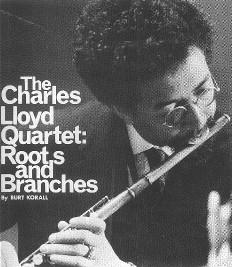
It is Lloyd's contention that a musician should be able to touch people while finding his own words for the life he describes in his music.
"You have to let the world in, pass on what is sensed and felt, expressing yourself so that the cool of the head and the warmth of the heart are blended," he said. "I like to take people on nice little trips, using variety of color and dynamics. We experience many things; the fantasies and stories from which music is developed come from pleasant places as well as out of dark corners. There's got to be balance in music, as in everyday life ... and adventure and movement too."
Lloyd's journey began in Memphis, Teen., a city within the blues belt, with a blues tradition of its own. There he heard and played the blues for the first time and discovered his ethnic heritage and Charlie Parker.
"A beautiful feeling comes from that area of the country," he said, "Many fine musicians have come out of there. The soil is fertile for growth. I was raised with Booker Little: we were tight. He just about had it together before he died in 1962. And there were a lot of other cats around town. George Coleman, who coached me, Frank Strozier, Hank Crawford, Harold Mabern, Louis Smith, and Phineas and Calvin Newborn."
It was Phineas, the piano-playing Newborn, who meant the most to Lloyd during his formative period in Memphis. "He talked about Bird, played his records, and showed me what was happening," Lloyd said. "Because he was a prodigy, he got into things before many of the other musicians."
Lloyd's teachers at the University of Southern California in Los Angeles took him beyond the blues and Charlie Parker into new areas of discovery. From the study of Bach came the realization of the value of order in music. The contemporary composers, including Bartok, Stravinsky and Varese, provided a fuller understanding of musical color in its infinite variety and of the elasticity of musical materials.
His evenings in Los Angeles were spent in the company of such jazz musicians as Harold Land, Eric Dolphy, pianist Terry Trotter, Buddy Collette, and Ornette Coleman, and in playing alto saxophone and flute with various kinds of small groups and in the Gerald Wilson big band. The experience was invaluable. Lloyd made mistakes and learned.
With two degrees, the background and credentials to teach school or to play in a symphony orchestra or to further his jazz career, Lloyd left the USC campus in 1961 after six years and entered jazz full time.
"I joined Chico Hamilton when he was still working with the chamber jazz instrumentation - a reed player who doubled, a cello, guitar, bass, and drums." Lloyd said, "There was a lot of written music - too much discipline.
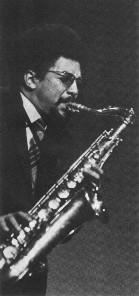
I had been listening to Miles and Coltrane, Sonny Rollins, Monk, and Ornette Coleman. Music was moving into a new, freer phase, and I didn't have enough room to move around."
When Hamilton decided to change the format of his group, not long after Lloyd came into the unit, he gave the young musician the opportunity he had been seeking. With carte blanche, Lloyd created a new library and sought out musicians to play his music.
Gabor Szabo was brought in on guitar. Bassist Albert Stinson and trombonist Garnett Brown, who later was replaced by George Bohanon, also joined the Hamilton band. It had a new look and made new sounds.
As would become increasingly apparent, Lloyd drew from many sources in his compositions, calling on his Memphis blues heritage as well as the many worlds of music with which he had had contact after leaving home. His loosely woven frameworks motivated the players to take chances, challenged rather than strictured them, and often provoked striking interplay.
Some of the Lloyd pieces, like Forest Flower, were melodic, distinctly programatic, and simply wrought. Others, a bit freer and more fragmented but with defined contours, assumed new shapes each time they were played. Solos of various lengths and improvised duets and instrumental conversations in other combinations were Lloyd's vehicles for achieving the newness. The soloist-rhythm section, theme-and-variations concept basic to jazz before this decade gave way in the Hamilton unit to a format of more flexibility. New and old concepts lived side by side, providing a sense of adventure but never a feeling of anarchy.
THE SAME BLEND of the roots and the branches, so to speak, carry over into Lloyd's own group and his playing. Essentially a tenor saxophonist since 1962 - "I made the change over from alto because I realized I should have been playing tenor all along" - Lloyd reflects in his work the various phases he has been through, from the blues and Parker through Rollins and Coltrane. Progressively, however, his sound and manner on the instrument, as on the flute, which he frequently plays during the course of an evening's work, are becoming his own.
As a leader of his own unit, Lloyd finds it easier to move as he desires, to set his own pace and guidelines, both as an instrumentalist and composer.
"I created a number of procedures during my three years with Chico," Lloyd noted. "With Cannon, however, the methods were more firmly established. Though I wasn't restricted and the group played my things and encouraged me to create, I felt I was going in another direction. In order to grow, I had to be on my own, no matter what the risk."
With the veteran record man and jazz writer George Avakian in his corner, Lloyd has had invaluable assistance in starting his own group. Two Lloyd albums were recorded by Avakian and released by Columbia before Lloyd signed with Atlantic. Work for Lloyd in this country and abroad has been plentiful if not bountiful.
Fortunately, he has not had to make commercial concessions. In many ways, his quartets, which at various times have included guitarist Szabo, bassists Ron Carter and Reggie Workman, pianists Don Friedman and Herbie Hancock, and drummers Tony Williams and Pete LaRoca, are logical extensions of the Hamilton quintets.
Lloyd's goal remains unaltered: "I want to extend music beyond its previous limits, while retaining the lyrical, earthy feeling that has been part of jazz since the beginning."
Experimenting with dissonances, often in combination with compensating consonant sounds, he and the unit move within and stretch basic material. While extending and reinterpreting this material rhythmically, harmonically, and melodically, through use of modulation and superimposition of one structure upon another, they retain the story content of the older jazz and its excitement, while adding innovations.
"We try to use all components of music," Lloyd explained. "Chordal composition and improvisation are not finished, nor is complete freedom the answer. It all depends on what you want to say. If you want more rhythmic freedom, working with modes, where there are no specific deadlines (as with chords), is logical. Another feeling might call for a chordally developed piece....
"When you think about it, however, the fact remains: having the craft is most important. You can be free and expressive within a II-V-I progression and make any kind of music work if you have the equipment. It's a matter of knowing and playing the music."
The latest Lloyd unit, which includes Keith Jarrett, piano; Cecil McBee, bass; and Jack DeJohnette, drums, makes the leader's point for him. The men play the music rather than the other way around. Freedom for Lloyd and his band is not a password, cry, or excuse for shamming.