Looking for jazz CDs?

|
Looking for jazz books ?
 |
|
by Tom Conrad
Down Beat, April 1994, p.
34-37
Charles Lloyd sits naked in the lotus position on the top level of the steam room. Undeterred by the heat and the dense fog, his voice is clear, melodious, and caressing, not unlike his tenor saxophone. "I'm trying to get to the place where the tone is just the distillation of essence, and that quality of suchness or purity can come through. It's a selfless kind of high. It's like a benediction. I'm still trying. When I was young I was a very good swimmer and diver. I won competitions. But I don't do that anymore. I'm trying to be a musician now. In music, I've never gotten good enough to quit."
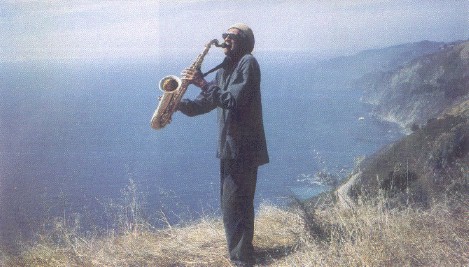
Stories about Charles Lloyd always begin with Forest Flower, because what happened is remarkable. The album was recorded at the Monterey Jazz Festival in 1966, and it became one of the first jazz records to sell a million copies. It struck a chord in a generation whose anthems were provided, not by jazz musicians, but by Jimi Hendrix, Cream, and the Grateful Dead.
Lloyd brought together avant-garde liberties, impressionistic harmonics, elements of what we now call "world music," and variants on rock rhythms. The blend acted on its audience like a siren's call. And there was another quality that helps explain the phenomenon of Forest Flower: a hypnotic, lyrical intensity that sounded like ... rapture. The Flower Generation may not have been big on jazz, but it was very big on rapture.
Lloyd underwent one of the rarest of experiences for a jazz musician: He became a star. His quartet (which introduced Keith Jarrett and Jack DeJohnette along with veterans Ron McLure and Cecil McBee) played on the same bills with Janis Joplin, Jefferson Airplane, and Santana at rock shrines like the Fillmore Auditorium in San Francisco. Lloyd's albums received heavy airplay on the liberated FM stations of the late-'60s counterculture. His band toured Europe, the Far East, and the Soviet Union. Then, at the pinnacle of his success, Charles Lloyd walked away.
After Forest Flower, the most widely known fact about Charles Lloyd is his self imposed exile. Searching for precedents, critics have cited Artie Shaw or Sonny Rollins. But the Shaw analogy is inexact, and Rollins used to drop out and regroup for only a year or two. Charles Lloyd disappeared for most of two decades.
"Back then, when I had my first quartet, I thought that my music could change the world. When I found out that I was wrong, I embarked upon a long journey of trying to change my character and transform myself."
Lloyd went in search of the "inner life" he had lost during 10 years on the road. He meditated in Malibu, studied Eastern religious thought in Big Sur, and walked in the woods. He still played his tenor saxophone and his flutes, but rarely in public.
Then in 1981, 17-year-old piano prodigy Michel Petrucciani, who had heard Lloyd's early albums in his native France, made a pilgrimage to Big Sur. Petrucciani was severely disabled by a rare bone disease, but he played piano Lloyd says, "like an avatar." Lloyd was struck by "the beauty of Michel's being: and was inspired to play concerts and record again. A quartet with Palle Danielsson on bass and Son Ship Theus on drums made two well-received European tours in 1982 and 1983, and two live albums were recorded (one of which, A Night in Copenhagen, has been reissued by Blue Note). But Lloyd's return was short-lived. When Petrucciani struck out on his own, Lloyd retreated again into silence.
Then, toward the end of the decade, he returned. One of the people closest to Lloyd, his friend and manager Stephen Cloud, attributes the decision to a near-death experience from an intestinal disorder. "Charles was a few hours from death," Cloud says. "When he survived, he came out of the hospital with a decision: to rededicate himself to the great tradition, the jazz art form."
Lloyd put together a new quartet featuring Swedish pianist Bobo Stenson. When the new group appeared at Montreux in 1988, Swiss critic Yvan Ischer wrote of "a quartet endowed with Grace ... practically being born under our eyes." Later, ECM founder/producer Manfred Eicher used a different metaphor: "I really believe this is the refined essence of what music should be. All the meat is gone; only the bones remain."
In the last five years there have been several world tours and three albums for ECM. Unlike the group with Petrucciani, this quartet has announced its presence on the American scene, having played the Playboy, JVC, and Melon festivals. In the summer of 1993, after 27 years, Lloyd made a dramatic return to monterey.
Today Charles Lloyd lives in Montecito, Calif., outside Santa Barbara, in a Spanish-style hacienda on 10 acres. The San Ysidro mountains rise steeply on three sides of the property, but in front the land falls away and the vistas extend to the ocean. The rooms (large and bright except for the "meditation room") are a tasteful clutter of antiques, overflowing bookcases, sheet music, a Steinway grand, photographs, objets d'art, and whimsical paintings of dreamscapes by Charles' wife, Dorothy Darr.
Out on the front porch wearing a floppy hat and a blue Montecito Sports warm-up suit after his early-morning visit to the steam room, Lloyd's statements about his music are not so much responses to questions as they are insistences on elemental esthetic and spiritual truths. He is not interested in the "how-to" of craft, but in essence. "Music for me was everything. It was my door to higher consciousness. What I hear and what I feel is not about technique and it's not about being a musician as such. It's more about ... imparting something." He chooses his words carefully, squinting as he stares to the distant Pacific. "When you start playing an instrument, you should play long tones, so that you can control the triple pianissimo all the way up to forte and then back without vibrato. You start simple ... just with the sound. And here I am at this stage in life still trying to play long tones - trying to get to the essence of the tone."
Lloyd's first ECM album, Fish Out Of Water (released in 1990), evokes that essence. The opening a capella tenor saxophone emanations are just above a whisper, light on the surface but dark underneath. Thr "long tones" proceed with such smoldering slowness, emerging from ripose to search and aspire. The tonal atmosphere is so rapt, so focused on the quest for an inner path, that nothing disturbs the stillness.
"I've been so blessed to play with great musicians, and to hear them every night. I don't really take authorship. It's like an individual offering. And then, when you mix it with a lot of love, at a certain level, you get met and it becomes a divine offering."
Over the course of a morning and early afternoon, whether conducting a tour of the house and grounds, playing the piano, or sorting through photographs ("That's me and Coleman Hawkins in the kitchen at the Village Vanguard"), his thoughts always return to the music. Like one of his saxophone solos, he may start in one place and fly far away, but he always returns because "there's such a oneness to all of this."
He remembers Ornette Coleman and Eric Dolphy and Charlie Haden in Los Angeles; John Coltrane and Charles Mingus and Coleman Hawkins in New York; Duke Ellington and Johnny Hodges and Harry Carney - in Antibes. "All these great masters that I served with and played with, they live in me. I stood on their shoulders, and they all inspired me. There's a thread that runs through all of this. I look upon all these great masters as sages. They're bringing forth elixirs and truths. I've been blessed. So many people have helped me. I too must serve the music. But I still don't have the sound I hear."
On The Call, Lloyd's new release, the quartet has moved to another level: Collective improvisation on the edge of the moment suddenly feels seamless.
Lloyd's last three albums on ECM contain only original compositions. Asked about whether he has any interest in playing standards, his hands go to his golden face as he strives to find the words to contain the mystery "I am standards, you know. It's happening nonstop. I don't have lines of demarcation. Do I play standards? As far as I'm concerned, the whole thing is a tribal dance. My message is an urgent one. It's a call to all the sisters and brothers to come home."
When he talks of his new group - which includes Stenson, Billy Hart on drums, and Anders Jormin on bass - Lloyd's voice takes on a special intensity. "My father was a football coach. He was always proud of his teams. I'm very proud of my orchestra. But it's not selfish. It's not about someone's solo. Sometimes Bobo has to be cellos and voices and sometimes Billy Hart has to be the whole drum choir of the universe, the rhythm of the world. Billy's the best. He's not about keeping time. I'm always in the music, even when I'm not playing my instrument. Sometimes I'm playing Bobo. When I look over, there's Anders, found in the music .... There's Bobo, just devoted to the music .... I play for those miraculous moments when the music opens up and you know that you're home."
Lloyd's discourse reveals a fortunate son in a perpetual, Buddah-like state of personal reflection: "I am blessed that for whatever reason I got the saxophone, because it is an extension of myself. It somehow makes me whole when I can hold on to it. Sometimes when I'm playing, I really don't have to hold on. It's like levitation is happening ... It's weightless .... It's effortless .... It's so unto itself"
Once he became resigned to the necessity of discussing his equipment, Lloyd listed his instruments with precision: "I have two vintage gold-plated C. G. Conn tenor saxophones. They are very old. Older than me. The mouthpiece is an Otto Link 7-star. I use Hemke #3 reeds. The C flute is a Powell. The alto flute is a Haynes. The bass flute is an Artley. My piano is a seven-foot Steinway B. Oh, and I also have a Chinese oboe, maker unknown."
[omitted for topicality reasons; see the comprehensivediscography at Charles Lloyd Online Archive