
 |
|
|
|
Copyright©2001 RSPID |







RSPID is the oldest regular service project (RSP) in Nanyang Technological University (NTU) Welfare Service Club (WSC). It was formed in 1985 when NTU was still known as Nanyang Technological Institute (NTI). The father of RSPID is Mr. Tay Tiong Beng. He set up this regular service project, as he wanted to promote the spirit of volunteerism among the then NTI undergraduates.
Jurong Garden School (JGS) was chosen as the venue for RSPID as it was located near NTU. The activities carried out aimed to further train and develop the graduates to their fullest potential and to lead fulfilling lives. The school was once located in Old Jurong Road, but it has since shifted to Jalan Seh Chuan where it still stands.
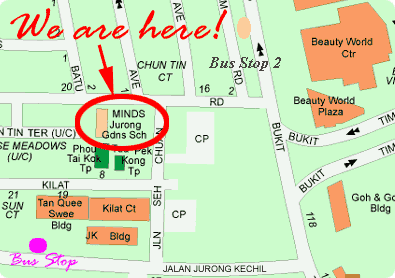
Bus Services Available : 61, 66, 77, 157, 173, 174,
185 (Bus stop 1)
67, 75, 170, 171, 173, 184, 852, 961 (Bus stop 2)
The school accepts students below 18 years old. Once they are 18 years old, they are considered as graduates and will be posted to the EDC (Employment Development Center) where they will work with other ID teens. If the center finds that the particular teen is efficient, he/she may be sent for open employment where they will work in society. Currently there are 28 ID teens in the RSPID project. As not every teen is suitable for our program, the volunteers carry out home visitations to know the teens better before allowing them to be part of the project.
Beneficiaries and activities
Basically, the beneficiaries in RSPID are known as trainees. They can be classified into 2 types, High Functioning and Low Functioning. High Functioning trainees are generally able to adopt with their physical locomotion, independent and academically more inclined. They are brighter and have not many problems communicating with the volunteers. Low Functioning trainees on the other hand, are weaker in their academic and communication skills, as well as in their motor skills. Different activities are designed for each group due to the different needs they require. Every Saturday at 2.30 p.m. in JGS, RSPID Volunteers will carry out activities which are based a monthly theme that aims to develop the trainees to their fullest potential, making them useful members of society. The session is further divided into 3 Main segments. They are as follows
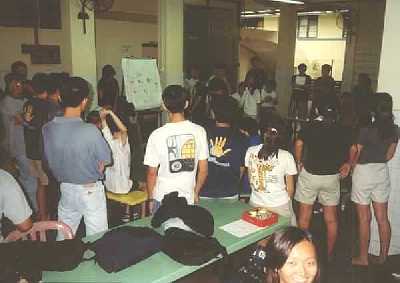
Sing-a-long (2.30 - 3.00)
In this 1st segment, a couple of Volunteers will teach trainees to sing a variety of songs. This is where they experience joy and laughter. In addition, certain songs allows us to teach trainees to use simple musical instruments and hand actions which makes the lesson more interesting.
Objectives
of Sing-a-long session:
To allow the trainees to…
- Gain
confidence through leading in songs and self-introduction.
- Gain
better movement/muscle-mouth coordination through action songs.
- Have meaningful recreation and interaction (in a fun way).
What
does it involve? Similar
to the sessions in the past except: Volunteers
are required to inject creativity into the session (rem obj 3!). Who
is in-charge? Curricular Development Training
(3.00 - 4.00)
In this segment, Trainees are taught various life skills in a variety of ways, i.e. through Games, Arts and Crafts and in a classroom environment. These are to equip trainees with skills to make them useful members of society. Skills are taught based on monthly themes, for example "Healthy Lifestyle" where trainees are taught the differnt types of food and the proportion in which they should be consumed. Under the supervision of Volunteers, we aim to make the trainees be as independent as possible.
Repetition is the key here as it takes a longer period of time for trainees to pick up the life skills.
Who
is in-charge? -------------------------------------------------------------------------------- *Physical and Recreational training Objectives: To
allow trainees to… [Of
course, trainees will have to enjoy the activities in order to benefit
& it is up to U to make it happening for them. i.e. be more creative
lah!] Physical and Recreational
Training (4.00 - 4.45) For
whom? All
trainees.
Whats
in it??
Firstly warm ups are always conducted before the activities are carried out. They aim at stretching their muscles and sometimes, some trainees are also encouraged to lead the rest of us in warm ups. Continued...)
Examples are
Who
is in-charge? [in
planning PRT, volunteers should also practise their own discretion in
game choice such that the games will not be the same as the previous week/2
weeks. We must always remember the nature of our trainees & make our
prog such that it suits them & they r enthusiastic to come again.] Teabreak
(4.45 - 5.15)
As the last session after a day of hard work, the trainees are taught
to use simple money concepts by buying their food and beverages from the
volunteers. After the meal, they will wash the dishes, wipe them dry and
brush their teeth.
RSPID will sometimes organize special events for the trainee, such as
Christmas parties, trips to the zoo or festival celebrations. These activities
usually are not only useful for the trainees, but also allows the volunteers
to get closer to one another, since they are asked to organize and prepare
the event. Volunteers
Currently, there are 80 volunteers in RSPID, including both junior and
senior volunteers. As many volunteers graduate every year, many new volunteers
are accepted. There are of course some basic requirements for new volunteers.
They must be responsible, sensitive, patient, have good initiative and
dedication. Although there is no special training for the volunteers before
they start their assignment, they will be guided by their "mentor"
volunteers to handle the trainee. Sometimes there are also talks for the
volunteers where experienced speakers from MINDS, NYC or JGS will give
them guidance on how to handle ID teens, therefore allowing the volunteers
to gain more knowledge about their trainees. Our
aims
Finally, RSPID hopes that there will be an improvement in the survival
or life skills of the ID teens and that this will facilitate their integration
into society. Also, RSPID hopes that the volunteers will build up confidence
by being the mentor of the ID teens and that they will cultivate a strong
sense of identity and commitment. Of course, our main objective will be
to help the ID teens gain open employment, and this will be achieved by
giving their best for the trainees. Contributed
by Wendy Ng ("xiaoniu")
[Why? Many trainees are bored with the previous
sessions which are repetitive and monotonous, and are thus reluctant to
participate; esp for some HF trainees.]
E.gs. incorporating a game, role-playing…
Volunteers are also strongly encouraged to teach new songs (must be relatively
simple) and to revise these new songs regularly.
A small reminder: Volunteers should ensure trainees shake their hand when
receiving their nametags, receive it with both hands and say thank you.
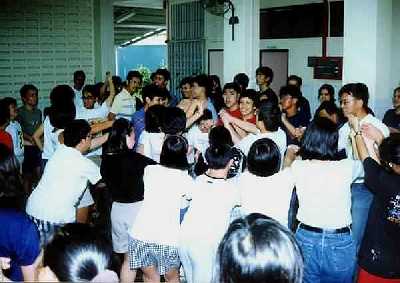 DoReMe - Singalong - "Doe a deer, a female
deer..."
DoReMe - Singalong - "Doe a deer, a female
deer..."
2 Volunteers rotated on a weekly basis.
A group of volunteers will be in-charge for 4 sessions. They will brainstorm for ideas relating to the main theme and plan for ways to implement them and lastly excecuting them.
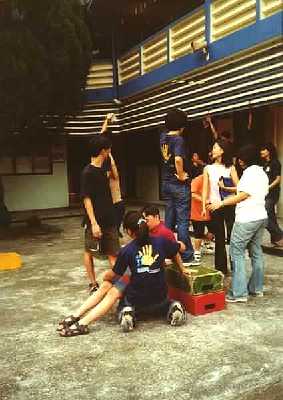
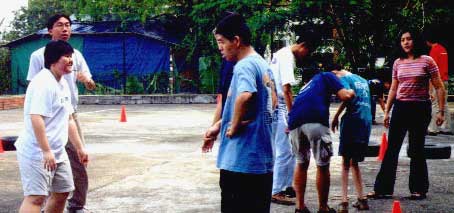
During Recreational Training, volunteers help
their trainees thorugh the games
Volunteers can actually play with the their trainees so that it’s
easier to guide them. 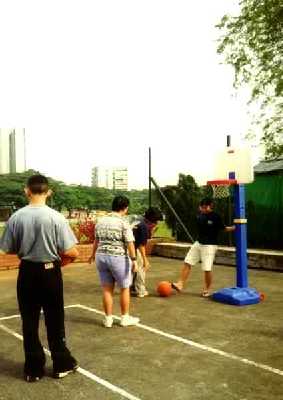
The same group of Volunteers involved in Sing-a-long and CDT will rotate among themselves to handle this segment.
Special
Events
In 1999, RSPID held its first Swimming Therapy session. The session not
only allows the trainees to exercise their motor skills, but it also helps
them to overcome their fear of the water.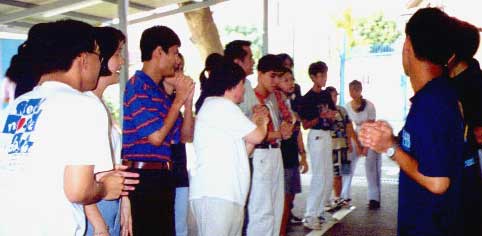
Our teens and volunteers practising for a Song
& Dance performance
Updated by Soh Poh Hock ("Baofu") and Michael Goh