March 29, 2006
Some Days It Doesn't Take Much
...to brighten my day.
1. Read in WaPo about the sentencing of Jack Abramoff to time in Federal prison.
2. Go to FARK.com.
3. Search in the page for the term PMITA
4. Search leads straight to blurb about Jack Abramoff.
It's nice to know there are certain things you can rely on in the news media. Ahhhhhh......
March 21, 2006
The Savings of JS
Number of blog entries I've made (and kept) before this one: 481.
Number of bytes of boilerplate JavaScript in each one: 2097.
What that last number turns into when a klutz tries to type it in: 2079.
Number of bytes I thought I'd save on my hard drive by putting the JavaScript in an external file: 481 × 2079, or 999999.
Number of calculations I had to do in the command-line calculator bc to convince myself that my computer wasn't giving me weird numbers like 999999 just to fuck with me: 2.
Mood after realizing that I had typed the wrong number, and that, moreover, I hadn't taken into account having to add some text to each file to include the newly excised JavaScript: crestfallen.
Likelihood of decreasing my hard disk usage by exactly 999999 bytes with this conversion: next to nothing.
March 16, 2006
Yahoo Gains My Respect, Loses It
Some of you may have noticed by now that Yahoo has been giving a secure SSL login by default for a few months. I am a big believer in NOT sending my password in the clear, and it bugged the crap out of me that the "Secure" option was an additional click away, a bone thrown to us obsessive nerds. So I was glad when "secure" became the default (which it was for Gmail from the beginning, I think).
Today, when I went to log in to Yahoo[u.p.o.] Mail, there was a link below the password field that said, "Why this is secure". Here's what it said behind that link:
Signing In and Your Security
Yahoo! now submits your ID and password securely via SSL (Secure Sockets Layer) encryption. This means that your personal information is more secure every time you sign in.
In the past, Yahoo! used a challenge-response mechanism to protect passwords using MD5. Passwords were scrambled using a one-way hash, so that they could not be converted to clear text.
Protecting your privacy and information online is extremely important to Yahoo!. We are constantly evaluating our security technologies to ensure we are taking reasonable steps to protect your personal information. As industry standards evolve, we evaluate them for reliability and scalability prior to implementation. As a result, Yahoo! is now able to offer reliable SSL submission of ID and password to anyone with an SSL-enabled browser.
Yahoo! takes your security seriously. For more information about how to protect yourself online, see the Yahoo! Security Center.
So on the one hand, I am rather impressed and pleased that they had been encrypting it with MD5, presumably with JavaScript, before sending it over the wire (but it sure would have been nice to TELL us!). On the other hand... are the above paragraphs the biggest weasel words you ever read, or what? They mention what they used to do, and what they are doing now, and the reason they've changed from one to the other is -- let's see, where is it -- ah, here we go. Wait, no, that's not it... er.... I guess you sort of have to take the last two sentences in the last paragraph together: "As industry standards evolve, we evaluate them for reliability and scalability prior to implementation. As a result, Yahoo! is now able to offer reliable SSL submission of ID and password to anyone with an SSL-enabled browser." "As a result?" Result of what? The ability to offer SSL submission of info is a result of the fact that you evaluate standards? How come Yahoo has only just acquired this ability, when other Web sites have been doing that for a decade? This wasn't really supposed to a jab at their technical skills, but this opaqueness just leaves all kinds of things open to interpretation.
March 15, 2006
Prototype.js Considered Harmful?
I keep wanting to refer to this blog post, Why I Don't Use The prototype.js JavaScript Library. As I fool around with JavaScript, I'm always looking into what tools would make my work easier. Prototype is all the rage now, but there seem to be some issues.
Mc Parlane's followup is also interesting.
March 11, 2006
UMSO Concerto Competition
I'm a big fan of (and very occasional performer in) performances at the Dekelboum Hall at the University of Maryland. Often, as I sit through the concerts, I find myself critiquing what goes on there. This tendency is so strong I can't resist it, and I usually leave the concert thinking I should bring a pencil and notepad in with me the next time I come to a concert.
Tonight I made the effort to get to the annual Concerto Competition Finals at the University of Maryland. Fantasies of music criticism were not on my mind as I went into the concert hall, but they are simply irresistible when you are actually watching a competition, rather than a concert. You want to get into the minds of the judges as well as those of the musicians. You want to root for a winner, and make sure the winner is well chosen. So you listen to the music, but you also listen to the musicianship. The music critic in you stirs from its slumber, and it cannot be put back to sleep.
Background: UMSO Concerto Competition.
This is an all-instruments concerto competition -- an odd animal. It makes for a pleasant variety for the listeners, but it must be hell on the judges. Each instrument has its own features, limitations, and foibles. String players are 100% responsible for their intonation. Brass players may miss a partial, playing a completely wrong note when a high note is asked of them, or fail to get a low, soft note to speak. String players are often asked to play double stops. A pianist is probably responsible for about four times the number of notes that a clarinetist is. A trombone is not known for having the range of expressive qualities that a violin or piano has -- and its repertoire sucks.
Each instrument also has a different pool of players. Millions of parents dream of seeing their child be the next Midori or Horowitz, so competition in piano and violin is intense, and there is a vast pool of very talented musicians; expectations are high. By contrast, not so many kids dream of being the next
[12:32 - breaking to find the name of a famous bassoon player]
[12:40 - writeup on Kim Walker sounds pretty impressive, so we'll go with that]
Kim Walker, so if you can scrape up a kid who can polish off a Mozart bassoon concerto without making the audience run out of the auditorium with their hands over their ears, you've got yourself a real find.
Let the Games Begin
It must be difficult being one of the first one or two performers. Such a fate fell this year to Alexei Gulenco, playing the Rachmaninoff Piano Concerto #3. I don't have much to say about him, except that he is, from the name, Russian, and his mane of hair seems fitting for a Russian post-romantic. It was a fairly solid performance. I like the flanking movements of this concerto, so his performance provided quite a bit of enjoyment for me. As an aside, an additional wrinkle in the judging of these competitions is that the accompaniment is provided by a pianist, so when the competitor is himself a pianist, it is often hard to tell who's playing what, and which notes you're supposed to be judging.
The second contestant was Jinjoo Jeon on violin, playing the Paganini's first concerto. Jinjoo participated in last year's competition, playing the Sibelius Concerto, which I made mention of in an earlier post. I thought at the time that she had done exceptionally well, and I thought she had had a good shot at winning the competition, but she didn't make the top three.
This year rather disappointed me. Paganini is about fireworks, first and foremost, and substance takes a back seat. I try to keep an open mind in the face of such acknowledged prejudices, but in this case, I suspect her choice of music worked against her. Her playing was not without its high points: she consistently nailed the high note in the introductory theme with force combined with perfect accuracy:
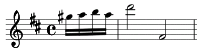
The note I'm talking about is actually the one immediately following these measures, but my music software crashed when I tried to put in that note; those of you who know the piece know what I'm talking about. And there were plenty of Paganini's trademark pyrotechnics -- double-stop runs, pizzicato notes snuck in between bowings, ricochet bowings (had to look that up), harmonics, etc., all executed well, especially the harmonics.
Intonation was less than 100%, however, as the piece went on, but the inaccuracies were mostly in the faster moving parts and didn't detract too much from the enjoyability. This is one of those areas where a piano, for example, simply can't be faulted, and this had been the first string player, so I had no basis for comparison as far as that went.
Overall, however, what I'm looking for when hearing Paganini is -- Niccolo Paganini. Paganini was the consummate showman, and took command of the stage like no one before him had done. I didn't get that full effect from Jinjoo. She has the technical skills to do a decent job playing anything put in front of her, and the artistry to handle pieces, such as the Sibelius, that demand a wide artistic range, but I personally feel she doesn't quite have the fire and stage command to do justice to Paganini.
Next up was the only other violinist, Jun-Young Park, playing the Violin Concerto #1 by Alban Berg. For all I know, Jun-Young Park may have given the best rendition the world has ever seen of Berg's violin concerto, but Berg is utterly incomprehensible stuff. Every note of her playing was beautiful, for the simple reason that each note brought the music closer to an end. And that's all I have to say about that.
The fourth performance was an odd exercise in reprises. The piece was Rachmaninoff's Piano Concerto #3 -- yes, the same as the first performance by Alexei Gulenco. And the performer, Daria Volchok, was also a repeat from the first performance, having been the accompanist for Alexei. I wonder how many performers are equally acquainted with the accompaniment as with the solo itself.
I suspect that Daria overextended herself by accompanying Alexei before performing herself -- the accompaniment for the Rachmaninoff seemed nearly as demanding as the solo part, and there were probably more missed notes coming from her than we got from Alexei. Nonetheless, she didn't miss enough notes to be distracting, was a pleasure to watch, and had a strong enough interpretation of this very expressive piece to move her to the front of the pack in my personal ranking. Oh, and bonus for the babe factor.
The last performance before intermission was Ivan Amir performing a piccolo concerto by Vivaldi. Astoundingly, someone performed this same concerto at the competition last year. You'd think people would learn lessons from year to year. Vivaldi is boring. The piccolo is painful to listen to for long periods of time. A Vivaldi piccolo concerto, therefore, can only be painfully boring.
Since I am not getting paid to write reviews, with all apologies to Ivan, I decided I would get more out of my evening by alloting myself an additional 15 minutes of intermission than by having my tinnitus exacerbated by a Vivaldi piccolo concerto, so I took the former option, and cannot report on Ivan's performance.
At the Encore bar, Justin Wright, trumpet player and composition major, hooked me up with a nice kamikaze. As I strolled around I walked by a bunch of Koreans sitting on the bench; one was Jinjoo. "Nice playing", I told her, because it's polite to compliment someone in such a situation, but also because I think she's hot. She seemed quite pleased. I soon realized that sitting in the same group was Jun-Young Park, the one who had chosen to spend her 15 minutes of fame torturing us with Berg. I told her she had also played nicely, because it's polite to compliment someone in such a situation, but also because telling her I survived it only by gnawing off one of my own arms would have been demonstrably false, as all my appendages were intact and in good health. I threw back the rest of my kamikaze and headed back in.
The first performance in the second half was Bruce Bertrand playing a Concerto for Bass Trombone by Ellen Taaffe Zwilich. I've never heard of this chick, and I'm sure I'll never hear this piece again. Remember what I said earlier about repertoire for trombones? Ever heard of Ferdinand David, the composer of the trombone concerto played by last year's trombone entry? Didn't think so; that pretty much sums it up. The Zwilich was a fairly modern work, but it was tolerable. This may have owed something to having had to sit through a Berg violin concerto. It also helped that Bruce was the only one whose accompaniment went beyond piano: two percussionists assisted, one on timpani, sometimes beating them with her hands, one playing various-sized cymbals, and also occasionally bowing something with a violin bow to produce a high-pitched bell tone.
The bass trombone is well-suited to powerful, throaty things like the March of Darth Vader, Symphonie Fantastique, Wagner, and so on, but Zwilich calls for soft, delicate playing more often than for the sound the bass trombone is famous for. Unfortunately, I think this worked against Bruce; the tone of a bass trombone tends to get fuzzy when it drops below chainsaw volume, and Bruce was not able to overcome that and produce a nice, round tone. Also, I noticed that high notes were never held very long. I don't know the piece at all, of course, so I don't know that this is not exactly what was called for, but as a trombone player myself, and one with a poor range at that, I know that cutting a high note short is usually a better musical alternative to continuing the note on the next partial down, at a moment of your lips' choosing. Verdict: fairly engaging, but not really a candidate for the top three.
Next up: Jihoon Chang, clarinet, playing concertino by Busoni. Yes, the guy who edited all those Bach inventions sitting in your piano bench actually wrote some stuff of his own. I could find no flaws in Jihoon's playing; perhaps if I had been able to stay awake during the whole thing, I might have. Unfortunately, the Busoni was not terribly interesting -- a wierd sort of hybrid of late Romantic and modern atonality. I can't write him off; I honestly don't know.
My sleepiness carried through considerably into Victor Coo's rendition of Variation on a Rococo Theme by Tchaikovsky. Little surprise: though I have become a huge fan of Tchaikovsky in recent years, the Rococo Variations really do nothing for me. However, I was able to stay awake for enough of it to get a sense of Victor's playing, and was quite impressed. He has a strong stage presence, and I could find no flaws in his playing, including intonation. Too bad the piece was so boring -- to me, at least; I can say "solid" and "polished", but I can't say "wow". Still, it was clear that at this point Daria Volchok had some competition.
The penultimate performance was Justin Drew playing Concerto for Horn by Eric Ewazen. Ewazen is a name I've been hearing a lot lately, probably because I'm a brass player and I have a lot of chances to talk with serious brass players. Despite this, I haven't had enough exposure to his works to get much of a sense of what he's about. Justin missed more notes than any other performer -- but on the horn, this is entirely expected. Unfortunately, I don't have much to add to this. Maybe I was just getting burned out, and was no longer up to the challenge of listening to Ewazen to figure out what it all meant, and whether Justin was doing it right. So Forest says, that's all I have to say about that.
The final performance was harpist Cara Fleck playing Introduction and Allegro by Ravel. I wasn't sure I was familiar with the work, but Ravel rarely fails to please, especially with harp, so I figured as long as she didn't screw up too badly, this would make a nice finish to the competition.
I couldn't have been more wrong. The competition ended with the final notes of Justin Drew's horn. What I attended was a competition with nine entrants, followed by a performance. No, performance isn't the word I'm looking for; a performance is when a musician presents a piece to an audience. Here, there were no judges, no audience, only Cara, her harp, and the lush, captivating music of Ravel, with Cara putting every bit of care into her playing not to score well in a competition, not to win the approval of an audience or her teachers, but because the music itself deserved nothing less than perfection.
Cara Fleck alone made the competition worth attending, for me. I would happily have paid good money to see this performance, just as it was -- I don't even care that the accompaniment was mere piano. I was utterly transported to another dimension for those fifteen minutes, completely immersed in wonderful music. You can hardly do better than that.
Conclusion
My experience with last year's competition showed these things to be inscrutable. Only one of my top three picks actually made it into the top three -- at second place, to be exact. A Rachmaninoff edged out a Ballade for flute by Frank Martin (refer to my mentions of Berg above to get an idea of what I thought about this piece), but was passed over in favor of the snoozer that is the David Trombone Concertino. The trombonist definitely put on a professional-level performance, but really, who expects a panel to give the top prize to a trombone, in a definitely very talented field?
I did not hang around to hear the results of this competition, and still don't know the results. Has a trombone won it a second year in a row? Who can tell? If I were to bet, I might place money on Victor Coo, but I know who I'd like to see performing next year with the UMSO, and I'm sure you do, too.
March 06, 2006
Who's Calling the Shots on English Spelling?
I just learned something I'm surprised I hadn't noticed on my own: a CD is a compact "disc", while a hard drive, if it rotates at all, is a hard "disk". According to Common Errors in English, "'Compact disc' is spelled with a 'C' because that’s how its inventors decided it should be rendered." Yay for commercial fiat! It goes on to say that "disk-with-a-k" has come to be used for magnetic storage, while "disc-with-a-c" is used for optical media.
I confess to finding the "c" ending a little more elegant, but it complicates things when you want to make derivatives like "discette".
My Down Phone Company
Every now and then I take a moment to read the literature that my various companies hide inside my bills, goading me to take advantage of more of their services (does that ever stop? Are there people who are already using every single service that their phone company/bank/ISP is providing? Do they get some kind of thank-you notice in their monthly bills for being so willing to part with so much of their money? I digress...).
Today's treat is from Verizon, which I'm still using for phone service (though the last time Speakeasy tried to get me to switch to VoIP, it actually looked like kind of a good deal). They're pushing Verizon Freedom Value℠. I won't go into what that is; I just like the first sentence of the concluding paragraph on this insert: "Don't miss out on what's going down at Verizon." Going down. Yes. I mean, word. Verizon is finally gettin' down with the peeps.
March 02, 2006
The Summer Wind
An odd friend gave me a CD of Michael Bublé. I'd never heard of him. She was surprised I'd never heard "Fever" and "How Can You Mend a Broken Heart", but there's a generation and culture gap, what can I say. One of the songs I did know -- slightly, in this case -- is "The Summer Wind", which Martin Prince sang, inexplicably (to me, at least), at the end of one Simpsons episode. It -- or at least the Michale Bublé version -- is a pretty cool song, but dang, aren't the melody and harmony essentially the same as "My Way"? The Chairman of the Board is associated with both these songs; wonder if he ever noticed the similarity. I like the lyrics to "Summer Wind" better; "My Way" is pretty much the epitome of the chest-thumping song -- I guess it's sort of a retirement home version of self-aggrandizing rap.