In scientific thinking, ideas are expressed as a concepts, which are ideas defined by accepted theories and tested by scientific methods; so concepts only exist in the structure of theories, and they can´t exist in a independent way. Scientific knowledge is completely conceptual and concepts are its basic cell, which establish a complex set of relationship, creating a conceptual system, named theory.
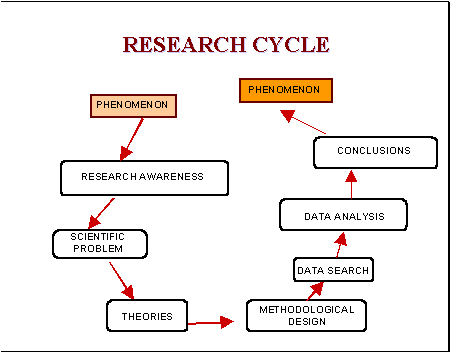
Scientific research (and university thesis) is an expression of theory, an instrument for testing hypothesis and theories through reliable data. Is for this feature that research and thesis are structured and supported by theories, not by isolated concepts or ideas coming from common knowledge.
But is frequent that theses have a poor use of concepts and theories, and not a few of them includes a speech based in intuition or common knowledge. This is a severe theoretical error of theses which could have a serious consequences for their quality.
Based in concepts, human reason function with judgements or logical propositions, which are connections of ideas or concepts, whose function is to explain complex process of reality in a synthetic way. Judgements are generals and constitute the basis of scientific explanations. In theses, judgements are the basic nature of conclusions and they must respect logical quality criteria.
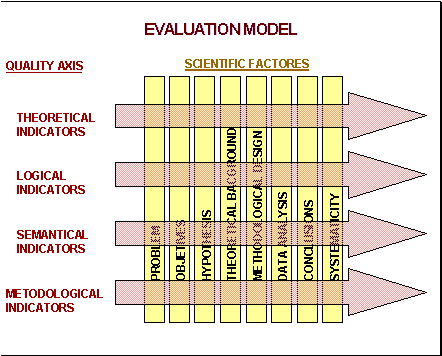
Hypothesis are the source of scientific explanations and they are educated guesses about the nature of the research problem, with base in previous knowledge. For this reason, hypothesis formulation is one of the most important task of scientific research. University theses (in the quantitative approach) must concede the sufficient attention to this step, which have a set of quality standards in the theoretical, logical, semantical and methodological axis.
Theories are systems integrated by concepts and judgements, which are previously proved by methodologically guided research process. Theories are the central structure of science, whose development depends of the acceptation or rejection of theories, and whose progress goes through more complexity in theory construction. But the utility of theories depend of the concepts which integrate it and of the state of the research in the knowledge field. So, theories don't offer an absolute true knowledge, but a relative true one, which is constantly reformulated, emerging new and more comprehensive knowledge as a result of the research action of thousand of scientist all over the world.
For a thesis, this feature is very important, because the students need to know the most important theories of their thematic field, but also because they need to be in permanent actualization in the new theoretical approaches and proposals. If the students don't have this actualized knowledge or the tutors don't demand it, the final result of thesis lack an important quality factor. Moreover, the theoretical background and discussion in theses, requires a set of quality standards which measure the sufficiency in this matter in the four quality axis. |