
Valletta
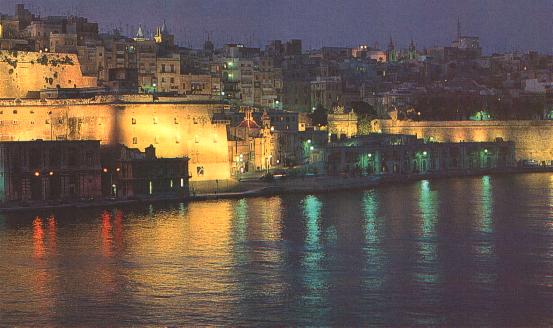
When Grand Master Jean Parisot de la Valette laid the foundation stone of Humilissima Civitas Vallettae the last thing that he had in mind was a city of fine palaces. Valletta was intended as a fortress to protect the two harbours on either side of the rocky peninsula on which it was to be built.
The first buildings to be erected were the Auberges; these were the headquarters of the different ethnic groups into which the Knights were divided.
The National Library, the Biblioteca, was the last building to have been built by the Order, having been finished in 1796. It houses a rich collection of books as well as medieval manuscriptsand the archives of the Order.
As a memento one can buy a photocopy of the deed of Emperor Charles V in which he granted Malta and its islands in fief to the Order in 1530.
Even if the Opera House has yet to rise from the ashes of the Blitz (some are of the opinion that a multi-storey car park should be built there instead), music lovers and balletomanes can still go to Manoel Theatre. This gem of a building was built in 1732 and has recently been restored to its former glory for, as its builder Grand Master Anton Manoel de Vilhena would have said, "...the honest recreation of the people". For art lovers there are the Museum of Fine Arts and the Cathedral Museum.
Valletta boasts of three Parish Churches and a host of others, but pride of place must go to St.John's Co-Cathedral.
The plain exterior of this edifice grossly belies its sumptuous interior: no space is left unadorned, the walls are carved and gilt and the painted vaulted ceiling is the masterpiece of Mattia Preti while four hundred slabs of inlaid marble pave the church.These slabs are emblazoned with the armorial bearings of the more important members of the Order.
In years gone by, people, young people especially, used to troop into Valletta every evening; they filled the many cinemas there, crowded the coffee shops or just strolled up and down the main streets to admire and be admired, followed by a last minute rush to catch the last bus to the village.
Auberge of Castille
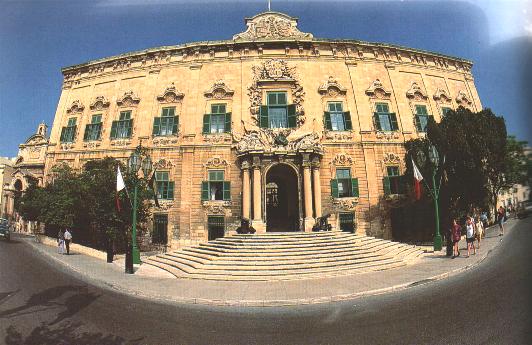
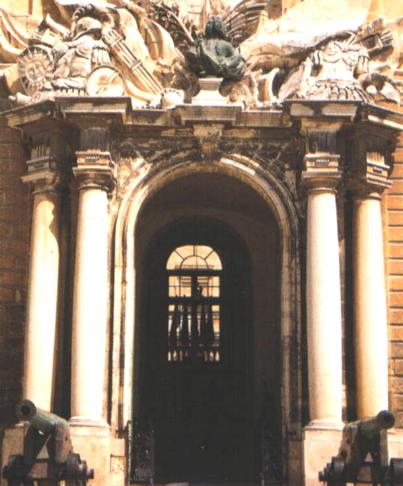
The Auberge of Castille, Leon and Porugal, is the largest and perhaps finest of all the Auberges. Its head was the Grand Chancellor of the Order of St.John
It was first built in 1574 by Girolamo Cassar on a site originally earmarked for the Magisterial Palace. Extensive reconstructions were undertaken in 1744 during Grand Master Pinto de Fonseca's term of office. Domenico Cachia, the architect responsible for these modifications was influenced by the Prefettura at Lecce and produced a very imposing facade.
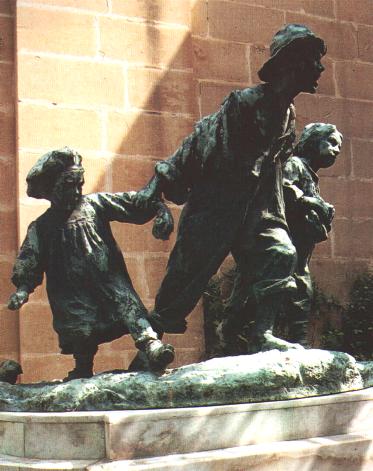
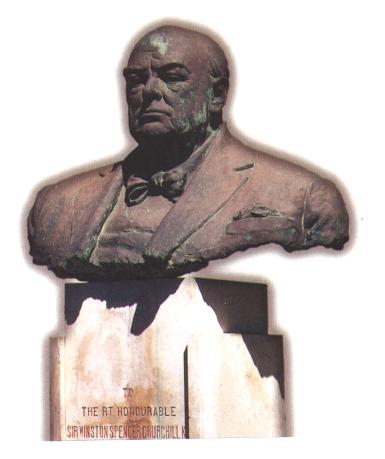
In the Upper Barracca gardens visitors can admire various monuments, including the very interesting Les Gavroches group by the Maltese sculptor Antonio Sciortino.

