 |
|
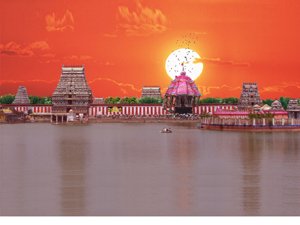
History - Architecture:
Tiruvarur (Tiruvalur) is in the district of Tanjore, connected by
the Southern Railway with Madras, a junction at which the Mayavaram
Karaikudi and the Tanjore Nagapattinam branch lines cut each
other. History
The temple of Tyagaraja became all the more famous by the visit of
a galaxy of Gods and Angels from heaven, like Brahma, Dasharatha, Rama,
Arjuna, Dharmaputra, Kings Nala and Haris- chandra, and Maharshis like
Vasishtha and Vishwamitra. Each installed a Siva linga. In the temple for
worship.
The legend goes that once Lord Siva took his abode with Devi
Parvati in a garden at the foot of Mount Kailas. Then a monkey dropped
some Bilva leaves on the Lord. Siva was very much pleased by this act of
the monkey and blessed it. The monkey in the next birth was born as a king
in the Manu dynasty, named Muchukunda. Muchukunda was a good and kind
ruler. He built many temples and encouraged pandits and scholars.
Everybody lived a life of happiness in his time. He was also a great
warrior and ruled the country with his capital at Karuvur.
After many years, an Asuranamed Vala again attacked the Devas. The
Devas was defeated in the battle. Thereupon Indra. Sent for his friend
Muchukunda, for help and King Muchukunda readily agreed to save the Devas
from, the attack of the Asura.
A fierce battle took place between the King and the Asura in which
the latter was defeated and finally killed by Indra. After the battle,
King Muchukunda. Offered prayer and pujas to Lord Siva. The Lord appeared
before him and asked him to build a temple for Him at Tiruvarur. When the
King was about to return to his capital, he requested Indra to give him
the Somaskandamurti that he was keeping with him and worshipping daily.
Indra, not willing to part with this idol, decided to present to the King
six other idols similar to the Somaskandamurti and placed them before the
King with the real Murti amongst them, for selection. Then Lord Siva,
without the knowledge of anybody, helped the King to select the real
Murti. Indra gave the other six idols also. Muchukunda then returned to
his capital with the idols.
A big temple was, constructed at Tiruvarur by Viswakarma. Then the
King installed a Siva Lingam (now known as Achaleeswar) in a portion of
the temple and worshipped it for many years. The peculiar feature about
this Lingam is that its shadow can be seen only in the eastern direction
and it is also said that this shadow will not be visible to a man who is
going to die within a period of six months.
Once there was a king named Amsa. He was childless. He conducted
many yagas to be blessed with a child. At last he came to Tiruvarur,
installed a Siva Lingam in the temple and conducted penance for many
years. Then Siva gave darsan to the King and blessed him. So the Lingam
came to be known as Siddheesar (Siddhi means success and Eesar means God).
By worshipping this Lingam one can- get what all one desires in this
world.
One day King Kulisa while feeding Durvasa Maharshi mixed meat in
the meal by mistake. The Maharshi, enraged by this act of the King, cursed
him to turn into a tiger. But soon the Rishi cooled down and told the
King: "After some years you will see the divine cow Kamadhenu when you
will get moksham."
The tiger roamed in the forests and at last came to a place near
Tiruvarur where it happened to meet Kamadhenu with her calf. The cow used
to go to the temple of Lord Tyagaraja daily and worship, Vanesa Lingam
bathing it with its own milk. On seeing the cow Kamadhenu, the tiger
rushed towards her. Thereupon the cow replied: "I don't worry about being
killed by you, but the thing is I have not the Siva Lingam today. So
kindly permit me to finish my duties first. I shall certainly come back
here when you can kill me." The tiger was not willing to miss the, chance;
yet, believing the words of the cow, he permitted her to do so.
Kamadhenu returned promptly after finishing her ' duties. The tiger
was touched by the exemplary behavior of the cow and had no mind to kill
her. Then the tiger came to know about its past life. It went to
Tyagaraja's temple, worshipped the Lingam and attained Moksham.In this
temple there is the Marakata Lingam obtained by King Muchukunda. From
Indra along with the idol of Tyagaraja. 'The palanquin of Tyagaraja is
made of gold. The Prabha is decorated with diamonds. The Goddess is known
as Padampiriyal (who would not leave the feet of God). Another name of the
Goddess is Neelotpalavalli. In the shrine of Neelotpalavalli, there are
painted pictures narrating some incidents, which happened in the past. One
of them is that a king known as Somaji Nayanar was performing a sacrifice
to propitiate Lord Tyagaraja. Somaji Nayanar expressed his desire to
Sundaramurti Nayanar that Lord Tyagaraja should appear himself and receive
the havis (oblation of raw rice cooked in orthodox manner).
Sundaramurti Nayanar conveyed the request to Lord Tyagaraja. Lord
Tyagaraja consented to the same saying, "If I could be recognized I don't
mind receiving it." This test the depth of devotion, Siva came as an
outcaste (Paraya), with Parvati carrying a pitcher of fermented palm juice
and holding two sons, and himself having a drum and four dogs representing
the four Vedas. Only Somaji was able to recognise him. Others shouted,
"Don't come near, don't come near." As Somaji was able to recognise God
even in the form of an outcaste, Siva received the havis and gave darsan.
Another legend current in this part and represented in the fresco painted
in the temple wall of Neelotpalavalli Sannidhi is as follows:
Once upon a time a harlot by name Manicka Nachiyar, according to
her established tradition, used to receive only a person who was wearing
Rudraksham. One day Siva, disguised as an old man with Rudraksham, entered
her house. She received him also with equal respect as he was having a
Rudraksham. During the course of the night he gave her a lot of worries
and at last died at her house. According to tradition, she played the part
of the wife in true Hindu custom. When the old man passed away in her
house, she had to perform Sati by following him in the funeral pyre.
The old man was taken in a bier followed by the harlot and a
funeral pyre was set up. When it was about to be lit, the old man
transformed himself into his original form of Lord Siva and gave
liberation to the harlot who had dutifully followed him even to the
funeral pyre. She was true to her tradition and devotion. As such she
deserved liberation.
Tiruvarur became very famous in the last century for the birth of
three great Carnatic musicians, viz., Muthuswami Dikshitar, Syama Sastri
and Tyagaraja. Tyagaraja composed his songs in Telugu, and they are
considered to be gems of Carnatic music,highly honoured even now.
Architecture
Tiruvarur is very famous for the shrine of Tyagaraja. The temple is
gigantic in structure. From a distance of miles the gopurams are visible.
It is a great pilgrim centre, through out the year, particularly in the
month of Chittirai when the most important festival, the annual festival
of Sri Tyagaraja is performed. There are four gopurams on four sides. The
tower on the west is particularly noteworthy for the fine sculpture in
brick and mortar. The colossal structure of the temple could be well
imagined from its length of 846 feet with breadth of 666 feet.There are
several tanks attached as an adjunct to the temple wherein devout pilgrims
take their bath before entering into the precincts of the temple.
On the western side of the temple there is a famous tank known as
Kamalalayam where Goddess Kamala (Lakshmi) took her birth. It is
considered to be the biggest tank in the whole of South India, having an
island temple in the middle dedicated to the Goddess. She was born with
the nectar during the course of churning of the Milky Ocean by the Devas
and the Asuras. Varuna, the God of Water brought up Kamala, and after
devoted penance she was married to Vishnu at Tiruvarur. Hence the name
Kamalalayam.
Besides the tank, a peculiar musical instrument called Panchamukha
Vadya and Sivalingam made of sapphire and called Marakatalingam are worth
seeing. The musical instrument has got five faces and is ornamented with
the snake, the swastika and the lotus on three. The fourth face is plain
without decorations. The central face shows the face of a deer. It is said
that Nandi played on this when Siva danced. The circumference of the
instrument is fifty-six inches. Tiruvarur is one of the seven sacred
places of Lord Tyagaraja. The others are Tirumaraikkadu (Vedaranyam),
Tirunagai (Nagapattinam.), Tirukkolili, Tirukkaramayil, Tiruvanmiyoor and
Tirunallar. In this temple where Tyagaraja's idol is worshipped, the
Navagrahas are placed in a line looking at the shrine. It is a peculiar
feature.
| |
