

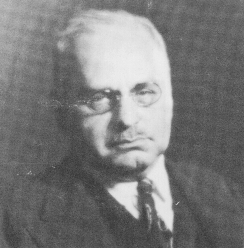
Adlerian and Historical Figures
Dagley (2000) noted that
Adler referred to Nietsche, and Kant, and Vailinger in conceptualizing
his theory of Individual Psychology. Dagley also pointed out that
Linden (1984) developed a strong case that particular Adlerian ideas can
be traced back to Epictetus, Spinoza, and Kant.
Galen (ca. 130-200) was the first to suggest a personality theory, based on four humors. Adler acknowledged the influence of a personality structure first suggested by Galen. “If we trace the explanations of psychologists regarding the nature of the temperaments, we must say that since antiquity science has not advanced beyond the postulation of four temperaments. Their classification into sanguine, choleric, melancholic, and phlegmatic originated in ancient Greece, was taken over by Hippocrates, continued by the Romans, and today still forms a venerable relic in psychology” (Adler, 1927).
Hans Vaihinger
Vaihinger (1911), in his writings on fictionalism, heavily informed Adler and his development of the idea of fictional goals (Ansbacher & Ansbacher, 1956), fictions that individuals come to believe are what is required to overcome a sense of inferiority. Vaihinger (1911) saw fictions as ideas, both conscious and unconscious, which are not grounded in reality but allow us to better deal with reality. Ansbacher and Ansbacher (1956) offer an example of the fiction “All men are created equal,” which has no grounding in reality but encourages individuals in their own sense of self-agency. The pragmatic approach (again, fictionalism) of Vaihinger has also been linked to William James’ concept of pragmatism and John Dewey’s instrumentalism (Ansbacher & Ansbacher, 1956).
Kant
Vaihinger (1911) noted that Kant’s writings integrated a pragmatic as-if approach to religion. Acting “as if” one believed something would later influence Adlerian clinical techniques and contemporary brief therapy models. Kant was also known for promoting the idea that our conscious experience was influenced by both the intake of sensory information and categories of thought in the mind.
Nietzsche
Vaihinger (1911) also acknowledged Nietzsche’s contributions to our understanding of the concept of fictionalism. Nietzsche noted that inaccurate conceptions of the world were regularly employed, although not consciously, to the benefit of mankind. Nietzsche said “…I am convinced that the most erroneous assumptions are precisely the most indispensable for us…”
Adlerian
and other schools of Psychology/ Psychotherapy
Similarities between Gestalt and Adlerian include the emphasis on the interaction of the whole rather than the individual parts. Social interest also was integrated into Gestalt by Solomon E. Asch 30 years after Adler first coined the idea (Ansbacher & Ansbacher, 1956).
Cognitive/ Rational-Emotive
Adler and Ellis both come from a very cognitive foundation (Mosak, 1989). Ellis (1970) sees these two theories as having parallel tracks. Among the similarities include the idea of irrational beliefs/ basic mistakes, that people create their emotions by their thoughts, individuals are the creators of emotions rather than the victims, encourage clients to take responsibility and an active role in their lives. The major difference may be in Ellis’ emphasis on self-interest juxtaposed to Adler’s social interest. Ellis (1970) also described Adler as “one of the first humanistic psychologists" (p. 32).
Neo-Freudian
Mosak (1989) noted that Adler had expressed a wish that his ideas outlast his name, and that he very well may have gotten his wish. Henri Ellenberger, 1970, p. 645: “It would not be easy to find another author from which so much has been borrowed from all sides without acknowledgement than Alfred Adler.”
Ansbacher & Ansbacher (1956) arguably present a convincing case that Neo-Freudians may more appropriately be called “Neo-Adlerians.” For example, Karen Horney and Erich Fromm moved beyond original Freudian conceptions to include the importance of the environment and social context in the development of the personality. One reviewer went so far as to announce that “Horney had just written a new book by Alfred Adler” (Farau, 1953, as cited in Mosak, 1989, p. 71). It should be noted that Freudians would criticize Adler for being overly simplistic, focusing solely on the social motivations and the ego at the cost of biological drives and the id (Prochaska & Norcross, 1999).
Rogerian/ Humanistic
Although the actual therapies of Rogers and Adler may be polar opposites (Mosak, 1989), they do have some strong convergences. Ansbacher & Ansbacher (1956) note that similarities between Adlerian and Roger’s theory include striving towards actualization, that the individual is an organized whole, the individual has a unique contextual window to the world, that improved interpersonal relationships can be an outcome of therapy, and that behavior is goal-directed (it should be noted that at the time of this citation Client-centered theory was still in it’s infancy). Also, Rogers’ ideas of discrepancy between the real self and ideal self would be akin to Adler’s ideas around the dissonance created by feelings of inferiority. Clearly, Abraham Maslow’s conceptions of a self-actualizing tendency can also be linked to Adler’s ideas on goal-directed striving. Maslow (1970) wrote “For me Alfred Adler becomes more and more correct year by year. As the facts come in, they give stronger and stronger support to his image of man” (p. 39).
Existentialism
Existential psychology and
Adlerian psychology cross paths in how the individual must transcend the
very real limitations of daily life through social connection and interaction
with others. Further, both philosophies suggest that a lack of this
social contact, or social interest in Adlerian terms, is the root of neuroses
(Ansbacher & Ansbacher, 1956).
 Back to "An Historical Look at Alfred Adler"
This page was created by Ryan Scott

My Webpage