A ship can fire its weapons during the opposing player's movement phase and
during its own combat phase. Weapons cannot be fired at any other time during
the turn.
Range
Before firing any weapons. the player that is attacking must count the range
from the attacking ship to its target. To find the range, count the number of
hexes in the shortest path between the attacking ship and the target sh ip.
Count the hex the target ship is in, but not the hex the attacking ship is in.
Weapons cannot be fired at targets beyond a certain range. and some weapons
become less effective at long ranges; see Weapon Systems for more
information.
EXAMPLE: The range from Ship A to Ship B in the illustration is five
hexes.
Fields of Fire
Laser batteries, torpedos and rocket batteries can be fired in any direction.
Laser cannons and assault rockets can only be fired straight ahead of the firing
ship. Laser cannons and assault rockets are called Forward Firing Weapons.
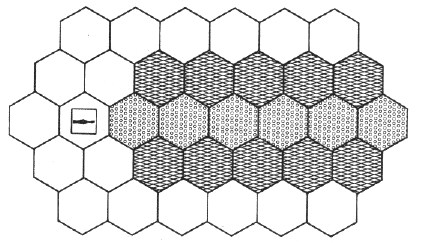
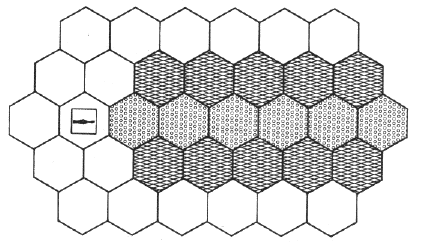
Forward firing weapons can be fired at any target inside the three-hexwide area
outlined in the diagram. (The weapons are not limited to the range shown in the
diagram. The field of fire extends to the limit of the weapon's range. Targets
in the central row of hexes are easier to hit; see Head-On Shots.)
If a moving ship enters a hex containing an enemy ship. the moving ship may
always use its FF weapons against that enemy ship. The enemy ship, however, may
only use an FF weapon for defensive fire if the last hex the moving ship was in
before entering the enemy's hex was in the enemy ship's forward field of
fire.
Aiming Weapons
A player must announce which weapons he is using and which targets he will
use them against before the dice are rolled to resolve any attacks. If a target
is destroyed by the first few shots, any other weapons the player had aimed at
that target must be fired, even though there is nothing for them to hit. The
attacker cannot shift these weapons to a new target once they are aimed. If
these wasted shots include torpedo or rocket fire, these weapons are fired and
must be crossed off the attacking ship's record sheet.
EXAMPLE: A player announces he will fire five weapons - two lasers, two
torpedos and a rocket battery - at an enemy. The lasers and one torpedo are
enough to destroy the target. The second torpedo and the rocket battery are
wasted shots, because their target is already destroyed.
Combat Procedure
When a player wants to shoot at an enemy ship, he must use the Combat Table.
Find the row on the Combat Table that lists the weapon being fired, and the
column that lists the defensive system being used by the target ship. The number
that is printed at the intersection of the weapon's row and the defense's column
is the attacker's percentage chance to hit the target. If the attacker rolls
this number or less on d1OO, the target ship has been hit. If the target ship
has more than one defensive system operating, the defense that is most effective
against the attacking weapon is used.
EXAMPLE: A laser battery is being fired at a ship that has a reflective hull.
According to the Combat Table, the laser battery has a 50% chance to hit its
target. The attacking player rolls d100 and the result is 26. This number is
less than or equal to 50, so the laser hits the ship. If the ship had a masking
screen, the laser battery would have had only a 1O% chance to hit, and a roll of
26 would have missed.
Attack Modifiers
A ship's percentage chance to hit its target can be modified by several
factors. These are explained below.
Head-On Shots. If a forward-firing weapon is used against a target in
the center row of the three-hex firing area, the attacker can add lO% to his
chance to hit. This central row is shown in the Forward Field of Fire
diagram.
If a ship with a forward-firing weapon enters the same hex its target is in.
the attacking ship automatically gets the head-on bonus.
Range Diffusion. Laser cannons and laser batteries become less
effective at longer ranges. The attacker's chance to hit his target with a laser
weapon is reduced by 5% x the range to the target.
EXAMPLE: A ship is firing its laser cannon at an enemy ship that is four
hexes away. The target ship has a reflective hull, so the attacker's base chance
to hit is 60%. The attacker is making a head- on shot, increasing the chance to
70%. This is reduced by (4 x 5% =) 20% because of the range. The attacker will
hit the enemy ship on a d100 roll of (70-20=) 50 or less.
Evasive Maneuvers. Fighters and assault scouts have a special
defensive ability. Because they are small and maneuverable, these types of ships
can try to dodge torpedos that have been launched at them. The player
controlling the ship under attack must declare that he is taking evasive action.
The MR of the evading ship is then multiplied by 5% and the result is subtracted
from the torpedo's percentage chance to hit.
If the evading ship is not destroyed by the torpedo, it must turn in every
hex it enters during its next move. until its MR is used up. The ship must move
a number of hexes equal to or greater than its MR on its next turn; it cannot
evade by staying in its hex and rotating. An evading ship can zig-zag or move in
a circle.
Rate of Fire
Laser cannons, laser batteries and rocket batteries can be fired during both
the controlling player's combat phase and during his opponent's combat phase.
Torpedos and assault rockets can be fired only during the controlling player's
combat phase. A ship with more than one torpedo, assault rocket or rocket
battery can fire each only once per turn. For example, a ship with four torpedos
and two rocket batteries can fire only one torpedo and one rocket battery per
turn.
Automatic Hits and Misses
If a target is within a weapon's maximum range, a dl100 roll of 5 or less
always will hit the target, even if the attack's chance to hit was modified to O
by range, evasion or other factors. Similarly, a d100 roll of 96 or more will
always miss, even if the attack's chance to hit was modified above 100%.
Defensive Attacks
The non-moving player can shoot at his opponent's ships at the start of his
opponent's combat phase. Moving ships can be shot at in any hex they moved
through during their move. No shots are resolved until after all ships have
finished moving. At that time, the non- moving player can shoot at any of his
opponent's ships as if they were in any hex they moved through during the turn.
The non- moving player can place upsidedown counters in hexes his opponent's
ships move through, so he will remember where the opposing ships
traveled.
Laser cannons, laser batteries and rocket batteries can be fired defensively
at the start of the moving player's combat phase. Torpedos and assault rockets
cannot be launched at this time; they can be used only during the player's own
combat phase.
Ship Damage
If a weapon hits its target, the player who made the attack must roll dice to
determine how many points of damage the attack caused. The number of dice rolled
depends on the weapon used; this information is listed on the Combat
Table.
Each ship has a number of Hull Points. When a ship is hit, the number of
points of damage caused by the attack is subtracted from the ship's hull points.
When all of the ship's hull points are gone, the ship is destroyed and
immediately removed from the map.
EXAMPLE: An assault scout has 15 hull points. In one turn it is hit by a
rocket battery (2d1O points of damage). The attacking player rolls 2d1O and gets
a total of 11 points of damage. The defending player subtracts 11 from his
ship's 15 hull points, leaving it with 4 hull points. On the next turn, the ship
is hit by a laser battery (1d10 points of damage). This attack causes 6 points
of damage. This damage reduces the ship's hull points to O or less, so the ship
is destroyed and the player removes it from the map.
Weapon Systems
The following weapons are used in the Basic Game. The abbreviations listed
after the weapon name are explained at the end of the weapon list.
Laser Cannon - FF / RD / Range: 10 / Damage: 2d10
A laser cannon is
a large weapon that is mounted on the bow of a spaceship. It fires an intense,
concentrated beam of light.
Laser Battery - RD / Range: 9 / Damage: 1d10
A laser battery is a
cluster of very small laser cannons mounted in a rotating turret. It can fire in
any direction, but is not as powerful as a laser cannon.
Torpedo - MPO / LTD / Range: 4 / Damage: 4d10
A torpedo is a
self-guided nuclear bomb that homes in on its target after it is launched.
Torpedos are propelled by prolonged fission reactions which enable them to
travel at tremendous speeds. A ship can carry only a limited number of torpedos,
and these must be marked off the ship's record sheet as they are used.
Assault Rockets - MPO / FF / LTD / Range: 4 / Damage:
2d1O+4
Assault rockets usually are carried by fighters and other small ships.
They can be launched at a target during the owning player's combat phase.
Assault rockets are powered by a brief fusion reaction which causes them to fly
even faster than torpedos. Unlike torpedos, however, assault rockets are not
guided missiles. They rely on their tremendous speed to hit their target before
it can dodge away. A ship can carry only a limited supply, so assault rockets
must be marked off the ship's record sheet as they are fired.
Rocket Battery - LTD / Range: 3 / Damage: 2d10
A rocket battery is
a cluster of small rocket launchers. These rockets are much smaller than assault
rockets, but they cause nearly as much damage as an assault rocket because many
rockets are fired together. Like torpedos and assault rockets, rocket batteries
must be marked off the ship's record sheet as they are fired.
Explanation of Terms
FF --- Forward-firing weapon
MPO --- Moving Player Only. MPO weapons can be fired only during the
attacking player's combat phase.
RD --- Range Diffusion. The accuracy of RD weapons is reduced by 5% x the
range to the target.
LTD --- Limited Supply. A ship can carry only a limited supply of these
weapons. They must be marked off the ship's record sheet as they are
fired.
Range: # --- The weapon can be used only against targets within the listed
range of hexes.
Damage: #d10-- - This is the number of 1 O-sided dice that are rolled to
determine how many points of damage are caused by a successful attack.
Defensive Systems
The following types of spaceship defenses are
available in the Basic Game. If a ship has more than one defensive system, an
attack's chance to hit is calculated against the most effective defense.
Reflective Hull. This is mirror-Iike paint that is sprayed onto a
ship's hull. It will often cause a laser beam to bounce off the ship without
causing any damage. A reflective hull is the most common defense on
spaceships.
Masking Screen. A masking screen is created when a ship releases a
cloud of water vapor into space. The vapor crystalizes a nd forms a protective
cloud surrounding the ship. Besides making the ship more difficult to hit, a
masking screen absorbs energy from a laser. If a ship is hit by a laser while
inside a masking screen, the amount of damage that is rolled is divided in half
(fractions are rounded up). The result is the number of damage points inflicted
on the target ship. A masking screen has exactly the same effect on a laser
fired out of the screen as it does on a laser fired into the screen. If a ship
surrounded by a masking screen fires its lasers, resolve the attack as if the
defending ship is masked.
To indicate that a ship is using a masking screen, place a screen counter on
top of the ship counter.This screen counter stays on top of the ship as long as
the ship travels in a straight line at its current speed. If a ship or space
station in orbit around a planet creates a masking screen, the screen will last
through one complete orbit. The hex the ship or station was in when the screen
was created should be marked with an upside-down counter, so players will know
when one orbit is finished. A ship can carry only a limited number of masking
screens. These must be marked off the ship's record sheet as they are used. When
all of them are used, the ship cannot create any more masking screens.
Interceptor Missiles (ICM). Interceptor missiles are small missiles
that can be fired at incoming torpedos, assauIt rockets and rocket battery
barrages. Before the torpedo or rocket attack is resolved, the player
controlling the target ship can declare that it is launching ICMs. The player
must declare how many ICMs the ship is using. The attack's chance to hit is
determined as if the attack was hitting a reflective hull or a masking screen,
whichever the ship is using. The number of ICMs launched by the target ship is
multiplied by the modifier on the Combat Table, and the result is subtracted
from the attack's chance to hit.
EXAMPLE: A torpedo is launched at a ship with a reflective hull. The player
that controls the target ship announces that it wiII fire two of its ICMs in
defense. The torpedonormaIly has a 70% chance to hit, but each of the ICMs
lowers this by lO%. The torpedo's final chance to hit is !70 - 20 =) 50%. A ship
carries a limited number of ICMs. Whenever one is used. it must be checked off
the ship's record sheet. ICMs can defend onlv the ship that launched
them.
|
| ||||
| COMBAT TABLE | ||||
|---|---|---|---|---|
| Weapons | Defenses | Damage | ||
|
| ||||
| Reflective Hull |
Masking Screen |
ICM | ||
|
| ||||
| Laser Cannon | 60% | 20%* | --- | 2d10 |
| Laser Battery | 50% | 10%* | --- | 1d10 |
| Torpedo | 70% | 70% | -10%/lCM | 4d10 |
| Assault Rocket | 60% | 60% | -5%/ICM | 2d10+4 |
| Rocket Battery | 40% | 40% | -3%/lCM | 2d10 |
| * The target ship takes only,one-half damage (round fractions down) if it is hit. | ||||
|
| ||||
| WEAPON RESTRICTIONS TABLE | ||||
|
| ||||
| Weapon | Restrictions | Range | ||
|
| ||||
| Laser Cannon | FF, RD | 10 | ||
| Laser Battery | RD | 9 | ||
| Torpedo | MPO, LTD | 4 | ||
| Assault Rocket | MPO, LTD, FF | 4 | ||
| Rocket Battery | LTD | 3 | ||
|
| ||||