Environmental Skill deals with relationships between intelligent life and nature. An environmental specialist has training in astronomy, biology, botany, chemistry, ecology and geology. There are nine Environmental subskills: Analyze Samples, Analyze Ecosystem, Find Direction, Survival, Make Tools/Weapons, Tracking, Stealth, Concealment and Naming.
When an environmentalist is dealing with an alien or unknown environment, he has a -20 modifier on his rolls to analyze samples or the ecosystem, find direction, track or use survival.
ANALYZE SAMPLES
Success Rate: 50% + skill level
An environmental specialist can analyze atmospheric, biological or geological samples.
An environmental specialist can use a vaporscanner to analyze atmospheric samples. If the analysis succeeds, the vaporscanner will indicate whether the air is breathable or poisonous, and what gases. are present.
The specialist needs a bioscanner to analyze a biological sample. If the analysis succeeds, the bioscanner will indicate what type of plant or animal the sample was, and whether it is edible or poisonous.
A geoscanner can be used to analyze geological samples. If the analysis succeeds, the geoscanner indicates what minerals are present in the sample and the possibility of finding rich ore or gas in the area.
ANALYZING ECOSYSTEMS
Success Rate: 30% + skill level
An ecosystem is the combination of all the plants and animals that make up the local environment, and their relationships to each other. If an ecosystem is upset or thrown out of balance, entire species can become extinct and whole regions devastated by floods, droughts or other natural disasters. One of the environmental specialist's jobs is to analyze local ecosystems and determine whether they are balanced and, if not, to determine what can be done to restore balance. An environmentalist must spend at least 200 hours studying the area to use this subskill.
FINDING DIRECTIONS
Success Rate: 50% + skill level
An environmental specialist can try to find directions in a wilderness without a compass or other aid. If the specialist makes a map or marks a trail (by cutting notches in trees or lining up rocks), his chance to find a direction on that path is increased 30%.
SURVIVAL
Success Rate: 40% + skill level
This subskill gives a specialist a chance to do several things related to survival: find food or water (if any is available in the area), find or improvise shelter, and set or avoid traps. If a trap is set in a built-up area (city, farm community, etc.), there is a 50% chance it will be noticed. This subskill also lets the environmental specialist make a special Intuition check to predict natural disasters.
MAKING TOOLS/WEAPONS
Success Rate: 100% if materials are available
An environmental specialist can make tools and weapons out of stones, sticks, cords, and other natural materials. Only bows, axes, clubs, knives and spears can be made. Only the spear can be balanced well enough to use as a thrown weapon. The referee may allow an environmentalist to improvise tools and weapons from wreckage and scrap parts.
TRACKING
Success Rate: 30% + skill level
An environmental specialist has a chance to follow a creature, person or machine by watching for its trail. This skill works only in the wilderness, not in settled areas. The specialist also can use this subskill to cover his own tracks.
STEALTH
Success Rate: 20% + skill level
Stealth is the ability to move without being seen or heard. This ability is useful for stalking animals, but also can be used to sneak up on guards of follow suspects.
CONCEALMENT
Success Rate: 10% + skill level
Concealment is the art of hiding in natural cover. Once concealed there is an 80% chance the specialist will not be seen as long as he does not move or make noise.
NAMING
Success Rate: 100%
One of the benefits of being an environmental specialist is that when he discovers a new plant, animal, mountain range, sea, etc., he is allowed to name the new discovery.
Medical SkillA character that has Medical skill is called a medic. Medics need a medkit to use their skill. Medics diagnose ailments, heal wounds, control infections, neutralize poisons, cure diseases, wake up unconscious individuals and prevent tissue deterioration.
There are nine Medical subskills: Administer Drugs, Diagnosis, First Aid, Minor Surgery, Major Surgery, Control Infection, Cure Disease, Neutralize Toxins and Activate Freeze Field.
If a patient is treated in a hospital or sick bay all Success Rates are increased 20%. If the patient is an animal or an unfamiliar alien, all Success Rates are reduced 20%. These two modifiers are cumulative, so the chance to perform major surgery on an unfamiliar alien at a hospital is normal.
ADMINISTERING DRUGS
Success Rate: 100%
Three drugs are covered under this subskill: stimdose, staydose and telol.
A medic can use one dose of stimdose to wake up an unconscious or stunned character, or to restore 10 Stamina points to a character that was poisoned or contracted a disease or infection. Stimdose can only be given by a medic. If more than one dose is given in a 20-hour period, the second dose has no effect.
A medic can use one dose of staydose to place an individual in a state of arrested animation. A character whose Stamina has been reduced to 0, but not below -30, will be brought back to life by the drug if it is injected within one minute (10 turns) after death. The staydose slows down the character's heartbeat and breathing so he can survive with no Stamina points. If the character's Stamina is brought back above 0 within 24 hours, he will live. If not, the character dies. Only one dose of staydose can be given to a character, until his Stamina is raised above 0.
Telol is a truth drug. Only a medic can administer it correctly. There is an 80% chance the telol will work. If it does, the injected character will answer up to five simple questions, using simple answers. An injected character passes out for 1d10 hours, whether the drug works or not.
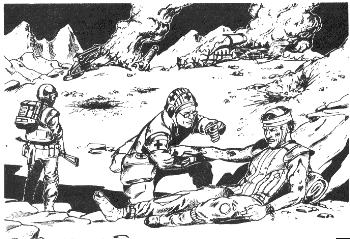
DIAGNOSIS
Success Rate: 60% + skill level
A medscanner will give a medic a brief diagnosis. This diagnosis will outline the patient's general symptoms and will identify the ailment as a wound, a disease, a poison or an infection.
Once the medic has a general diagnosis, he can use this subskill to get a specific diagnosis. If he passes the skill check, the medic knows exactly what the ailment is. With this information, the medic can use one of his other subskills to heal the wound, control the infection, cure the disease or neutralize the toxin.
Without a specific diagnosis, a medic can not use a subskill to treat a victim. However, the medic can use the medscanner's general diagnosis as a guide to which drug the victim needs. After the medic gives the injection, the victim must roll his current Stamina or less on d100 to overcome the effect of the poison, disease or infection. If the victim fails this roll, the drug has no effect. A second dose given within 20 hours automatically has no effect.
FIRST AID
Success Rate: 100%
A medic can heal 10 points of wound damage automatically by using one dose of biocort plus any appropriate items from the medkit (local anesthetics, plastiflesh spray, etc.) Only one shot of biocort can be given to a character in a 20-hour period. If a second shot is given within 20 hours, it has no effect. If a character suffered more than 10 points of damage, the medic must use major or minor surgery to heal him completely. Biocort has no effect on poisons, infections or diseases.
MINOR SURGERY
Success Rate: 40% + skill level
Minor surgery can heal up to 20 points of damage. This is in additon to the 10 points that can be healed with first aid. For every 10 points of damage (or fraction of 10 points) that is healed, an additional dose of biocort is required. Minor surgery also uses one dose of anesthetic. If the surgery fails, the patient does not recover any Stamina points and one dose of biocort is used.
MAJOR SURGERY
Success Rate: 20% + skill level
Major surgery can heal any amount of damage to a character. For every 10 points of damage (or fraction of 10 points) healed, a dose of biocort is used. The only limit to the amount of damage that can be healed is the patient's original Stamina and the supply of biocort. If the operation fails, the patient does not recover any Stamina points and one dose of biocort is used up. The medic can try minor surgery on the same patient, if he has not already. Major surgery also requires one dose of anesthetic.Major and minor surgery are effective only on wounds. They can not be used to heal damage from infections, diseases or poisons.
CONTROLLING INFECTION
Success Rate: 50% skill level
Controlling infection requires a dose of omnimycin. If the attempt fails, the omnimycin is used up and the infection is out of control. Infections are rated by their infection strength (S) and duration (D). The infection causes a specific amount of damage every 10 hours. For example, an S6/D8 infection causes six points of damage every 10 hours for 80 hours if it is not controlled.
CURING DISEASES
Success Rate: 40% + skill level
Curing a disease requires a dose of antibody plus. If the attempt fails, the antibody plus has been used up and the disease has not been cured. Diseases are rated according to how they modify ability checks, how long the modification lasts and whether the disease is fatal. The modifier is a negative number and the duration is in 10-hour periods. If the duration is followed by an exclamation mark, the disease will kill anyone it has infected after that length of time unless the disease is treated at a hospital. For example, a -10/D10! disease modifies every ability check the character makes by -10 for 100 hours. The victim will die after 100 hours unless he is treated successfully at a hospital.
NEUTRALIZING TOXINS
Success Rate: 30% + skill level
Neutralizing a poison inside a victim's body requires a dose of antitox. Poisons are rated like infections, according to how much damage they cause and for how long. Poison damage is inflicted every turn instead of every 10 hours, and the duration is in turns. An S7/T9 poison will cause 7 points of damage every turn for 9 turns. Neutralizing a poison stops the poison from causing any more damage, but does not heal damage the poison caused on earlier turns
ACTIVATING FREEZE FIELDS
Success Rate: 30% + skill level
A freeze field is a device that places a body in stasis and preserves it until it can be revived. Only a medic can activate a freeze field correctly. A freeze field must be activated within two minutes (20 turns) after death, or the body can not be revived. Activating the field takes five turns. The process can be interrupted, as long as the field is completely activated within the two-minute time limit. If the medic does not pass his skill check and there is at least one minute left in the time limit, he has two options: he can make a second attempt to activate the field, or he can inject the body with staydose. If the second attempt to activate the field fails, the body can not be revived.